
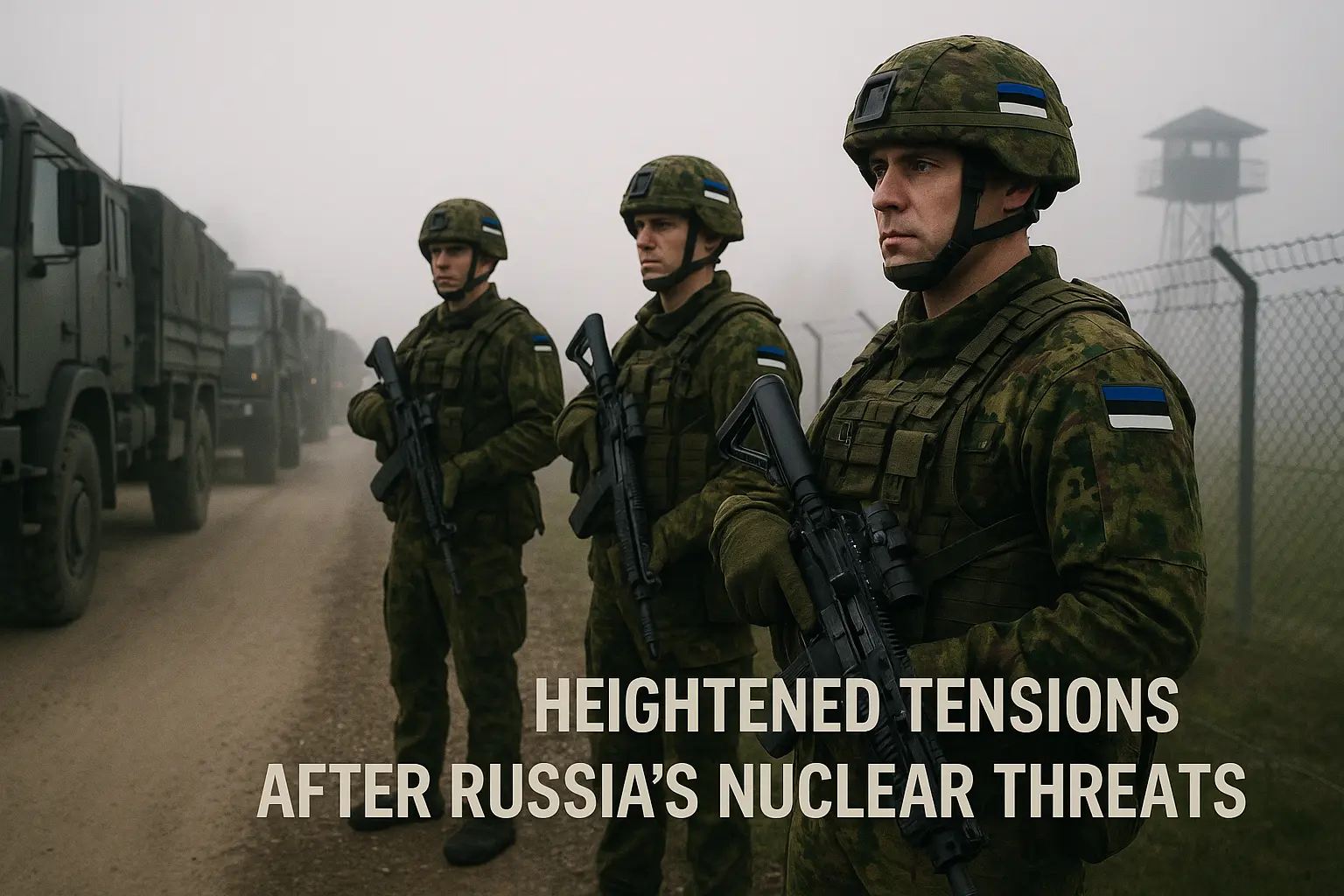
Kremlin Issues Terrifying Threat: ‘Nuclear Arsenal Now Aimed at Estonia’ After NATO Speculation
‘If anyone wants to bring nuclear weapons closer, let them not be surprised when they are in our crosshairs too.’ That was the chilling warning from Kremlin spokesman Dmitry Peskov on Sunday, sending shockwaves through the Baltic region and rattling nerves all across NATO territory. In the wake of thunderous speculation over Estonia’s willingness to host NATO nuclear arms, Russia has made its intentions devastatingly clear: Any move to put nukes on Estonian soil will instantly make the tiny nation Moscow’s #1 nuclear target.
With rhetoric ramping up and diplomats scrambling to cool tensions, it is impossible to ignore the fact that Europe stands on the precipice of something truly dangerous. As Russia moves from veiled threats to explicit ultimatums, the question rings out: Is the West ready for the nuclear standoff Russia is now promising?
‘They Will Be Aimed at Estonia’: Russia’s Explosive Nuclear Threat Sends Western Leaders into Panic Mode
The jaw-dropping threat came during an on-camera interview with Russian state media, where Peskov clarified to journalist Pavel Zarubin that, should nuclear weapons appear on Estonian soil, ‘our nuclear weapons will be aimed at the territory of Estonia.’ Peskov framed the statement as a defensive response, not a provocation, but let there be no mistake: the Kremlin’s message was meant to send chills down NATO’s spine.
What sparked the latest war of words? Estonia’s own Foreign Minister Margus Tsahkna stirred the hornet’s nest by confirming that his country is open to deploying allied nuclear weapons on its territory if NATO’s grand strategy requires it. Speaking to reporters just hours after Peskov’s remarks, Tsahkna’s words added fire to the already incendiary debate gripping Europe.
‘Welcome to the new Cold War, where all it takes is one headline and a small European country could find itself in nuclear crosshairs,’ prophesied one anonymous NATO official, reportedly shaken by Russia’s bold messaging.
Adding even more fuel to the fire, Moscow’s First Deputy Chief of the General Staff, General Sergei Rudskoy, accused NATO of reinforcing its coalition forces, upgrading mobilization systems, and accelerating infrastructure upgrades to speed up troop transfers-moves that Russia says threaten its very existence. If the Kremlin’s warnings are to be believed, the run-up to 2026 is shaping up to be the tensest East-West standoff in decades.
Peskov’s statement was unambiguous. In the age of global uncertainty, where mistakes are measured in megatons, Russia is making it excruciatingly clear that any nuclear hardware delivered to Estonia-or even the intention to do so-would see the Baltic country vaulted to the top of Russia’s target list. ‘We do not threaten anyone, but we must guarantee our security,’ he insisted, a refrain Western analysts call the classic Kremlin justification for saber-rattling.
Estonia, NATO, and the Shockwave: Why Europe’s ‘Frontline States’ Are Courting Catastrophe
This isn’t just idle talk. Estonian leaders are openly courting NATO nukes within their borders, in a political gamble that could redraw the post-Cold War European map. The foreign minister’s openness to nuclear deployment is, insiders say, a response to growing uncertainty over Washington’s commitment to defending Europe amidst spiraling tensions. But the consequences-intended or not-are perilous for a nation bordering the most irascible nuclear power on the planet.
History offers dire warnings. Russia has already demonstrated a willingness to move nuclear-capable hardware closer to NATO lines. Notably, in 2018, Moscow brazenly deployed Iskander missiles to Kaliningrad, right on the doorstep of Poland and Lithuania-two NATO countries that now look like dominoes in this latest strategic logjam. If Estonia joins the club, the strategic dynamic of northeastern Europe will be dramatically, and perilously, altered.
Meanwhile, the U.S. presence is anything but symbolic. Tactical (non-strategic) American nuclear weapons are already stationed in Germany and Italy-a fact that hasn’t gone unnoticed by the Kremlin. But for easternmost NATO states like Estonia, the calculus is very different: proximity to Russia makes any move hugely provocative. General Rudskoy’s characterization of NATO’s readiness and force deployments as ‘an imminent military confrontation’ shows just how seriously Moscow takes these maneuvers.
‘Our sovereignty is not negotiable, but neither is our survival,’ remarked an Estonian MP, igniting debate in Tallinn’s parliament about the truly existential stakes at play.
In response, NATO may point to its Enhanced Forward Presence-multinational battalions already operating in Estonia, Latvia, Lithuania, and Poland-as necessary deterrents against potential Russian aggression. But the Kremlin has shown it’s prepared to escalate, and Western leaders are left guessing where the breaking point lies.
Baltic Brinkmanship: Is NATO Underestimating Putin’s Resolve as Election Jitters Roil the West?
With President Trump’s resounding reelection and America’s security priorities in flux, Eastern European NATO members find themselves in uncharted territory. The willingness of countries like Estonia-and notably Poland, where President Karol Nawrocki has mused about a homegrown nuclear program-to consider breakneck escalation underscores just how unnerved the region has become about long-term U.S. commitment. Russian Foreign Ministry spokeswoman Maria Zakharova didn’t mince words, dubbing Estonia ‘one of the most hostile countries’ and claiming the Baltic republic routinely spreads ‘myths and falsehoods’ about Russia. It’s rhetoric like this, conservative experts warn, that has put the entire freedom-loving world on red alert.
Critics say that by openly suggesting nuclear deployments, Baltic leaders are playing nuclear chicken with a regime that has already shown the world its threshold for risk is alarmingly low. The precedent is clear: In the past three years, Russia transferred tactical nuclear weapons to Belarus, jolting Europe into a new era of uncertainty. And, as if to underscore their readiness, Russian chiefs have condemned U.S. missile defense systems like Aegis Ashore in Romania, claiming these systems are a direct threat to Moscow’s power projection-never mind that Moscow has time and again used ‘security’ as the pretext for aggression.
‘The West’s willingness to provoke Russia with more nuclear escalation is playing with fire on a scale we haven’t seen since the Cuban Missile Crisis,’ wrote a prominent conservative columnist. ‘And the flames could engulf us all-unless leaders remember that deterrence, not provocation, is the real path to peace.’
With the next Russian presidential election just over the horizon and memories of the disastrous Biden years still fresh, conservative analysts insist: The only way out of this dangerous game is through strength-not the empty symbolism we’ve seen from Europe’s bureaucrats. Washington’s ironclad leadership under President Trump is applauded by many for keeping Europe on its toes but refusing to be drawn into another endless quagmire. If the Baltic states truly want security, this is the moment to double down on realism, not risky provocations that could set the world alight.
As talk of nuclear deployments and Russian targets escalate, Americans-and freedom-loving people everywhere-are forced to consider the real cost of reckless posturing versus iron resolve. Will Western leaders heed the warning this time, or are we teetering closer than ever to the point of no return?