Mayor Mamdani’s Outrage Shakes New York: ‘This Is an Act of War!’
‘When America uses its military to remove a foreign head of state, it is the very definition of regime change-and an act of war.’ -New York Mayor Zohran Mamdani, January 3, 2026
New York City was thrown into political uproar this weekend as the city’s newly inaugurated mayor Zohran Mamdani unleashed a furious denunciation of President Donald Trump’s headline-dominating military operation in Venezuela. The mayor, who had only been seated for three days, condemned the U.S. strike and subsequent capture of embattled Venezuelan President Nicolás Maduro as ‘an act of war’ and a ‘gross violation’ of both international and American law. The action-which saw American special forces invading Venezuelan soil and extracting Maduro straight to the infamous Brooklyn Metropolitan Detention Center-has ignited political backlash in New York’s vast immigrant community and beyond.
Mamdani’s reaction was fierce and immediate. ‘This blatant pursuit of regime change doesn’t just affect those abroad,’ he declared on the steps of City Hall, ‘it directly impacts the safety of New Yorkers of Venezuelan descent and brings the specter of war to our own streets.’ The mayor, a progressive Democrat and son of Ugandan immigrants, said he personally phoned President Trump to express ‘total opposition’ to the surprise assault. The phone call, confirmed by mayoral aides, reportedly ended in a frosty standoff-with Mamdani vowing to protect New Yorkers from ‘retaliatory violence, hate crimes, or divisive rhetoric as a consequence of this operation.’
Many New Yorkers are demanding answers after the mayor’s unprecedented condemnation. Calls flooded talk radio and social media, with users asking: ‘Is our city now a target?’ and ‘Is Trump starting another endless war for oil?’
Mamdani’s stance is already reverberating throughout the halls of power in both Albany and Washington. Allies and political opponents alike are accusing him of defending a dictator, undermining U.S. national security, or failing Venezuelan New Yorkers by refusing to acknowledge the abuses of the Maduro regime. Conservative voices argue that his condemnation shows just how out of touch ‘far-left politicians’ have become. As the story continues to rage, it is forcing New Yorkers-and Americans-into a soul-searching debate over the limits of executive power and the cost of foreign intervention.
Prisoner in Brooklyn: Maduro Joins Infamous Inmates as Anti-War Protests Erupt
The details of ‘Operation Absolute Resolve’ sound like something out of a Hollywood blockbuster. Beginning with a coordinated air campaign involving over 150 aircraft-from F-35s to B-1 bombers and attack drones-elite American commandos shattered Venezuelan defenses and seized Maduro during a daring nighttime raid on his fortified Caracas residence. Maduro, along with his wife Cilia Flores, was flown under heavy guard directly to American soil. News crews captured the convoy entering the Metropolitan Detention Center in Brooklyn, an institution notorious for violence, squalor, and high-profile inmates ranging from ‘El Chapo’ Guzmán to embattled rapper Diddy. Maduro’s expected court appearance is set for Monday, and city officials are bracing for demonstrations outside the courthouse.
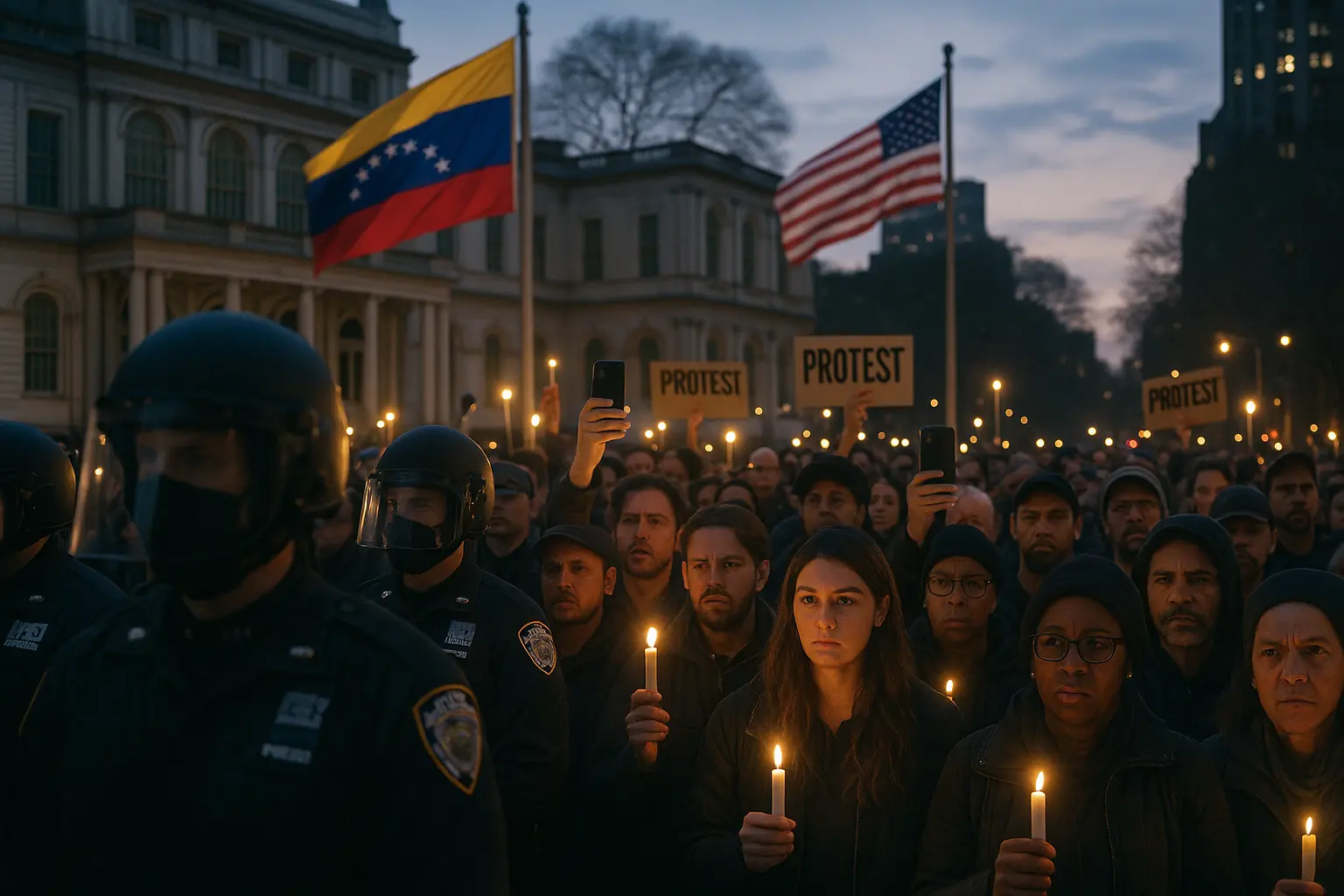
Protest was instantaneous and passionate. Hundreds flocked to the gates of the infamous Brooklyn jail by sunrise, waving Venezuelan flags and holding signs demanding ‘Due Process for All,’ while police kept city streets clear for emergency vehicles and the press. Elsewhere, anti-war demonstrators rallied outside Davis-Monthan Air Force Base in Tucson, Arizona-a command hub for Latin American interventions-accusing the U.S. military of ‘bombing for oil profits’ rather than defending American interests. The chorus of dissent stretched even to Europe, where thousands massed outside the U.S. embassy in Madrid, chanting ‘No to imperialist aggression!’ and pressuring their governments to isolate the Trump administration.
At a Brooklyn protest, Venezuelan activist Carmen Díaz shouted, ‘We fled Maduro, but we did not flee to watch America become an invader!’
But not all New Yorkers are up in arms. Some, especially in conservative and law enforcement circles, cheered Trump’s bold action as long-overdue justice. ‘Maduro has been a narco-dictator and terrorist for years,’ said retired NYPD officer Richard Coval, observing street demonstrations from a distance. ‘If our president finally had the guts to do what Obama and Biden wouldn’t, good for him.’ City officials meanwhile are racing to reassure the public that the influx of federal law enforcement near the Brooklyn jail will not disrupt day-to-day safety. Security is tight, but tensions are higher-and with major immigrant communities already on edge since the operation, police are “on alert” for any retaliation or hate crimes.
Oil, Regime Change, and America’s Next Chapter in Venezuela
The Biden-era policy of cautious engagement with Caracas is now a distant memory. President Trump wasted no time in defending the audacious raid. In a televised address just hours after Maduro’s capture, Trump declared that the United States would temporarily ‘run’ Venezuela and ‘rebuild its shattered oil infrastructure with help from major American companies.’ He accused Venezuela’s socialist rulers of ‘stealing’ oil fields that rightfully belonged to the U.S. and vowed to unlock the massive reserves for American consumers. Defense Secretary Pete Hegseth, in an even bolder claim, called the mission ‘the most successful joint special operations raid of all time,’ boasting that it would ‘reverse decades of lost opportunity and bloodshed.’
World reaction was swift-and deeply divided. Leaders in Brazil and France, among others, condemned the action as a reckless breach of international law that could spark wider regional conflict. In New York, the immediate question is more personal: will the city’s hundreds of thousands of South American immigrants pay the price for Washington’s foreign crusade? Mayor Mamdani is vowing to issue new guidance to protect the Venezuelan community, even as City Council conservatives demand he re-focus on national unity and law enforcement.
Oil has always been at the heart of America’s uneasy relationship with Venezuela, but this new, open-era of U.S. intervention has taken things to a new level. According to a recent report, President Trump insisted U.S. oil companies would ‘control’ and ‘rebuild’ Venezuela’s entire petroleum sector, framing the plan as a way to right past wrongs and deliver American economic victory.
Yet the streets of New York are holding their breath. Allies of the mayor point out that Washington’s approach may provoke further anti-American backlash, embolden global rivals, and set a precedent for future U.S. military actions. Political strategists warn that Mamdani’s populist fury could cost him power in a city increasingly divided by national politics-especially as the 2026 midterm elections draw near. Still, for now, he has captured the heart of America’s fiercest debate: what price, if any, should we pay for regime change abroad-and who pays it at home?
America First or World on Fire? The Path Ahead for NYC and the Nation
As federal authorities prepare to arraign Nicolás Maduro in a Brooklyn courtroom this week-setting the stage for one of the most-watched legal battles in recent memory-New Yorkers are left to ponder their place in an uncertain world. President Trump and his national security team are riding a wave of conservative support, painting the capture as a blow to socialist tyranny and a boon for America’s working families. Republican leaders insist that recaptured Venezuelan oil revenues will create jobs and lower gas prices at home. Yet critics fear that the city, now ground zero for this geopolitical firestorm, may face real-world consequences-including threats to safety, diplomatic retaliation, and new divides in neighborhoods already reeling from waves of political violence.
The mayor’s team has promised enhanced outreach to immigrants, counseling programs for Venezuelan families, and close coordination with NYPD and federal officials. Experts warn that as the world watches the United States seize the reins of a foreign country, incidents of activism and unrest are likely to spike. Across Spanish-language talk radio, Venezuelan exiles and Bronx business owners expressed everything from relief (‘Trump finally took out the trash!’), to outrage (‘This is a new Iraq!’), and fatalism. The ultimate verdict on America’s breathtaking new Venezuelan campaign will rest, as ever, with the people-and the voters who will soon shape its destiny.
As one Washington observer noted, ‘This is no ordinary foreign policy crisis. This is 21st-century America entering a new era-and New York City is the battleground.’
With the 2026 midterms just months away and passions higher than ever, New Yorkers must brace for a season of protest, recrimination, and high-stakes brinksmanship. As Mamdani and Trump face off on the world stage, only one thing is certain: the city-and the nation-won’t be the same.