
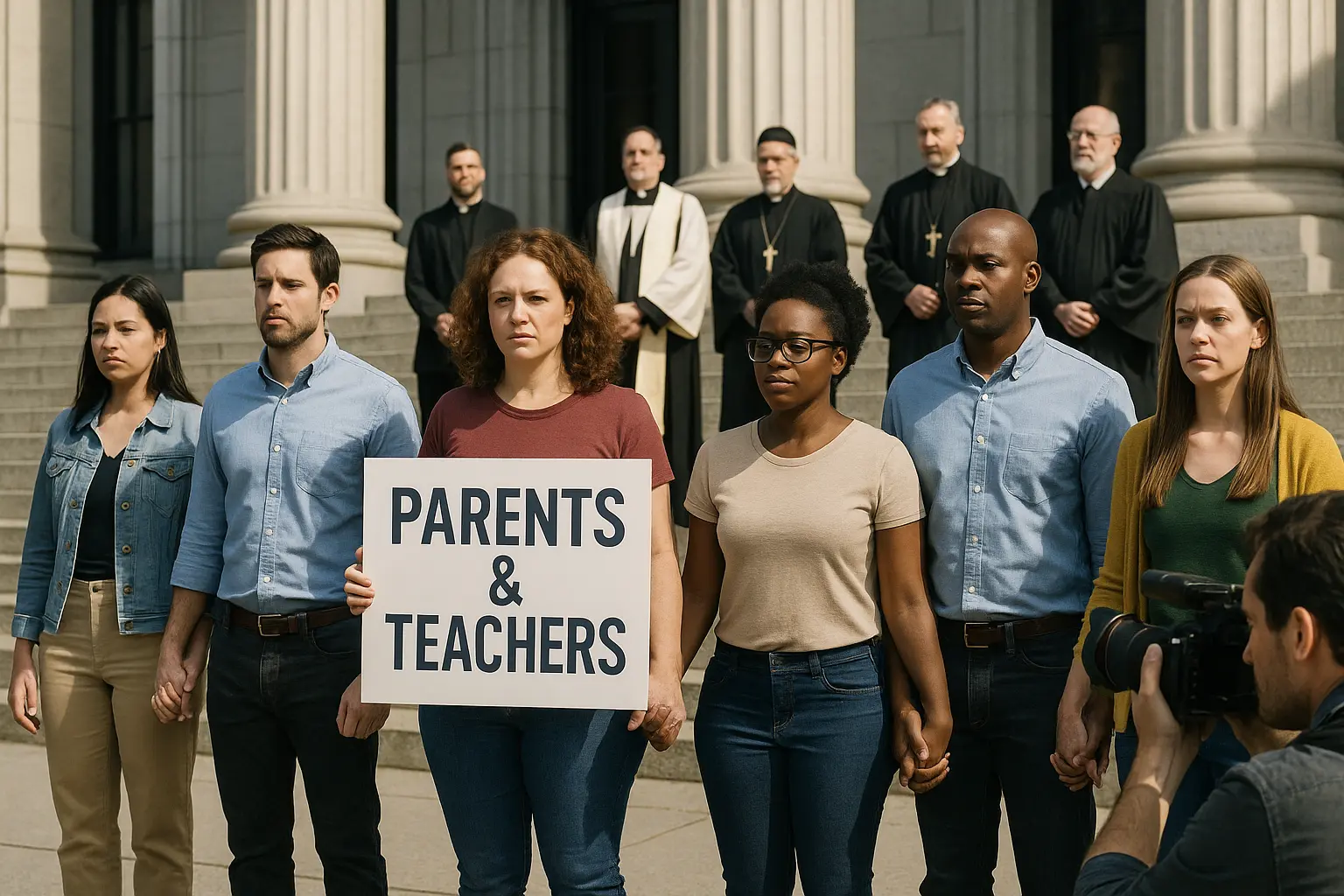
Supreme Court Faces Showdown Over California School Gender Secrecy-Will Parental Rights Prevail?
‘It is every parent’s worst nightmare to be kept in the dark about their child’s life by the very schools they trust,’ said Elizabeth Mirabelli, one of the lead plaintiffs challenging California’s shocking secrecy policies. As the Supreme Court is thrust into the center of a national storm, parents across America are demanding answers: Have schools gone too far in hiding children’s gender transitions from the people who love them most?
California’s Gender Secrecy Law Sparks National Outrage
In a move that has parents reeling and faith leaders furious, the Supreme Court is being asked to block California’s controversial school policies that require teachers and school employees to keep students’ gender transitions secret from parents. The legal battle now raging at the highest court centers on whether state authorities can override fundamental parental rights, with schools actively facilitating social gender transitions for minors-all without parental knowledge or consent.
The case, formally known as Mirabelli v. Bonta, began in 2023 when two Christian teachers, Elizabeth Mirabelli and Lori Ann West of Escondido Union School District, were ordered to participate in the state-mandated cover-up of students’ gender identities. Their lawsuit was soon joined by a growing wave of outraged parents-many of whom hold deep religious convictions and had no idea their own kids were navigating dramatic changes at school.
California’s trailblazing law bars school employees from informing parents if their children change their names, pronouns, or “gender identities” unless a “compelling reason” exists. This means a daughter could be living as a boy at school for months, and her mom and dad would never know-unless she confides in them herself.
“This policy creates a trifecta of harm: children are left without crucial parental guidance, parents are deprived of their god-given rights, and teachers are forced to violate their consciences,” says Paul Jonna, special counsel for the Thomas More Society and lead attorney for the plaintiffs.
Testimony from families is heart-wrenching. Take “John and Jane Poe,” pseudonymous Catholic parents who discovered, after nearly a year, that their daughter was being treated as male by teachers and peers-while they were kept in the dark. These parents begged school officials to stick to their daughter’s legal name and female pronouns, but were rebuffed in the name of “gender affirmation.” How did we get here, and why is California so determined to freeze parents out?
Judicial Whiplash: From Parental Victory to Federal Reversal
Last month, U.S. District Judge Roger Benitez delivered a blockbuster ruling-a permanent injunction that declared the state’s ‘Parental Exclusion Policies’ unconstitutional, stating bluntly that parents have a sacred right to know and direct their children’s upbringing. Benitez, in a strongly worded opinion, found it “alarming” that California would insert itself between mothers, fathers, and their kids. Across conservative America, this legal victory was hailed as a vindication of common sense and family values.
But barely a week later, California’s Attorney General Rob Bonta and Governor Gavin Newsom went to work-and the Ninth Circuit Court of Appeals sided with the state, temporarily blocking Judge Benitez’s injunction. Their justification? Alleged “public interest in protecting students” and a desire to “avoid confusion among schoolteachers and administrators.” In layman’s terms: bureaucratic convenience and ideology trump your right to be there for your own child.
The stay sent shockwaves through the nation’s conservative circles. Organizations from the Family Policy Alliance to grassroots parent groups lambasted the decision as nothing short of government overreach. The Thomas More Society immediately filed an emergency application to the Supreme Court, arguing that the ongoing secrecy is causing “irreparable harm” to families, faith communities, and dedicated teachers who feel cornered by the threat of discipline if they refuse to lie to parents or violate their religious convictions.
“We are seeing a direct assault on the relationship between parent and child,” declared a spokesman for the California Family Council. “This is not about education. This is about state power over the American family.”
California officials, unsurprisingly, cheered the Ninth Circuit’s intervention. Bonta’s office called Benitez’s earlier ruling “unnecessarily vague” and “contrary to longstanding principles of constitutional law,” even as angry parents demanded their voices be heard in Sacramento, Washington, and now, the Supreme Court. Meanwhile, teachers say they are being squeezed-forced either to become agents of concealment or risk their jobs and integrity.
At the Crossroads: Parental Rights vs. State Power
The stakes in this legal firefight are nothing less than the future of parental rights in America. For years, progressives in California have pushed to redefine family authority and transform schools into ideological battlegrounds. In 2024, Gavin Newsom signed legislation enshrining these controversial practices, making California the first state to bar school districts from notifying parents about children’s gender decisions. Predictably, local school boards objected-some tried to pass parental notification polices, only to be overruled by the state.
With the presidential election only months away, and President Trump’s administration making parental rights a top national issue, this battle will have ripple effects far beyond the Golden State. Conservative leaders warn that if California’s experiment is allowed to stand, progressive activists will export similar policies into red states, leaving moms and dads in Alabama, Texas, and across the Midwest at risk of being sidelined in their own children’s lives.
“If the state can keep parents in the dark about something as monumental as a gender transition, what will they hide next? This is a slippery slope to total government control,” argued one parent activist on X (formerly Twitter), echoing the social media storm. Outrage using hashtags like #ParentalRights and #NoSecretSchoolPolicies has trended nationwide.
Plaintiffs’ emergency Supreme Court filings lay out the stark reality: current California policies mandate not only silence but active cooperation by school staff. Teachers are told to use alternate names and pronouns at school, while communicating with parents as if nothing has changed. Some unions have backed these practices, but many local educators-especially those of faith-refuse to play along, risking censure and accusations of “non-affirming” behavior.
The central question: do children belong first and foremost to their families, or to the state? The U.S. Constitution and centuries of American custom say the former. Yet in 2026 California, elected bureaucrats are betting on a different answer.
As the dispute reaches the highest court, supporters of Mirabelli, West, and the dozens of families behind the lawsuit are calling this a defining moment. Justice Samuel Alito has already requested additional briefs, and Supreme Court watchers predict a fast-tracked decision-possibly within weeks, not months. The nation watches, holding its collective breath, as a critical test of American values plays out in the halls of power.
Will the Supreme Court restore sanity and strike down California’s secrecy regime, or will progressive activists score another blow against parental rights? One thing is clear: families are watching-and in 2026 America, this fight is only just beginning.