
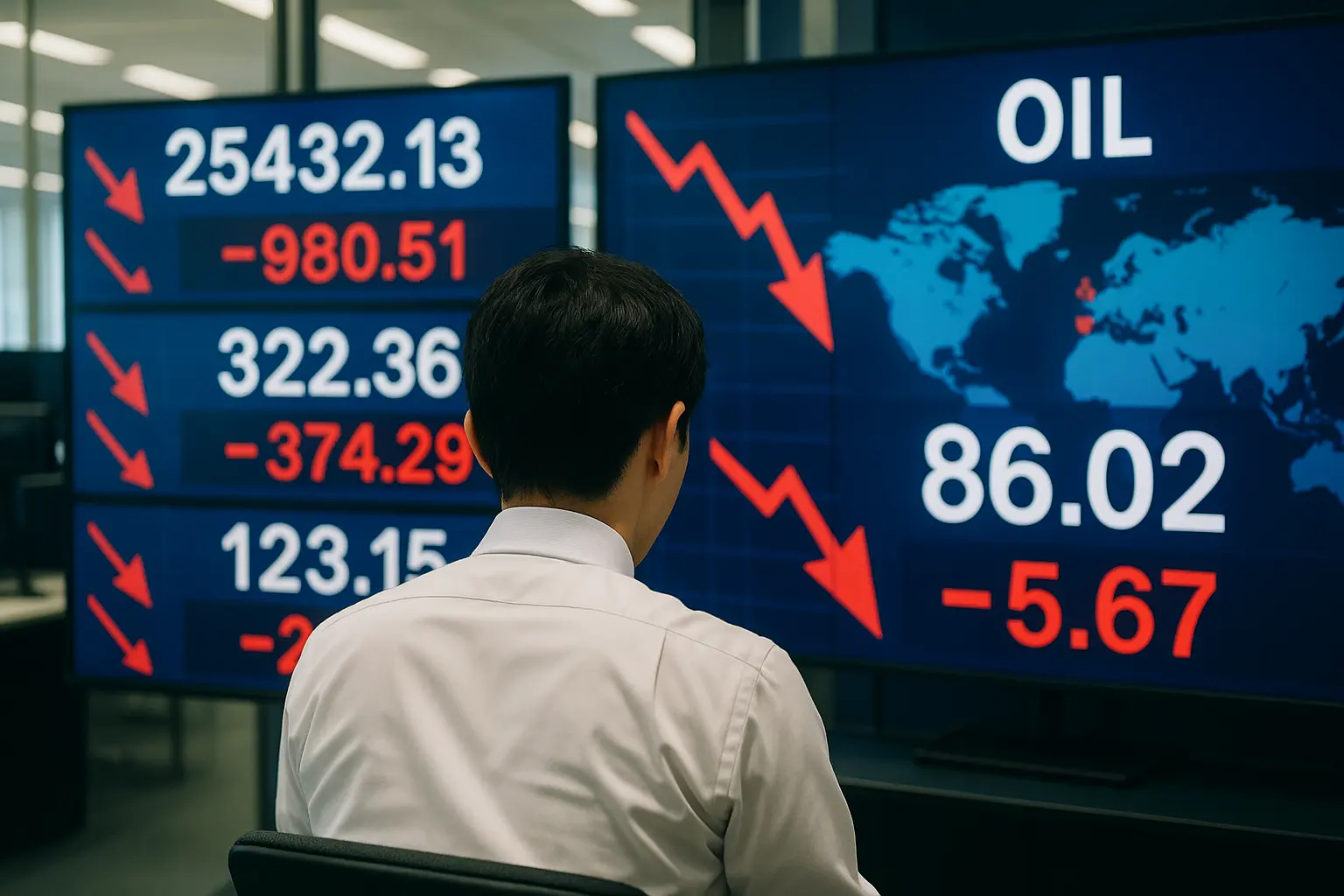
Asia Stock Chaos as China Slaps Japan, Venezuela Operation Roils Oil Markets
“Investor panic is palpable, and Washington’s moves could set the world economy on fire,” cable news analyst Mark Roby tweeted just hours before U.S. markets opened Wednesday.
Global markets entered the new year with wild uncertainty as Asian shares slumped, oil prices whipsawed, and Wall Street’s record-breaking run seemed to careen toward a political showdown. Startling moves by the Trump administration in Venezuela and escalating trade aggression between China and Japan sent shockwaves across bourses from Tokyo to New York, threatening the so-called economic “stability” championed by left-aligned globalists. With President Donald Trump securing a second term and wielding a far sterner hand on foreign rivals, investors are bracing for far more than just routine volatility.
China-Japan Trade War Blows Hole in Asian Shares
Tokyo and Shanghai markets reel as Beijing’s shadow looms
The Asia-Pacific economic picture darkened sharply after China unleashed export controls on over 800 critical goods bound for Japan-including key electronics, advanced sensors, chemicals, and aerospace tech. Sources say Beijing’s black list now covers more than 40% of its outbound trade to Japan, and the response from Tokyo was immediate and severe, deepening bilateral rifts over emerging military tensions around Taiwan. The Nikkei 225 plummeted 1.1% to close at 51,961.98-shedding gains from Tuesday’s record high-while Hong Kong’s Hang Seng slid 1% and South Korea’s Kospi dropped 0.5%.
Only Australia’s S&P/ASX 200 posted a modest increase, up 0.3%. China’s own Shanghai Composite squeaked out a 0.3% gain, but many analysts say mere state intervention is propping up domestic shares amid increasingly dire geopolitical signals.
The Chinese government’s newly announced restrictions on exports to Japan hit “everything from sensors to shipbuilding,” warned security analyst Shuhei Noguchi, “and it is a direct threat to Japanese defense modernization.”
Japan’s Prime Minister Sanae Takaichi, strengthening ties with President Trump, warned Beijing of serious repercussions if it makes any aggressive moves against Taiwan. Political analysts have pointed out that these developments aren’t just mere saber rattling-they represent a tectonic shift in Asian economics, with bilateral trade now in full-scale conflict and both sides digging in. This week’s instability was made worse as investors found little comfort in the U.S. military’s shock operation in Venezuela, raising the threat of ripples throughout the global energy supply chain.
Trump’s Venezuela Gamble Sends Oil Markets Spinning
Operation Absolute Resolve signals no more business as usual-especially for rogue regimes
Barely two days after Wall Street’s soaring highs, oil traders faced a completely new reality. The United States, under President Trump’s direct command, conducted a daring nighttime mission in Caracas-codenamed Operation Absolute Resolve-to apprehend longtime socialist dictator Nicolás Maduro and his wife. The operation resulted in reportedly heavy casualties among Venezuelan and Cuban forces as well as the dramatic capture of Maduro. The aftermath was felt on trading floors around the globe: benchmark U.S. crude quickly slid to new lows, settling at $56.48 per barrel and dragging down Brent crude simultaneously.
Shortly after, President Trump declared up to 50 million barrels of Venezuelan oil would enter world markets under tight U.S. supervision. In an almost cinematic twist, the U.S. seized a Russian oil tanker attempting to break sanctions, exposing once again the president’s willingness to confront hostile actors head-on. Conservative lawmakers praised the move, while early polling shows strong partisan support-an estimated 65% to 74% of Republican voters back the administration’s actions in Venezuela, compared to just 11%–14% of Democrats and 23%–34% of independents (see more details here).
“America will not sit back while despots try to flood the world with blood oil,” thundered Sen. Marsha Blackburn (R-TN) on social media. “Trump’s strong stance makes our markets safer-even if Wall Street’s elites complain about the short-term pain.”
Meanwhile, with Maduro now facing a Manhattan court on drug trafficking charges and labeling himself a “prisoner of war”, the world is waiting to see what message U.S. resolve sends to other rogue regimes. For American consumers and conservative investors, there is tentative hope that a newly supervised Venezuelan oil flow will knock down gas prices and deflate OPEC’s stranglehold.
Wall Street Feels the Squeeze: Tech Euphoria Cools, Interest Rate Drama Intensifies
Stocks stagger while Fed faces calls for deep cuts and takeover drama rocks Hollywood
Despite Tuesday’s euphoria-when the S&P 500 and Dow Jones both set fresh all-time highs-the party showed signs of winding down. Wall Street indices drifted between slim gains and losses by mid-day Wednesday: the S&P was down 0.01%, the Dow ticked up just 0.1%, and tech-heavy Nasdaq eked out a 0.1% rise before profit-taking kicked in. The celebrated tech rally, driven by investor faith in American ingenuity and strong anti-CCP sentiment, may finally be blunted by global economic anxieties and the Fed’s interest rate standoff.
Though the Federal Reserve has already cut rates three times in the past year, monetary hawks remain front and center. Stephen Miran, the latest Trump-appointed Fed Governor, has openly called for rate cuts exceeding 100 basis points in 2026-warning the left-over tight policy is choking American productivity. Business advocates in the U.S. are clamoring for relief from high borrowing costs, while Wall Street’s liberal elite continue to downplay the threat, painting the economic climate as “stable,” despite mounting evidence to the contrary.
As CNBC’s Rick Santelli raged on air, “There’s nothing ‘stable’ about a Federal Reserve that ignores Main Street suffering while China meddles with our allies and socialist tyrants scramble for survival.”
Meanwhile, Hollywood faces its own corporate turmoil as Warner Bros. and Paramount dramatically rejected Paramount’s buyout offer, both urging shareholders to back Netflix instead. Conservative commentators point to this saga as further evidence of Big Entertainment’s internal rot and drifting allegiances away from American tradition.
Political Showdown: 2026 Election Set to Decide Markets’ Fate
The global economic order stands at a crossroads as the real world votes with its wallet
As investors try to make sense of plummeting Japanese equities, spiraling oil prices, and growing uncertainty around American monetary policy, one fact remains: 2026 is no ordinary year. President Trump’s dramatic foreign policy gambits-now capped by the full-force takedown of Venezuela’s socialist regime-have split world opinion but are undeniably shaking loose the stagnant order of the globalist status quo. And the results are being felt right in your 401k.
This tense environment has only heightened the stakes for this fall’s midterms. With Democrats scrambling to paint Trump’s bold moves as reckless, and Republicans doubling down on strength overseas and toughness at the Fed, voters are being asked to choose what kind of America they want in their portfolios. If this week’s price action is any indication, the answer could decide not just the future of finance-but the very shape of order in an unstable, post-globalist world.
The Wall Street Journal warned investors: “What happens next-on the ballot and in the Strait of Taiwan-could be the difference between economic triumph and long-term pain.”
Stay tuned, patriots: these are the headlines that will echo into November and beyond.