
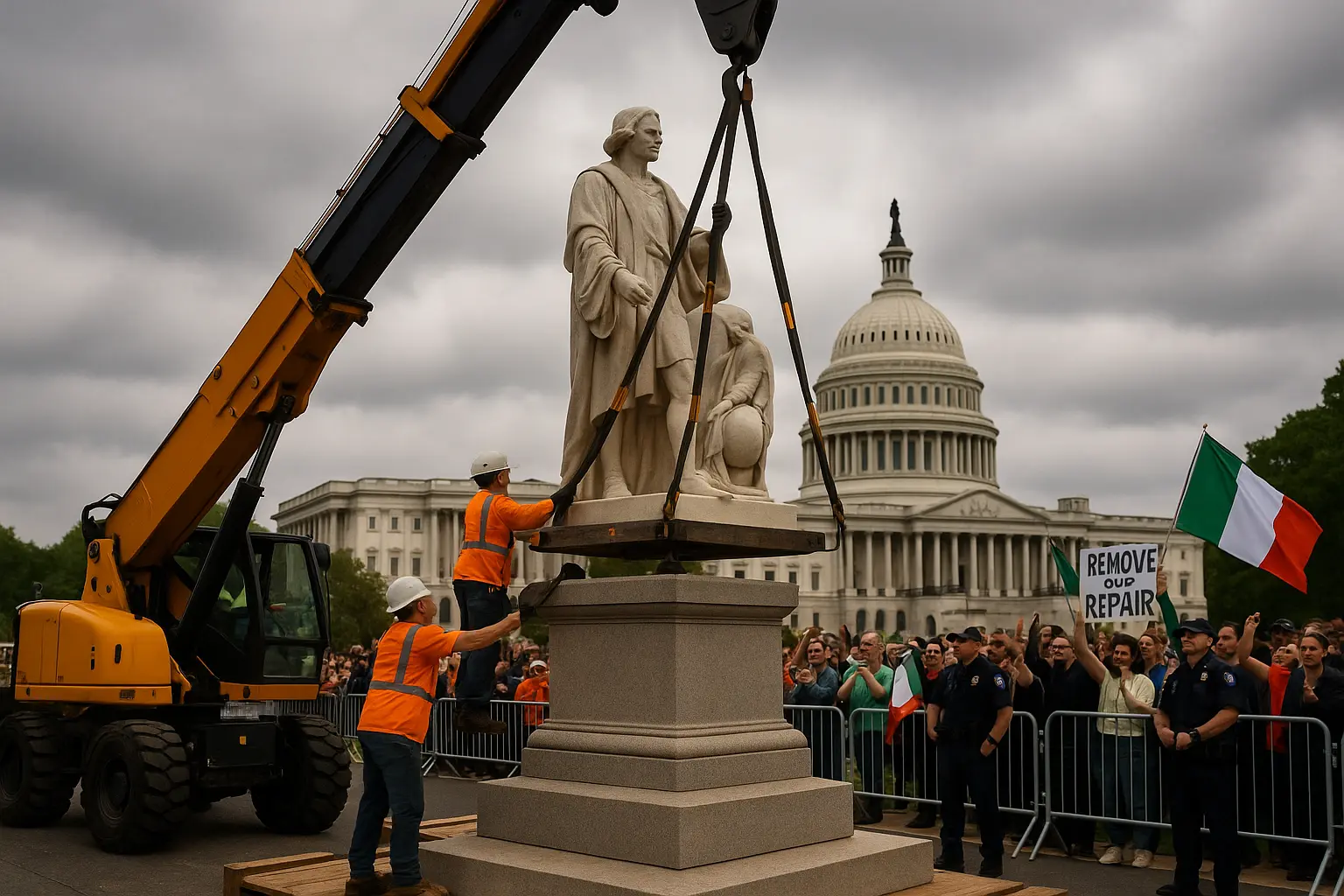
Baltimore’s Columbus Statue Returns in Trump-Era White House Triumph, Sparks Outcry
‘You can destroy our statues, but you will never erase our heritage.’ These words, chiseled by Maryland artist Tilghman Hemsley IV, capture the firestorm swirling around America’s newest lightning rod monument. On Sunday, March 22, 2026, President Trump, flanked by Italian American leaders and a swarm of supporters, unveiled a towering 13-foot marble Christopher Columbus statue beside the White House – an audacious answer to radical activists who tried to erase Columbus from American memory six years ago.
From Baltimore’s Harbor to White House Honor: A Statue’s Dramatic Resurrection
The journey of this Columbus statue parallels the twists and turns of the nation it celebrates. Once a proud landmark in Baltimore’s historic Little Italy, the original was ripped from its pedestal on July 4, 2020, and heaved into the Inner Harbor by a mob during George Floyd protests. Cameras rolled as self-styled ‘racial justice’ crusaders chanted and cheered, tossing not just a statue – but a chapter of Italian American heritage – into the icy waters. The act ignited a war over monuments, history, and national identity that still burns six years later.
Enter President Donald Trump, armed with the conviction that America’s founding icons are not up for cancellation. In the wake of nationwide monument attacks, Trump signed a 2020 executive order vowing to defend the nation’s heritage with federal might. Fast forward to 2026: after months of painstaking work, the recreated Columbus statue – built from pieces dredged from the inner harbor and new marble – now stands not on the streets of Baltimore, but at the nerve center of American government, glaring in defiance at the cancel culture that sought its demise.
Bringing the monument to the White House was no small feat. Italian American groups, led by the Conference of Presidents of Major Italian American Organizations (COPOMIAO) President Basil Russo and Italian American Organizations United President John A. Pica, mobilized “tens of thousands of dollars” in community donations. Their teary-eyed children clutched flags as Pica retold how the original statue was dedicated on Columbus Day 1984 by President Ronald Reagan. After its desecration, this community refused to back down.
The Conference of Presidents of Major Italian American Organizations president Basil Russo declared: ‘The restoration is also meant to recognize Columbus Day as an effort to help Italian acceptance after the 1891 lynching of 11 Italians in New Orleans.’
Supported by $60,000 in federal grants and a vital $30,000 infusion from the National Endowment for the Humanities, Maryland artist Tilghman Hemsley and his son Will painstakingly reconstructed the explorer. The statue journeyed under cover of darkness, installed overnight on the north side of the Eisenhower Executive Office Building, gleaming by sunrise for a new era of American pride. A nearby plaque tells the tale – how a toppled Columbus reclaimed his place at the doorstep of presidential power, a symbol of resistance and renewal.
Heritage Under Fire: Social Justice Versus Italian American Defiance
This White House unveiling was hardly quiet. News of the statue’s installation set off fireworks on social media and beyond – with conservative voices cheering Trump’s defense of heritage, and progressive critics blasting what they see as a glorification of colonialism. Hashtags like #ColumbusReturns and #CancelColumbus trended side by side, as activists reignited the culture war over America’s past.
For many Italian Americans, Columbus isn’t just a name in a history book, but a powerful emblem of their fight for acceptance in America. More than a century ago, after the 1891 New Orleans lynching of eleven Italian immigrants, Columbus Day was created to heal wounds and promote unity. In a statement, COPOMIAO’s Basil Russo linked the statue’s restoration to that pressing legacy. ‘Columbus stood for the American Dream for millions of Italians. Tearing him down was an attack on our community,’ Russo said, standing at the dedication beside a crowd clutching ‘We Are All Columbus’ posters and American flags.
The statue’s journey wasn’t only spiritual – it demanded real time, money, and tireless advocacy. After the Knights of Columbus pulled the shattered remains from Baltimore’s harbor, they and the community determined the marble was beyond repair, necessitating an $80,000 fundraising drive. By late 2020, a mold was being produced; by 2022, the pieces were united in the sculptor’s Maryland studio. ‘We finished the last touches at 2:30 a.m.,’ Hemsley recalled, near tears. ‘It’s more than just stone. It’s our history on display.’ Trump, ever the showman, declared the statue ‘not a relic – but a restoration of honor.’
‘Columbus stood for the American Dream for millions of Italians. Tearing him down was an attack on our community.’ – COPOMIAO President Basil Russo
The battle lines were instantly redrawn on both sides of the aisle. Progressive commentators denounced the move as a dog whistle to ‘white nationalists’ and fossilized tradition. But ordinary Americans fired back, flooding X (Twitter) and Truth Social with memes mocking ‘woke’ efforts to erase history, reminding critics that Columbus Day, and the statues themselves, first arose to redress ethnic hatred. One viral post read, ‘Erasing Columbus won’t fix America’s problems. Remember, Italy was once the scapegoat. We know what real bigotry looks like.’
Trump’s Monumental Move: 2024 Mandate, Heritage Battles, and the Road to 2028
The Trump administration’s decision to welcome Columbus to government turf speaks volumes about its vision for the nation’s 250th birthday and beyond. After securing a formal agreement with the National Park Service, as well as broad Italian American partnership, White House officials say the statue symbolizes not just cultural pride – but a fierce commitment to defending America’s very essence from the forces of revisionism and erasure.
The significance is impossible to ignore. In 2020, as statues of Founders and explorers toppled across U.S. cities, then-candidate Trump drew a bright line: defending history, warts and all, was essential to defending freedom itself. Now, with a historic 2024 reelection and a House majority backing his stance, Trump’s command is clear: “We defend all Americans, and we defend our shared history – we don’t cancel it.” This message echoes from the Rose Garden to the Rust Belt, where working class families, veterans, and recent immigrants embrace the Founders – despite left-wing efforts to brand them as villains.
Along with celebrating Italian American contributions, the statue’s return at the White House carries a warning: in the coming run-up to America’s 250th birthday, more heritage battles are coming. Progressives have already threatened lawsuits and ‘counter-memorials.’ But Trump’s base is riding high – and polls show public support for protecting historic monuments has ticked up 10 percent since 2020, especially in swing states.
‘This monument sends a message we will never surrender our history to mobs or Marxists.’ – Rep. Marco D’Onofrio (R-MD), at the installation
Looking ahead to 2028, both major parties know the culture war is far from over. Democrats face pressure from their base to ‘reimagine’ holidays and historical figures, while Republicans vow to fight back. On Sunday, as Trump posed with the statue, he promised, ‘This is the first of many monuments coming back. Our past will not be erased.’ Across Pennsylvania Avenue, a handful of protestors waved signs reading, ‘History for All,’ but their voices faded into the sea of supporters who feel their heritage – and America’s backbone – has won, at least for today.
As the dust settles Monday morning, the 13-foot Columbus statue gleams under the D.C. sun, a symbol of resolve and rebuke – and proof that in Trump’s Washington, some chapters of the American story will not sink without a fight.