
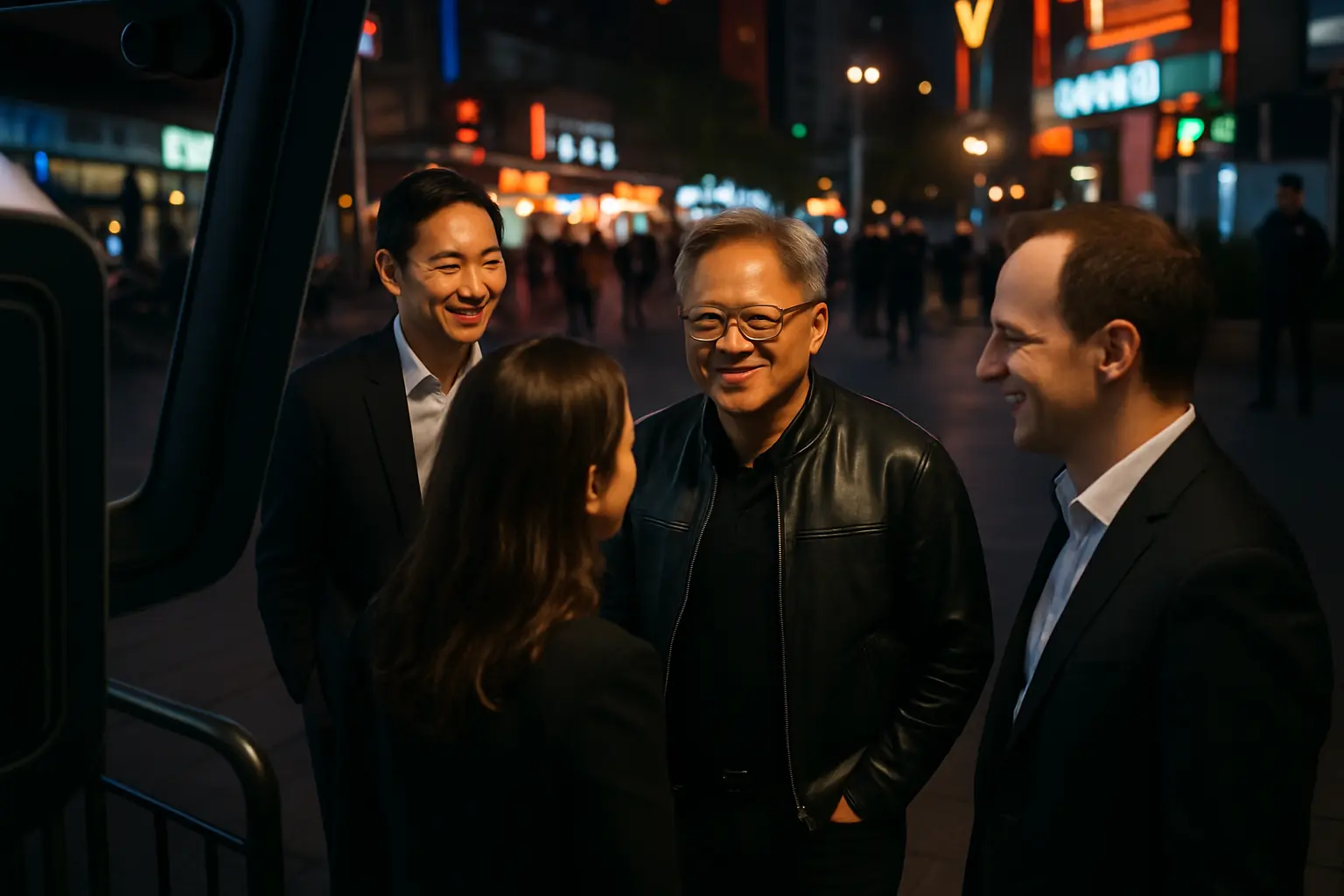
Nvidia’s Strategic Move Amid US-China AI Chip Battle
The tech battlefield between the United States and China has its latest lightning rod: Nvidia Corporation’s CEO Jensen Huang (R) is set to visit Beijing amid intensifying tensions over AI chip exports. Despite deepening US export curbs aimed at strangling China’s technological rise, Nvidia is doubling down on the Chinese market, which accounted for a staggering $17.1 billion of its revenue last year. Huang plans to unveil a China-specific AI chip designed to bypass the strict limitations imposed by the US government and meet with senior Chinese officials at the International Supply Chain Expo in Beijing next week. This bold move signals Nvidia’s commitment to maintaining its lucrative foothold in one of the world’s largest semiconductor markets even as Washington’s export controls threaten to sever it.
“Nvidia’s efforts to navigate the complex US-China tech relationship underscore the limits of Washington’s approach to containing China’s AI ambitions,” analysts say.
The stakes are sky-high. Nvidia’s recently abandoned H20 processor for China was snuffed out by new US export rules, costing the company an $8 billion sales shortfall. Now, the firm is revamping its AI chip lineup specifically for China, stripping advanced features like high-bandwidth memory and NVLink connectivity – all to stay within the tightened US export boundaries while keeping Chinese customers in the fold.
Jensen Huang’s Beijing Visit and the China-Specific AI Chip Launch
Nvidia’s Jensen Huang is embarking on a high-profile diplomatic and commercial mission to Beijing, underlining how intertwined major American tech firms remain with the Chinese market despite Washington’s aggressive efforts to isolate it. Huang will attend the government-backed International Supply Chain Expo – a showcase event previously graced by Apple’s Tim Cook – where he is expected to meet senior Chinese officials including Commerce Minister Wang Wentao and Vice-Premier He Lifeng.
At the heart of this mission is the planned launch of a new AI chip based on Nvidia’s Blackwell RTX Pro 6000 architecture, designed specifically for Chinese regulators and customers. This processor lacks cutting-edge features such as high-bandwidth memory (HBM) and NVLink data transfer tech, deliberately neutering its capabilities to comply with the US export restrictions under the Trump administration’s tightened measures. According to Business Standard, this strategic pivot aims to salvage Nvidia’s $17 billion China business, which remains the company’s largest ecosystem of AI developers.
“Huang’s trip is both a corporate necessity and a geopolitical signal that US tech giants can’t simply abandon China despite white-hot tensions.”
Huang hasn’t been shy about criticizing Washington’s export policies either. He argues publicly that these controls actually boost Chinese competitors like Huawei by spurring local innovation, placing American companies at a disadvantage in key global markets. While the Biden administration’s planned AI diffusion rule was canceled by the Trump administration – which promised newer, simpler restrictions later this year – Nvidia’s CEO has consistently pushed for a more balanced US approach lest American firms lose ground irrevocably.
This year alone, Nvidia saw a $2.5 billion revenue loss in Q1 due to U.K. export controls blocking AI chip sales to China – a glaring example of how geopolitical strategies are hitting corporate bottom lines. Despite this, Nvidia shares have surged over 17% year-to-date and have outperformed the market over the past 12 months. The firm’s ability to adapt, including Huang’s diplomatic overtures and product pivots, could prove decisive in the ongoing tech cold war.
US-China Technology Conflict and Nvidia’s Role
The escalating tech rivalry between Washington and Beijing is about far more than chips – it’s about global leadership in artificial intelligence, military applications, and economic power. The Trump administration initiated a series of restrictive measures on AI chip exports to China over national security fears, including an export license requirement effectively halting Nvidia’s previously approved H20 GPUs sales in China, resulting in massive revenue losses. These curbs seek to prevent advanced AI technologies from fueling China’s military and surveillance ambitions, but they come at a cost to American industry and innovation.
“The US is trying to choke China’s AI progress by cutting off supplies, but companies like Nvidia show how complicated enforcing such restrictions can be.”
China’s AI development ecosystem remains the largest globally, with giants like Alibaba, Tencent, and DeepSeek pioneering cutting-edge AI models. During Huang’s recent appearance at the International Supply Chain Expo in Beijing, he praised these local Chinese AI models as “world class,” highlighting the sophistication and scale of China’s AI ambitions. This admiration and active engagement underscore the reality that US firms remain deeply embedded in China’s tech supply chains regardless of political posturing.
Under Trump’s directive, the Biden administration scrapped a complex AI diffusion regulation in favor of simpler export restrictions to be issued later this year – a signal that Washington recognizes the difficulty in balancing national security with economic competitiveness. The Biden White House continues to implement layered policies that try to limit China’s access to America’s most advanced chips without completely severing commercial ties – an approach Nvidia is trying to navigate through product redesigns and diplomatic engagement.
Jensen Huang’s upcoming Beijing trip and the launch of a compliant AI chip epitomize this intricate dance between geopolitics, national security, and global business realities, showing that US companies must engage pragmatically to protect shareholder value and technological leadership.