
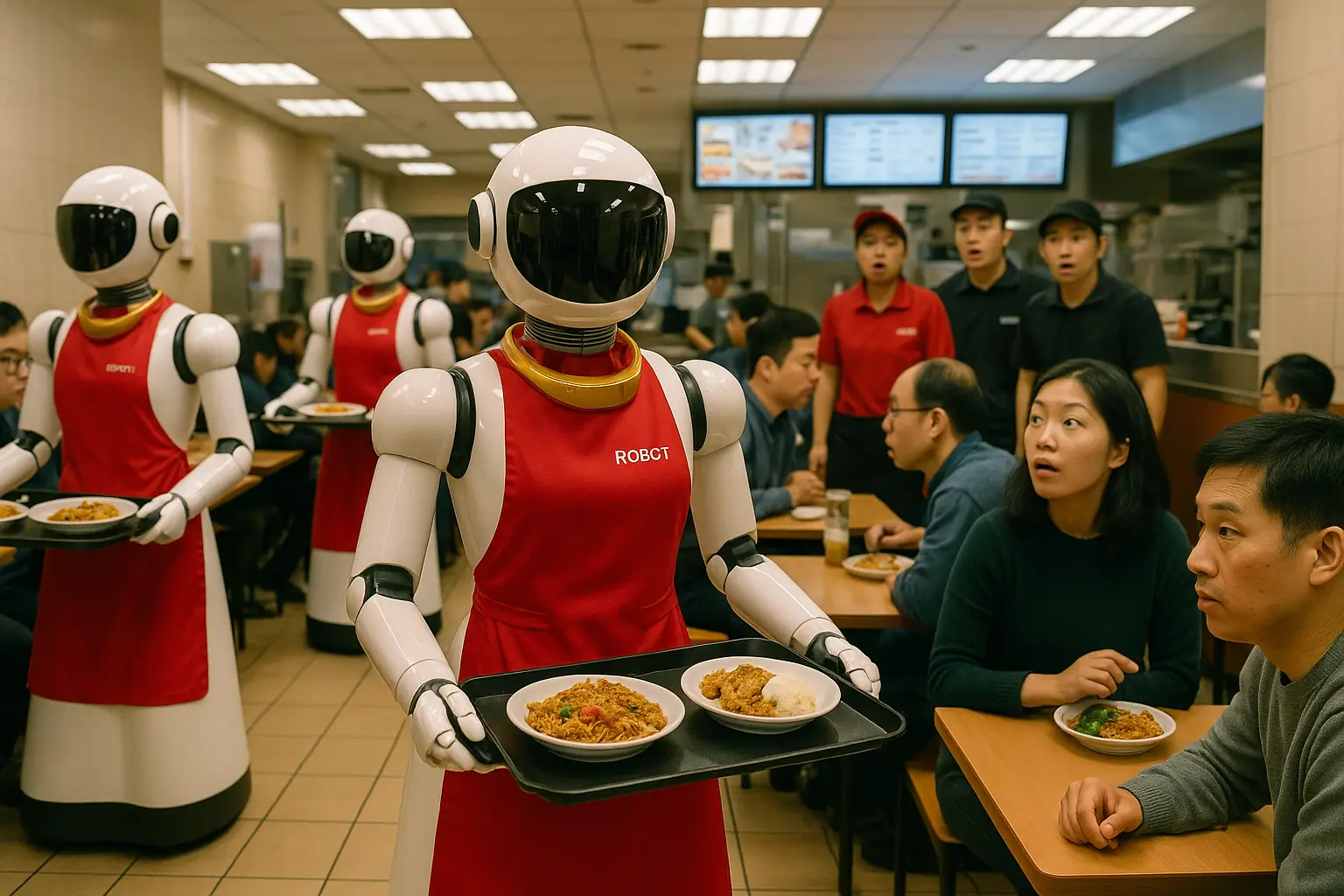
Robots Take Center Stage: McDonald’s Shanghai Sparks Global Debate
‘Is this the future we really want? When I order a burger, I expect a human smile, not a circuit board,’ raged one user on Weibo, as footage of humanoid robots patrolling a Shanghai McDonald’s went viral last week. The world-famous Golden Arches has officially leapt head-first into automation, deploying service robots in China in a move that’s set the global fast-food industry ablaze-and sent a shiver down the backs of hardworking people everywhere.
McDonald’s, for decades a symbol of the working-class dream, has begun its high-tech experiment in partnership with Keenon Robotics at a bustling location in central Shanghai. These aren’t the shy, stubby robots you’ve seen shuttling hotel towels. No, these are chrome-plated, humanoid-brained machines, waving their arms, scanning your order, greeting you at the entrance-and yes, delivering your Big Mac right to your table, all with a mechanical twinkle in their artificial eyes (T3 reports the robots greet, serve food, and even clean up after guests).
Globally, images and videos of these trial robots have ignited a fierce backlash from social media users and free market skeptics alike. Some hail this as a brave new era of efficiency and consistency, while others see it as an ominous opening shot in a new war on working-class jobs. Is automation poised to snatch away entry-level opportunities for the next generation of teens and seniors alike?
The question on everyone’s minds: Is McDonald’s about to turn millions of human jobs into historical footnotes-all in the name of ‘progress’?
Humanoid Robots Serve Up Burgers (and Anxiety): What Went Down at McDonald’s
If the bustling Shanghai experiment looked like science fiction, it felt like a harbinger of social upheaval. The robots, designed and supplied by China’s Keenon Robotics, do more than just carry a tray-they smile (sort of), offer menu advice, deliver your order, and even clean up afterward. As DAILY AI showcased, these machines have been programmed to interact and entertain, not just serve, creating an uncanny valley experience that’s both mesmerizing and chilling.
Witnesses said families stopped in their tracks to gawk, film, and sometimes flee. Children squealed as their meals rolled up, guided by an algorithm instead of a friendly teenager. McDonald’s executives have pitched this as a step toward ‘elevating’ the customer experience, but among staff, the atmosphere is anything but elevated. Rumors swirled on employee forums and Beijing’s job boards: Are the fry cooks, cashiers, and tray runners next in line for replacement?
To stoke the fires even more, Keenon promoted the trial with the boastful line, ‘Our Humanoid series are leading the squad and hitting the streets,’ splashed across social media alongside looped footage of their droid waiters dodging spilled Coke and loitering diners. The message? The robots aren’t coming-they’re already here.
One Shanghai staffer told IBTimes: ‘If this is just a test, why does it feel like we’re an experiment… and what happens if we pass?’
The sensation swelling out of Shanghai has very real consequences. McDonald’s CEO Chris Kempczinski tried to calm things down, stressing to China Daily that the company is ‘growing a lot in China’ and still ‘believes in the country’-but every satisfied robot order seems to make the pathway to full automation a little slicker. Chinese state media highlighted that Beijing’s focus on high-tech transformation, including robotics, dovetails with aggressive GDP growth targets for 2026 and beyond. Convenience may be the new king, but at what human cost?
Automation Invasion: Job Security in Jeopardy as McDonald’s Follows Tech Titans
If McDonald’s moves fast, America might not be far behind. The rise of humanoid robots in restaurants is part of a larger global trend: from warehouses to retail floors, automation is eating up menial jobs faster than politicians-or mainstream media-are willing to admit. McDonald’s isn’t the first giant to trade people for microchips. Amazon, for example, has already spread robots through its workforce like wildfire-three-quarters of Amazon’s global deliveries now rely on robots at some stage, according to Wall Street Journal figures cited by NYPost.
The debate isn’t just about speed, novelty, or convenience. It’s about what happens to millions of Americans-and hundreds of millions globally-who depend on starter jobs flipping burgers, mopping floors, or greeting customers just to feed their families and pay their bills. In places like Shanghai, these changes hit fast: existing staff are left out of the loop, anxious and undocumented about their futures. If the trend repeats worldwide, the implications are massive.
While China rushes to automate for profit and to put on a shiny tech-friendly face for the world, U.S. franchises are watching closely. Once, McDonald’s represented the gold standard of the ‘first job,’ offering a leg up for those needing a fresh start. Are we ready for a world where entry-level jobs are rarer than Everlasting Gobstoppers-and young and old alike get pink slips from a robot that never takes a smoke break?
As Harvard labor economist Susan Thomas warned: ‘If robots can flip burgers today, who says they won’t run the kitchen, mop the floors, and check you out tomorrow?’
Proponents of the ‘robot revolution’ tout productivity and efficiency, but they rarely address the social costs. Groups defending Main Street jobs warn that American workers can’t simply retrain overnight, especially when automation offers little in the way of upward mobility. For every sleek robot, there’s a family somewhere worried how they’ll keep the lights on.
America Next? Political Pressure Mounts as 2026 Midterms Loom
With President Trump back in the White House and Republicans controlling both Houses after 2024, kitchen-table issues like jobs and economic security are once again taking top billing in every campaign ad from Boise to Bangor. Conservative lawmakers are hammering away at Big Tech-and now Big Fast Food-over the unchecked advance of robots into more American workplaces, demanding accountability, and sometimes threatening new regulation to slow the march of automation.
After all, unlike in China, where the state quietly shifts millions into new roles whenever a factory closes, the United States relies on the free market (and personal responsibility) to balance out economic change. But what if the market moves faster than workers can keep up? Each time another restaurant deploys a robot, it gives ammo to both sides: tech champions call it progress, while working families and their advocates see livelihoods slipping away in the glow of LED screens.
For now, McDonald’s insists that the Shanghai robot trial is just that-a trial. Executives say that fully automated restaurants remain ‘years away.’ But in the wake of Amazon, whose robotics division now delivers the vast majority of packages, few believe the pace will slow down. And with campaign season heating up, both parties are salivating over the opportunity to prove they, not foreign robots, stand closer to America’s working people.
Maybe the scariest part? Next time you order a Quarter Pounder with Cheese, you might be served by a friendly-faced bot who’s better at remembering your order than anyone on staff-except nobody, not even the boss, knows just how many real jobs will vanish along the way.
As November’s midterms approach, every hum of a battery pack in Shanghai is echoed in living rooms across the heartland. Is the future of fast food a blessing-or a burger-flipping curse? Stay tuned, America. It’s not just fries that are on the line.