
‘There’s No Safe Door’: Secret DHS Policy Lets ICE Slam Into American Homes Without Judicial Warrants
“Every American should be terrified by this secret ICE policy authorizing its agents to kick down your door and storm into your home.” Those explosive words are not from the fringes – they come straight from Sen. Richard Blumenthal, echoing new whistleblower revelations that send shockwaves across the nation. Just when you thought government overreach had hit its limit, the trailblazing Trump administration has quietly greenlit a seismic shift that could redefine how far federal power will go – and how much privacy Americans actually have in their own homes.
Buckle up. Thanks to two courageous government insiders, the public can now see what the mainstream press won’t dare report without spin: an undisclosed Department of Homeland Security memo has surfaced, authorizing Immigration and Customs Enforcement (ICE) officers to forcibly enter homes using so-called “administrative warrants.” That’s right – not the judicial warrants the Constitution demands, but paperwork rubber-stamped in-house, opening the floodgates to government agents on your doorstep, battering rams in hand, with no neutral judge required.
FOIA Bombshell: Demanding Truth and Transparency on Constitution-Busting Home Raids
When it comes to upholding the principles that built this great nation, sunlight is the best disinfectant. National Security Counselors, a bastion of legal pushback, has just filed a Freedom of Information Act (FOIA) request on behalf of MSW Media, demanding records from the Department of Homeland Security Office of General Counsel. What do they want? The full legal rationale – the “determination” – that claims ICE can break down doors with only a bureaucratic document, not a judge’s order, in hand.
If confirmed, this means decades of Fourth Amendment tradition have been swept aside. These so-called “administrative” I-205 warrants are not reviewed by courts, but simply generated within ICE itself. It’s a see-no-judge, speak-no-judge process, and advocacy groups warn it is tailor-made for abuse. Critics say this “pretext” can now be used to invade any home linked to an immigrant facing final removal – no independent oversight, no questions asked.
“This policy is a legal and constitutional disaster waiting to unfold,” one legal expert told SJO Daily, warning it could result in lawsuits that make the agency’s infamous workplace raids look tame by comparison.
Here’s where it gets even more alarming: the Associated Press uncovered an internal ICE memo, dated May 12, 2025, and signed by Acting Director Todd Lyons, which spelled out this sweeping new authority. The memo doesn’t just hint at forced entry – it explicitly tells ICE officers they may use “a necessary and reasonable amount of force” to arrest someone in their own home, even if the only legal justification is an administrative warrant. And while the DHS legal team now claims the Constitution and federal law allow this radical new standard, seasoned legal minds across the spectrum are sounding the alarm.
‘Knock, Announce – or Break Down the Door’: Inside ICE’s Quiet Training Revolution
While America was busy watching the border crisis escalate, few noticed what was quietly underway inside ICE training. The new directive, rolled out just months after President Trump’s Executive Order 14159 declared an “immigration emergency,” has been selectively – even secretly – communicated to agency personnel. According to whistleblower disclosures released by the legal nonprofit Whistleblower Aid, the memo wasn’t circulated department-wide. Instead, it was slipped to a handful of top officials, who then verbally briefed rank-and-file agents behind closed doors.
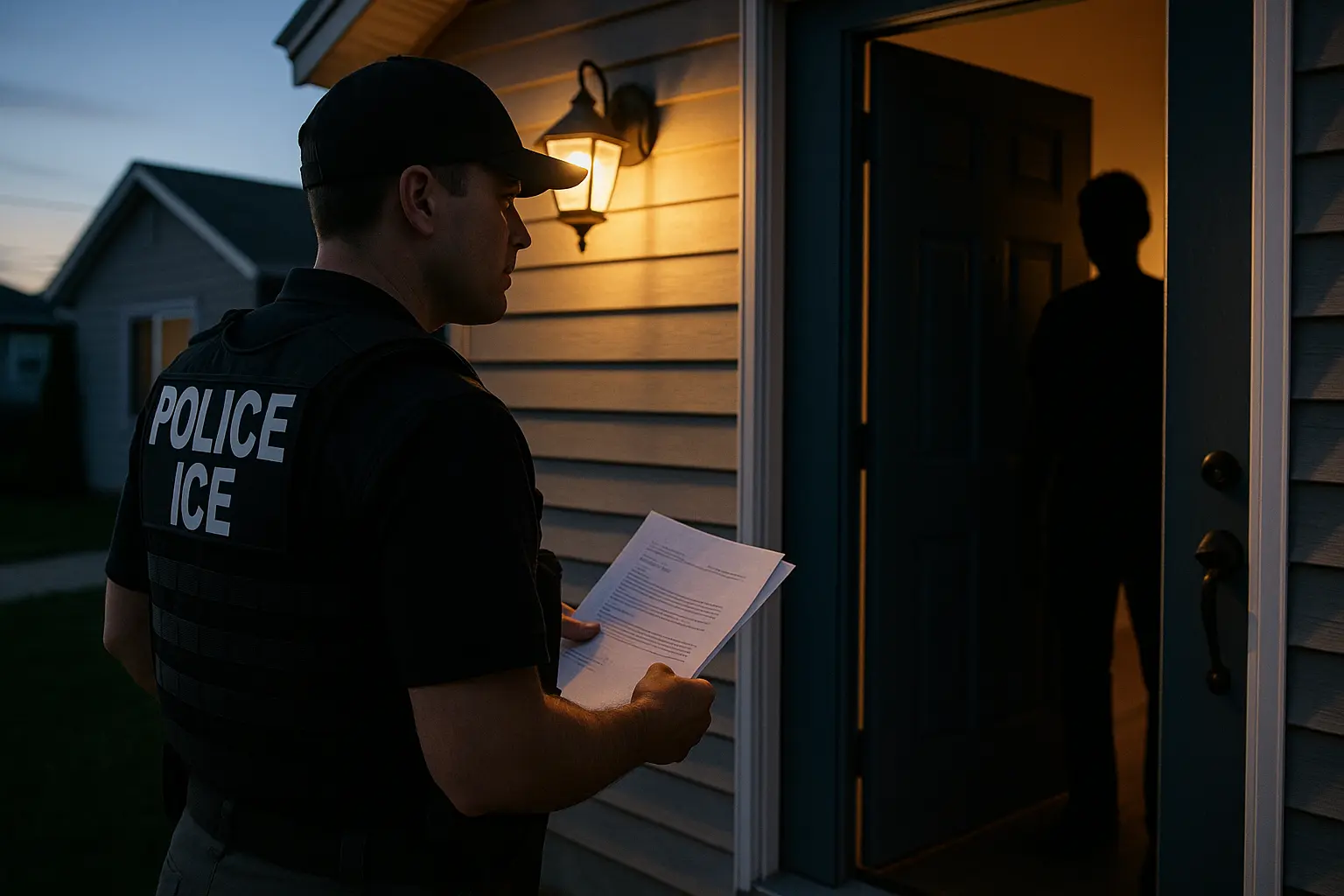
Front-line ICE officers now have marching orders: arrive at a residence, knock, and announce themselves. If the door doesn’t open – and why would it, with “ICE” badges on display? – the agents are permitted to force entry, relying on paperwork signed only by ICE, not a judge. Multiple outlets have confirmed this top-to-bottom reversal of agency policy: The Washington Post reported that the memo tells officers to act on Form I-205 administrative warrants alone, letting judges – and constitutional checks – fall by the wayside.
“They’re treating your home like it’s a mere extension of the border,” a retired ICE supervisor told RedPledgeInfo. “Next, they’ll be writing their ‘warrants’ on napkins and calling it due process.”
This is no academic matter. Since last summer, with President Trump’s full-throated backing for mass deportation sweeps, ICE has ramped up deployments of thousands of new officers. Field reports from across the country, including accounts covered by ABC News, confirm that these agents aren’t taking “no” for an answer. If a suspect’s family or landlord hesitates, officers are now legally sanctioned to break down doors. This has already led to flagged cases – including a Liberian family in Texas whose home was forcibly entered mere minutes after officers’ arrival, observed by nearby reporters, the very picture of the new directive in brutal action.
Constitutional Chaos: Who Polices the Policemen?
The core question tearing through legal circles and even civil libertarian corners of the Republican base is chilling: If ICE can set aside the common-sense barrier of judicial oversight, where does it stop? Are Americans ready to see federal power at their neighbors’ doorsteps – or maybe their own – backed only by unchecked executive muscle and bureaucratic “warrants”?
Not surprisingly, the Homeland Security bureaucracy is desperate to justify the move. PBS News documents DHS spokeswoman Tricia McLaughlin’s claim that these “targets” have already had ‘full due process’ and received “final orders of removal.” Yet critics point out this bureaucratic doublespeak sidesteps the rights of those inside homes – including family members, minor children, and even tenants – whose own Constitutional protections are trampled in the process. Traditional ICE guidance warned officers not to cross the threshold without a signature from a neutral judge. Now, the doorstop is off, and only time will tell who ends up in the agency’s crosshairs.
“This is what happens when government power faces no real check. Today it’s ICE; tomorrow, who knows?” – Conservative legal analyst on RedPledgeInfo LIVE panel
The policy is not just a legal curiosity – it is the frontline of Trump’s sweeping anti-illegal immigration crackdown. Acting ICE Director Todd Lyons, as quoted by The Guardian, reportedly bragged he wants deportations to run like “Amazon Prime, but with human beings.” Is this just government efficiency, or a dystopian vision of unchecked, door-kicking power?
What Happens Next: Lawsuits, Election Pressure, and a Nation on Edge
This constitutional grenade is already primed to explode in both the courts and on the campaign trail. Immigrant-rights groups, predictable as ever, are raising millions to fund lawsuits aiming to block or reverse the new policy. But even among immigration hawks, a nagging concern is taking hold: What happens the first time an American citizen’s home is cracked open – or a botched entry leads to tragedy? Will local law enforcement stand by, or step in? And will the president’s massive crackdown withstand a coming legal offensive from blue-state governors and big-city mayors?
No wonder National Security Counselors and MSW Media are ramping up their FOIA efforts. The American people deserve to see the actual legal memos, not just White House talking points. Whistleblower reports have already made clear: DHS’s legal team declared Fourth Amendment protections irrelevant when ICE comes calling. Now, sunlight is the only defense against government secrecy.
“They always say, ‘if you have nothing to hide, you have nothing to fear.’ That’s not the founding American spirit – that’s the excuse of an unaccountable bureaucracy.” – RedPledgeInfo Editorial Board
As 2026 midterm campaigns heat up, both sides are poised to weaponize the controversy. Will voters rally to the law-and-order president claiming results, or will anxieties about government overreach drive new coalitions at the ballot box? Either way, this battle – at the crossroads of privacy, executive power and border security – is just getting started. At stake isn’t just immigration policy, but the very boundary between the citizen and the state.