
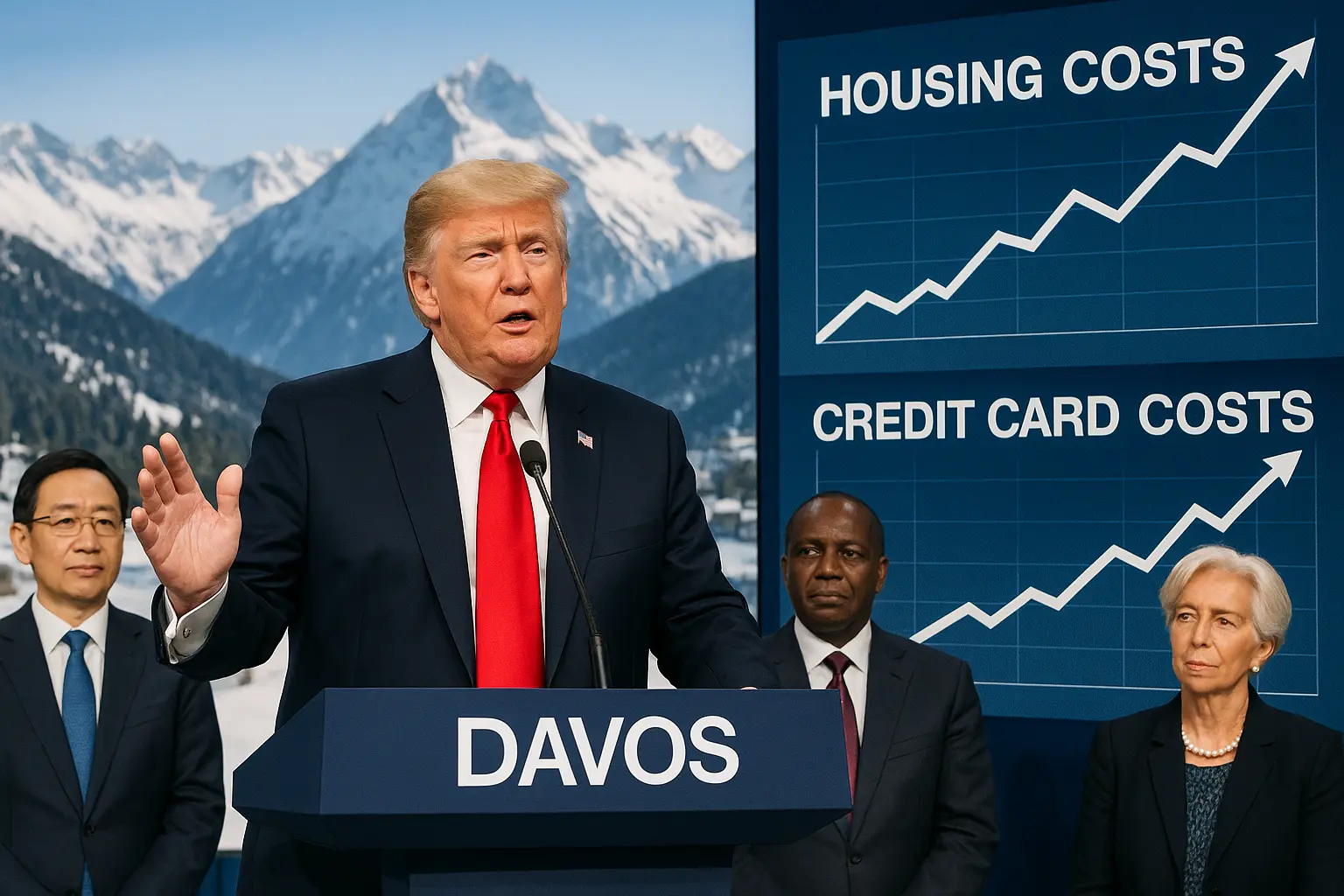
Trump Storms Elite Davos Gathering With Bold Pitch To Slash Housing, Credit Card Costs
‘They call themselves the smart, global elite, but it’s time America got a better deal.’ With these pointed words, President Donald Trump launched his long-anticipated address at the World Economic Forum in Davos, Switzerland on Wednesday. But while moguls and billionaires sipped champagne amidst alpine backdrops — and anyone could drop $4.4 million on a ski chalet without flinching — Trump made waves by promising Main Street relief for ordinary Americans struggling with runaway bills and home prices. His message: MAGA means affordable living, not just Wall Street windfalls.
Davos Drama: Trump Promises Relief Amid Lavish Backdrop
It’s not every day a U.S. president pitches a housing affordability agenda in the same Swiss resort town where oligarchs drown in caviar and the average vacation home fetches $4.4 million. But politics is show business for tough guys, and Trump played both roles-swaggering into Davos just as American anxieties about home ownership, crushing debt, and inflation hit fever pitch ahead of midterm elections.
Trump’s team teased major proposals to cool housing costs: expanding 401(k) access for down payments, expanding federal mortgage support, and even supporting a ban on mega-investors scooping up homes. He was quick to frame his ideas as a populist battering ram against entrenched interests and coastal elites. “America is for families – it is not for speculators and global hedge funds snatching up homes while you pay record rent,” thundered the president.
But instantly, backlash exploded across social and legacy media. Critics pounced on the irony: how can Trump champion affordable living while delivering such a message surrounded by billionaires and jet-set Davos insiders? “At the end of the day, it’s the investors and billionaires at Davos who have his attention,” said activist Alex Jacquez, while some left-leaning pundits mocked the speech as being as out-of-touch as the slopes outside. Trump, ever the counterpuncher, shrugged it off. “Let’s put it this way: It’s going to be a very interesting Davos,” Trump quipped, never passing up a chance for headlines.
During the speech, Trump reminded the hall, “Americans don’t want another handout for bankers – they want a home to hand down to their kids.” The crowd, heavy with investors who made billions in the past decade, was noticeably tense.
Yet, while the contrast between message and venue couldn’t be starker, Trump’s agenda comes at a dire moment. Mortgage rates remain stubbornly high, most families can’t afford to buy, and recent polls show six in ten Americans believe Trump has made the cost of living worse, even as some Republicans beg for more action on spiraling prices. The White House sees the Davos gambit as a chance to rewrite that narrative-and paint Trump as a straight shooter on economic pain.
Housing, Debt, and Populism: Can Trump’s Proposals Deliver?
Beyond spectacle, Trump’s policies may prove consequential for millions of Americans. He’s vowing to let first-time buyers tap their 401(k) accounts for down payments, pushing a new federal program for lower mortgage insurance premiums, and even floating a controversial ban on large investors buying up single-family homes. The populist tone was clear: crack down on Wall Street landlords, boost the middle class, and tame the credit card companies-by force, if needed.
One signature idea: capping credit card interest rates at 10%. According to the Associated Press, the administration claims this could save Americans as much as $100 billion per year in interest payments-a figure many industry leaders dispute, and which immediately triggered fierce pushback from the banking sector. While the White House trumpeted the benefit to everyday Americans, banks demanded to know what real consequences would follow for violators. The administration, so far, is light on specifics.
Meanwhile, Wall Street’s shadow looms over the American Dream: 3% of all single-family rentals are now owned by big investors who’ve driven up prices far beyond what average Americans can pay, sparking cross-partisan concern. Trump’s plan to choke off this corporate buying binge caught some Democrats by surprise-though passing such a ban will take congressional action no Republican can guarantee in the divisive Senate.
Still, even as Trump dangles new access to 401(k)s for first home purchases, critics warn that the proposal sounds better than it is. Currently, the law already allows limited 401(k) withdrawals for homebuyers-but with hefty penalty fees for younger savers, and plenty of middle-class Americans simply don’t have big retirement balances to begin with. As Forbes points out, even as Trump blasts corporate hoarding, the wealthiest 0.1% of Americans have doubled their fortunes since he first took office-while ordinary earners still fight over high rents and shrinking paychecks.
“The credit card proposal sounds like big savings. But no president has ever muscled a 10% interest rate cap through Congress,” one analyst told RedPledgeInfo. “It’s a big promise at a tricky time.”
Trump’s red-hot populist rhetoric-“Your paycheck shouldn’t be sentenced to die by a thousand credit card cuts”-may fire up his base. But the legislative path is steep, and the financial lobby is gearing up to fight tooth and nail.
Beneath the Surface: Wealth Gaps, Political Backlash, and Election-Year Stakes
The stakes behind Trump’s Davos declaration couldn’t be clearer. Beneath the policy details lies deep voter anxiety, festering discontent, and a growing sense of economic unfairness. Even with job markets booming in headline numbers, the biggest winners have been Wall Street and Silicon Valley. According to multiple reports, the richest 0.1% of households saw their wealth climb by an eye-watering $11.98 trillion since Trump’s first inauguration-a sum that dwarfs the total gains of the bottom 50% of Americans in that same period.
Trump’s challenge? Convincing Americans he’s on their side when so many of his closest backers are those billionaires now lounging in Davos. For his critics, the venue says it all: hobnobbing with the jet set while families at home scrape to cover rent and groceries. But the president’s camp sees it differently-claiming only someone who can work the room with the one percenters can bend global capital to benefit working families at home. As the White House put it, positioning Trump as the lion in the billionaires’ den takes both guts and guile in an election year.
On social media, the pitch is landing with mixed gusto. Populist voices hail Trump’s brag that he’ll “give credit card companies a taste of their own medicine.” But for every MAGA-touting supporter, there’s a frustrated swing voter sharing memes of Davos’ gourmet brunches with sarcastic captions like, “This is what affordability looks like?” Even some Republicans expressed concern, telling reporters that it’s time for the administration to back up rhetoric with real results-before Democrats hammer the GOP on cost-of-living in November.
One X (formerly Twitter) post racked up 80,000 likes: “Trump’s tough talk is a start, but rent, credit bills and grocery prices won’t pay themselves.”
Still, Trump’s inner circle believes 2026 is the ultimate test: can Republicans hold Congress if many voters feel their wallets shrinking? That’s why the president is betting big on a brash housing and affordability package, rolled out with worldwide cameras watching, even if it means braving jokes about $4 million chalets to do it.
As Trump closed out his Davos address, he issued a warning both to world elites and to Washington insiders: “The era of cheap talk is over. America must be affordable again.” Whether Americans believe that will depend on how boldly promises become reality as the 2026 campaign rolls on.
