
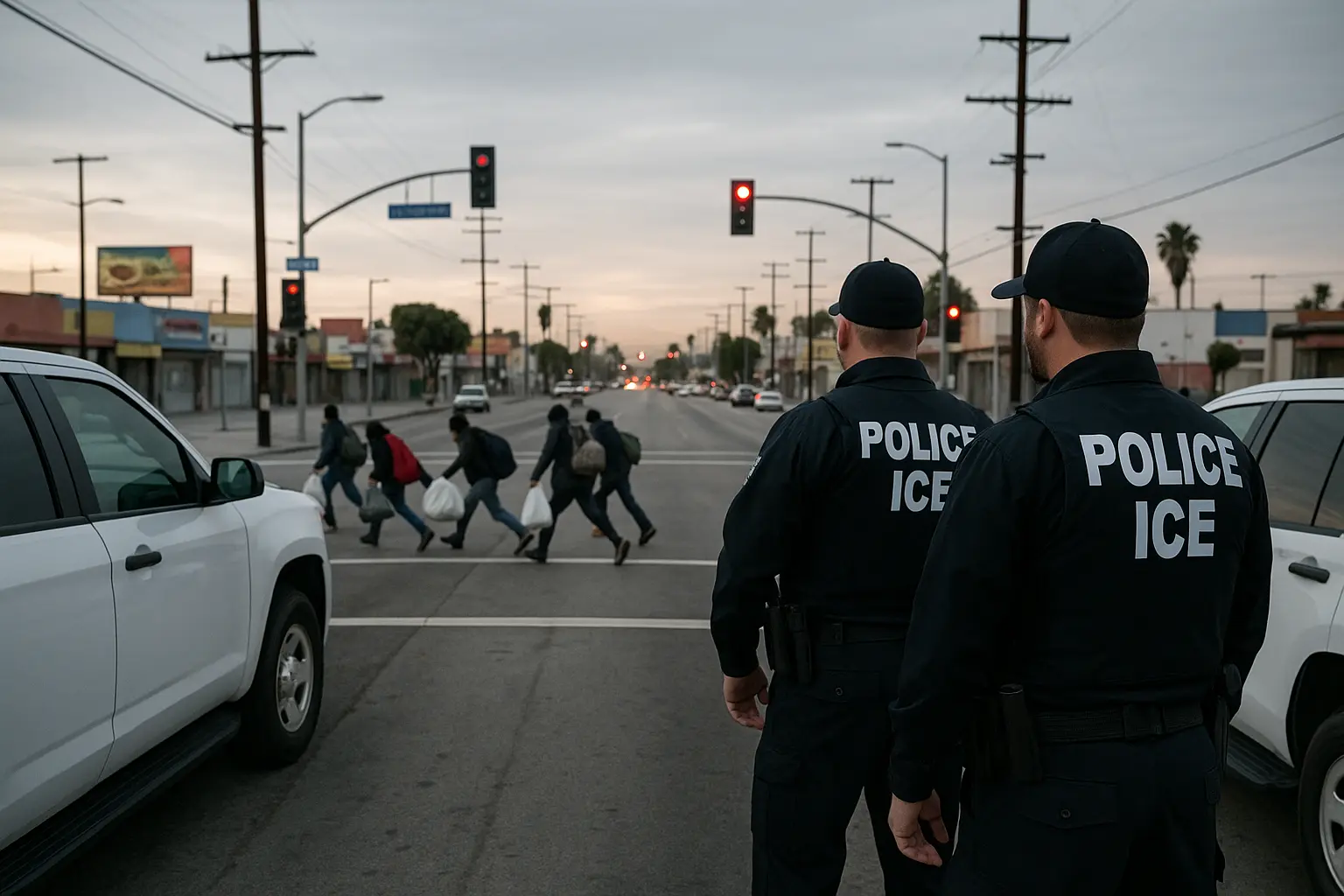
Supreme Court Greenlights Trump’s Full-Force ICE Raids in L.A. – Is Any City Safe?
‘Justice is finally catching up to California’s sanctuary chaos,’ a local business owner declared, as news spread that the Supreme Court gave President Trump the go-ahead to restore law and order to L.A.’s streets.
The U.S. Supreme Court delivered a thunderous win for conservatives and law-abiding Americans nationwide on Monday, lifting a controversial federal restraining order and restoring federal immigration enforcement powers in Southern California. By a 6-3 vote along familiar ideological lines, justices swept aside a Biden-appointed judge’s limits, freeing ICE agents to lawfully stop, question, and detain suspected illegals with no more roadblocks from activist courts or local politicians.
The ruling, issued on the so-called “shadow docket” without a full hearing, comes as L.A. reels from a recent wave of street crime and community frustration with lenient sanctuary policies. Administratively, President Trump’s team had worked feverishly to overturn the previous block, calling out what they described as a “straitjacket” on enforcement that left millions of Southern Californians vulnerable (Associated Press).
So, what exactly does this breaking Supreme Court action mean for Los Angeles-and could this landmark decision change how cities handle illegal immigration across the country?
Trump’s Big Win: ICE Free to Restore Order-No More Tied Hands
For months, Immigration and Customs Enforcement (ICE) in the nation’s second-largest city had been hamstrung by a July order from U.S. District Judge Maame E. Frimpong-an appointee of President Biden-who found their actions unconstitutional and dramatically crimped when and how they could stop anyone suspected of being in the country illegally (Associated Press). Judge Frimpong’s ruling had barred stops simply for ‘speaking Spanish’ or working ‘certain professions,’ a move that critics say amounted to a get-out-of-jail-free card for illegals and handcuffs for federal agents.
But as of September 8, those restrictions vanished with the swipe of the Supreme Court’s pen. The ruling authorizes ICE, under President Trump’s staunch direction, to conduct so-called ‘roving patrols’ and street checks-using a ‘totality of circumstances’ standard for reasonable suspicion, as the law has long recognized. Justice Brett Kavanaugh, writing a key opinion, argued the old order excessively limited ICE’s authority, though he emphasized that ethnicity alone cannot justify stops. “This is about restoring proper enforcement under long-established rules-not targeting based on race,” he clarified (Associated Press).
‘For too long, our agents have watched criminals and unlawful migrants slip through their fingers while activist judges in D.C. and L.A. made it nearly impossible to enforce the law. That ended today,’ said a senior ICE official speaking on condition of anonymity.
President Trump doubled down on his tough-on-crime message in a fiery social media post Monday night, blasting “open borders Democrats” for prioritizing politics over public safety and vowing, ‘We are putting American citizens first-no matter how much the far-left howls.’ Across conservative circles, praise poured in for the Supreme Court’s no-nonsense rebuke of judicial overreach. Many see this as a model for other sanctuary cities, raising hopes for similar battles in Chicago, New York, and San Francisco.
The Left’s Meltdown: Outrage from Activists, Biden Allies, and ACLU
Predictably, progressive activists and Democratic politicians are up in arms. The fierce dissent from Justice Sonia Sotomayor-who warned the ruling essentially greenlights racial profiling and would ‘subject many to dehumanizing treatment’-quickly set liberal Twitter ablaze. Immigrant rights groups and their allies accused the high court of callously inviting abuses. In particular, Sotomayor lamented, ‘We should not have to live in a country where the Government can seize anyone who looks Latino, speaks Spanish, and appears to work a low wage job’ (Reuters).
The American Civil Liberties Union (ACLU) and United Farm Workers, who spearheaded the legal challenge, claim the decision will unleash chaos on law-abiding residents and fuel mistrust in law enforcement. Social media lit up overnight, with #NotOurCourt and #ProtectLA trending as activists accused the justices of ‘rubber-stamping Trump’s agenda.’ The coalition pointed to stories like that of Brian Gavidia-a U.S. citizen who was detained by mistake-as examples of what they fear will become common in the wake of this ruling (Associated Press).
‘Today the Supreme Court gave Trump an unlimited license to terrorize our communities,’ tweeted an attorney for the coalition, as protest calls rang out from L.A. City Hall to Capitol Hill.
Biden administration officials, meanwhile, have stayed largely silent, but California’s Governor issued a statement condemning the ruling as “an attack on basic civil rights.” Many legal scholars, however, counter that these arguments intentionally blur the difference between constitutional policing and political grandstanding. Justice Kavanaugh noted that overruling the lower court orders would require significant legal changes, underscoring both the complexity-and the stakes-of this fight (Reuters).
America’s Immigration Tipping Point: What Comes Next for California-and the Nation?
Monday’s ruling goes far beyond L.A., impacting the entire region covered by the Central District of California-a sprawling area of over 20 million people, from the city itself to Riverside, San Bernardino, and San Luis Obispo. It has sent an unmistakable signal to other cities: the federal government’s constitutional duty to enforce immigration law trumps local political preferences and activist overreach. With President Trump doubling down on these priorities ahead of the 2026 midterms, the future of sanctuary policies nationwide may soon be decided in the courts-and at the ballot box.
Law enforcement professionals say the decision gives them a fighting chance to keep criminal aliens off the streets, noting that when cities create safe havens for illegal immigrants, crime surges and chaos grows. Even some local officials, frustrated by skyrocketing crime rates and mounting public anger, have quietly welcomed the return of federal support. Conservative lawmakers argue that for every Brian Gavidia story, there are countless victims of preventable crimes by repeat offenders here illegally.
‘This is the Supreme Court sending the message: If you want to break federal law, you don’t get to hide behind the bench or city hall. Period,’ said Rep. Mike Garcia (R-CA), who called for Congress to enshrine even tougher restrictions on sanctuary cities in light of the decision.
In the coming weeks, expect aggressive street sweeps to resume throughout Southern California-and watch as progressive activists fight back in the streets and courts. But for the millions of Americans who have demanded that the nation’s laws be enforced and order restored, this ruling marks a crucial victory. After years of gridlock, President Trump’s vision of secure borders and safe neighborhoods is back-front and center, with the Supreme Court’s full backing.
Bottom line: The Supreme Court’s decision is a pivotal conservative triumph, empowering ICE to get back to work in America’s largest immigrant sanctuary and offering a blueprint for law and order nationwide. As the 2026 midterm elections loom, the political battle over immigration will only intensify. But for now, at least one thing is clear: L.A. is once again on the front lines, and history is being written in real time.