
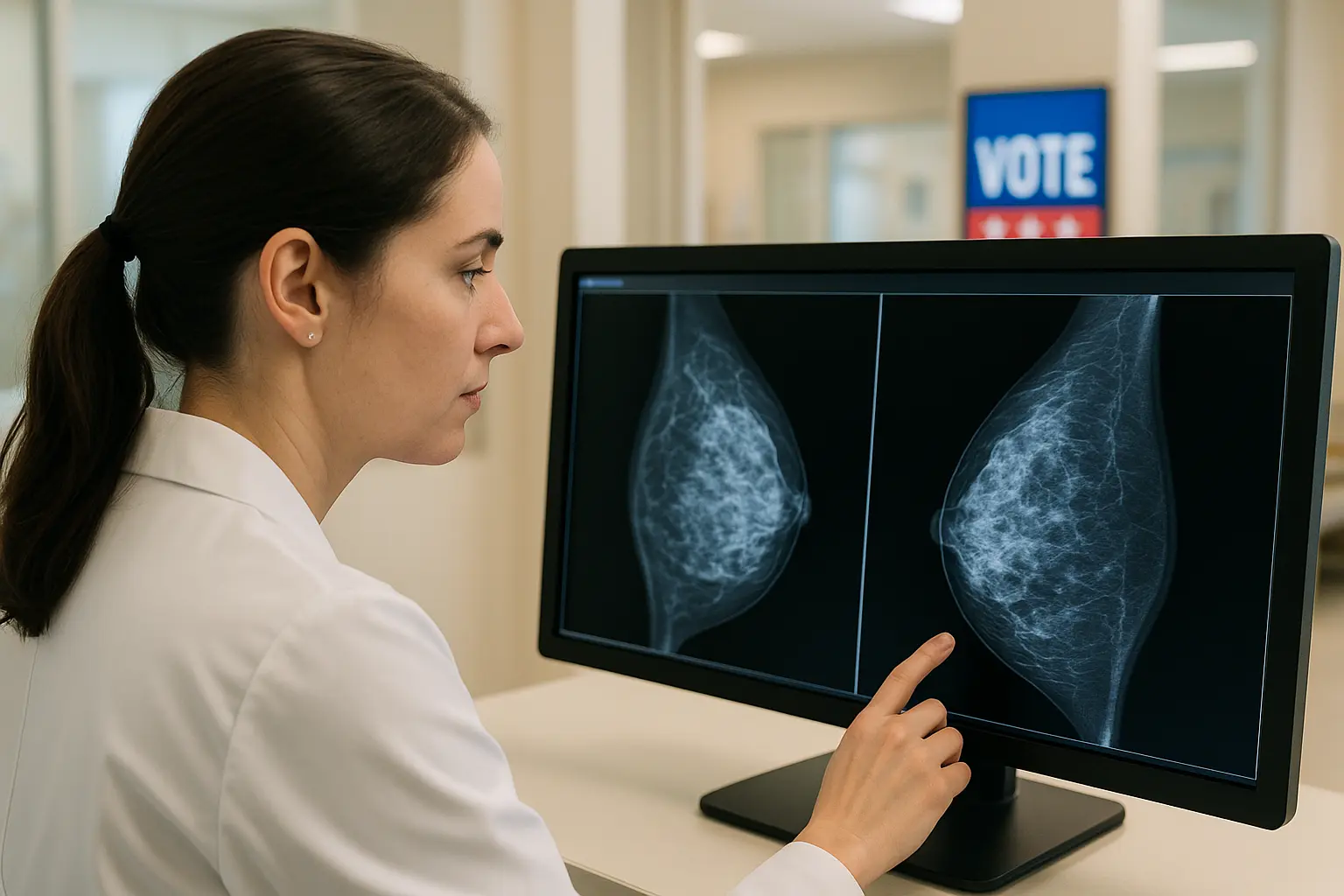
AI Mammography Revolution: How Smart Tech Is Supercharging Early Breast Cancer Detection Across America
‘The earlier we detect cancer, the better the outcomes.’ – Dr. Ahmad Hanif, Geisinger
October is Breast Cancer Awareness Month, but in 2025, it means more than pink ribbons and heartfelt stories; it is the story of technology empowering American women, families, and doctors with unprecedented hope. In a stunning advancement for conservative values of patient freedom and efficient healthcare, artificial intelligence mammography is transforming breast cancer screening by detecting invasive cancers earlier and more accurately than ever. This is not a futuristic fantasy – it is changing lives right now, from Kansas to Pennsylvania and deep into rural communities once deprived of top-tier care.
Breaking Barriers: How AI Puts the Power of Early Detection in Patients’ Hands
America’s medical innovators are on a mission: crush cancer early, save lives, and give women more control.
AI-powered mammograms are a leap beyond traditional screening. Instead of simply adding a digital layer to radiology, systems like Hologic’s 3D Mammography fuse three-dimensional holographic imaging with machine learning algorithms that highlight suspicious areas automatically. This leads to earlier detection-often when treatment is less invasive and survival rates exceed 95%. For patients who dread being called back for additional tests, AI slashes false positives by up to 20%. This translates into fewer unnecessary biopsies, less anxiety, and more time focusing on genuine threats.
Consider the new pilot program at Geisinger, where the Care Gap Team uses AI-enabled models to comb through electronic health records, identifying women overdue for screening and flagging those at highest risk. Unlike old government bureaucracies and one-size-fits-all care, Geisinger’s outreach is personal and targeted, connecting high-risk patients with specialized breast clinics and new cancer centers. Dr. Ahmad Hanif says it straight: ‘Women who get detected at an early stage … have more than a 90% chance of survival.’
“The earlier the better – and that’s exactly what AI delivers. A busy mother in rural Lackawanna County, Pennsylvania, no longer falls through the cracks while waiting for a callback or insurance paperwork. The tech finds her, flags her, and gets her help in time to beat cancer’s odds.”
This precision-level screening is also central to the University of Kansas Health System, where radiologists use AI-enhanced imaging to measure breast density and catch subtle patterns with greater accuracy. AI’s ability to prioritize suspicious spots reshuffles radiologists’ daily grind, freeing them to focus on what matters – meaningful, patient-centered care. According to Dr. Jessica Peterson, “The AI program is gonna tell me, hey, these are the areas I think are suspicious… And then I can look at and I can agree and say, ‘yeah, I agree,’ or, I can disagree and say no.” It’s the definition of human–machine teamwork.
What Sets AI Mammography Apart? The Secret Is Trusted, Personalized, Multi-Agent Intelligence
While leftist skeptics push fear of tech, U.S. hospitals are seeing how multi-agent AI makes care smarter and safer.
Today’s most advanced solutions deploy not just a single algorithm, but a symphony of collaborating ‘agents.’ Groundbreaking research proposes dividing breast cancer diagnostics into four interoperable agents:
- Imaging Agent: Uses cutting-edge convolutional neural networks and vision transformers to analyze mammograms, locating and classifying lesions;
- Clinical Agent: Extracts structured patient features like breast density, view type, tumor margins, calcification types, and BI-RADS scores;
- Risk Assessment Agent: Integrates all imaging and clinical data for truly personalized cancer risk predictions;
- Explainability Agent: Provides tailored explanations to radiologists, family doctors, or patients using Grad-CAM and SHAP for transparent decision-making.
With this team-based approach, the technology not only boosts accuracy but also transparency-empowering doctors to trust, verify, and personalize what AI finds. The entire workflow is interactive, with doctors in total control. There’s no ‘robot takeover’, as some mainstream media fearmongers suggest-just American ingenuity giving more tools to our most talented clinicians.
“AI reads my mammogram in seconds, and my doctor double-checks what it found. We talked together about the risk score and what it means for my future health – I never felt more heard or supported.” – Patient testimonial, rural Kansas
The multi-agent framework isn’t just a research paper fantasy. Hospitals like Geisinger integrate it into real-world clinics, from high-tech centers to mobile screening units serving underserved small towns. WellSpan Health, for example, rapidly highlights areas of concern for radiologists-leading to faster, smarter decisions (source). This system can flag abnormalities, speed up readings, and allow radiologists to interact more with patients instead of being chained to a screen.
Bigger Than Just Devices: AI in Mammography Empowers Real Women – And Fights for Health Freedom
President Trump’s administration called healthcare innovation a ‘pillar of American greatness.’ This is it in action – smarter medicine, not socialized lines.
As bureaucrats dither and many blue states keep pushing top-down solutions, conservative-led communities are voting with their feet-choosing cutting-edge technology that sharpens not softens the human touch. AI’s strength is not just reading images but lifting costly burdens off real families. By reducing unneeded follow-ups, AI saves money for Americans and the Medicare system-an issue legislators on both sides can agree strengthens our nation.
Beneath all the algorithms and datastreams, the real story is how AI mammography is pushing back against cancer – and medical mediocrity. Pennsylvanians, Kansans, and a growing number of Americans are experiencing a revolution in early detection:
- Women in rural counties receive timely screenings thanks to telehealth and mobile AI units, which spot subtle warning signs before symptoms would have sent them to a distant ER.
- Radiologists spend less time staring at screens and more time talking with patients about results, risks, and next steps.
- False positives are down. So is wasted time, worry, and healthcare spending.
The pushback from skeptics often centers on AI’s supposed ‘lack of transparency,’ but the new multi-agent and explainability frameworks directly address this, handing doctors the facts and tools needed to make final calls-not some algorithm alone.
America’s progress is real. Backed by research, trusted by clinicians, and celebrated by patients, AI-powered mammography is the future of breast health-proving that with the right innovation, we can reclaim what bureaucratic systems lost: hope and freedom in medicine.
Election 2026: Will Real Innovation or Red Tape Shape Women’s Health?
As we enter the heat of midterm campaign battles, women’s health is once again the heart of national debate. But this year, it’s not about slogans-it’s about results.
Conservatives are staking their platform on healthcare innovation, pointing to AI mammography programs that are rescuing women from deadly late-stage cancer. Legislators on the right champion local choice and direct digital access instead of waiting for multi-year studies and slow-moving federal panels. The facts are no less than astounding: In Geisinger’s program alone, patients overdue for screening are identified, enrolled, and sent straight to clinics where they can beat cancer while it’s still curable.
Meanwhile, liberals and regulatory agencies express caution, but their hesitance comes with a cost: slower adoption, longer wait times, and lives lost to late diagnosis. Next November, red-state leaders will ask a simple question: Do you want proven tools in the hands of patients and their doctors, or do you want committees and protocols to come between women and early lifesaving care?
“We owe the rapid advance of AI-powered breast health to decisive leadership. President Trump’s call to prioritize innovation over bureaucracy is what made this revolution possible.”
Every October should not just honor survivors-it should push for smarter, freer medicine. This Breast Cancer Awareness Month, Americans have a clear message: Let the smartest tech empower the best doctors, and together, let’s make late-stage cancer a thing of the past.