
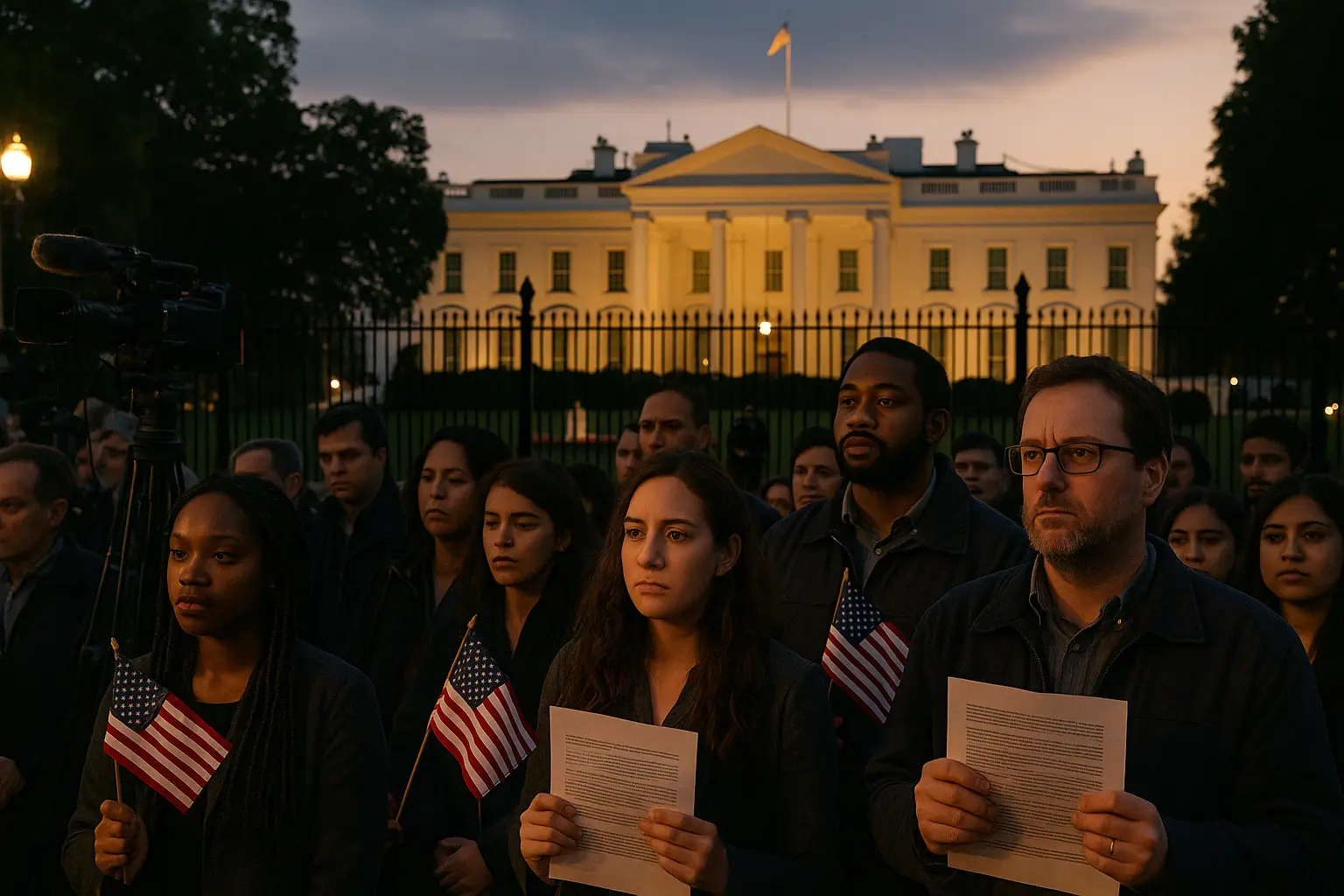
Trump Puts Brakes on Diversity Visa After Brown University Shooting Shocks America
‘He should never have been here’: President Takes Swift Action After Immigrant Gunman Shatters Campus Peace
‘Americans deserve safety, not senseless violence at the hands of strangers,’ declared Homeland Security Secretary Kristi Noem, standing beside President Donald Trump as he signed the order halting America’s controversial green card lottery just 24 hours after one of the bloodiest attacks on a college campus in recent memory. The move comes after the government revealed that the suspected shooter behind the Brown University massacre, who also killed a renowned MIT professor, was an immigrant from Portugal who entered via the Diversity Immigrant Visa Program (DV1).
For years, conservative voices have condemned the green card lottery as a dangerous loophole inviting in migrants without adequate vetting. Now, with blood staining the storied halls of Brown and MIT, President Trump has drawn a bold line, fulfilling a campaign trail promise that was reignited by tragedy. Secretary Noem minced no words: ‘A heinous individual should never have been allowed in our country.’ The administration’s decisive action signals a return to prioritizing American safety over politically correct immigration schemes championed by the left.
‘How many more Americans have to die before Washington realizes how broken this system is?’ thundered social media commentator @NashvilleRedWave, echoing the fury of millions of families across the country.
As details emerge, critics of open-border policies are demanding accountability from pro-immigration Democrats who insisted such risks were ‘statistically insignificant.’ But the nation is now grappling with the catastrophic results of a visa lottery that many say was doomed from its inception-a Democrat legacy program dating back decades and now directly tied to the deaths of promising students and educators.
Bodies, Broken Dreams, and Border Breaches: What Really Happened
The chilling timeline begins on a quiet Sunday at Brown University in Providence. At dawn, gunfire ripped through the campus, taking the lives of Ella Cook-vice president of Brown’s Republican Party association-and 18-year-old freshman Mukhammad Aziz Umurzokov. Nine more were left wounded, their futures hanging in the balance. Just two days later, MIT was shaken to its core as acclaimed physics professor Nuno Loureiro was shot and killed in his Cambridge office. The nation awoke to headlines asking how a single man could unleash so much horror-and why he was here in the first place.
The culprit, Claudio Manuel Neves-Valente, a 48-year-old Portuguese national and former Brown Ph.D. student, entered America through the very diversity visa program now under fire. According to Associated Press reporting, he was granted entry in 2017 along with a green card-a triumph for immigration advocates, a tragedy for his victims’ families.
Valente was linked to both campuses, having briefly studied at Brown in 2000–01 and previously worked alongside Professor Loureiro in Portugal. But, as authorities pieced together his twisted path-from a Miami address to Boston, then north to a New Hampshire storage facility where he was found dead of a self-inflicted gunshot wound-the central question became inescapable: How could such a ‘randomly selected’ foreigner slip through the very safeguards designed to keep Americans safe?
‘If he hadn’t come here through that lottery, my daughter would still be alive,’ said Dr. Sam Cook, father of Ella Cook, during an emotional interview. ‘What’s it going to take for D.C. to put Americans first?’
The tragedy exposed glaring holes in the lottery vetting process, which critics say awards up to 55,000 green cards every year to self-selected applicants from countries with ‘historically low’ U.S. immigration rates. The suspect, though one of just 38 Portuguese winners in 2025, represents a system that gives opportunity to millions-without adequate oversight-and now, heartbreak to the nation.
Cracks in the Immigration Lottery: The Political and Legal Firestorm to Come
With the suspect dead and the families grieving, the fallout in Washington is only beginning. As mourners laid Ella Cook and Mukhammad Aziz Umurzokov to rest, President Trump took the bold step of freezing the green card lottery, a process the left had long held sacred. Critics swiftly took to social media, denouncing the ‘immigration free-for-all’ that allowed Neves-Valente to put so many innocent lives in jeopardy.
Trump’s executive action came just hours after police confirmed Neves-Valente’s death and closed the multi-state manhunt. The danger, as America now sees, is real-and the administration’s response is poised to set a new paradigm for handling legal immigration in the wake of violent acts by foreign-born suspects.
The legal and political challenges began instantly. Immigration advocates are threatening lawsuits and accusing the Trump team of leveraging tragedy for partisan gain. But supporters point out that this is not the first time the lottery has paved the way for bloodshed on American soil. Patriots recall the deadly 2017 attack in New York’s bike path, another case that triggered Trump’s fury at the time and earned political capital among those demanding secure borders and strong vetting.
Bestselling author and commentator Mark Meadows wrote on X: ‘This is why Trump was reelected in 2024. He’s not afraid to do what the weak and woke won’t-protect Americans. The radical left will fight him every step of the way, but justice is finally being served.’
Next comes the battle in the courts, as Democrat attorneys general prepare to challenge the suspension of the Diversity Visa Program, already labeled by Trump allies as ‘a dangerous relic of failed multicultural utopianism.’ As families grieve, Americans of every stripe are asking pointed questions about legislative priorities set in Washington, D.C., and whether the Biden era’s open-border policies made the perfect storm for this tragedy.
With the 2026 midterm elections looming, politicians on both sides are bracing for an incendiary debate. Republicans have made clear: this is about life and death, and the people will remember in November who protected their loved ones-and who gambled with national security.
The case is closed on the manhunt, but the battle to keep America safe has only just begun.