Stanford’s AI SleepFM Reads Your Sleep to Reveal Hidden Disease Risks Years Ahead
‘We’re looking at a goldmine,’ says Stanford’s Dr. Emmanuel Mignot. ‘Sleep data isn’t just about snoring anymore-it’s a window into your health years before disaster might strike.’
It’s not often Big Tech and Big Pharma are forced to sit up and pay attention, but a new shockwave from Stanford University is about to upend the entire medical establishment-and the implications for privacy, insurance, and your personal health data are enormous. Welcome to 2026, where a single night of sleep on hospital sensors can now forecast your risk for over 130 different diseases, including cancer, heart attack, stroke, Parkinson’s, and dementia-years before you feel a single symptom.
Your Sleep Is Watching You: How One Night Can Alter Your Fate
The Next Frontier in Health Surveillance-And Maybe Control
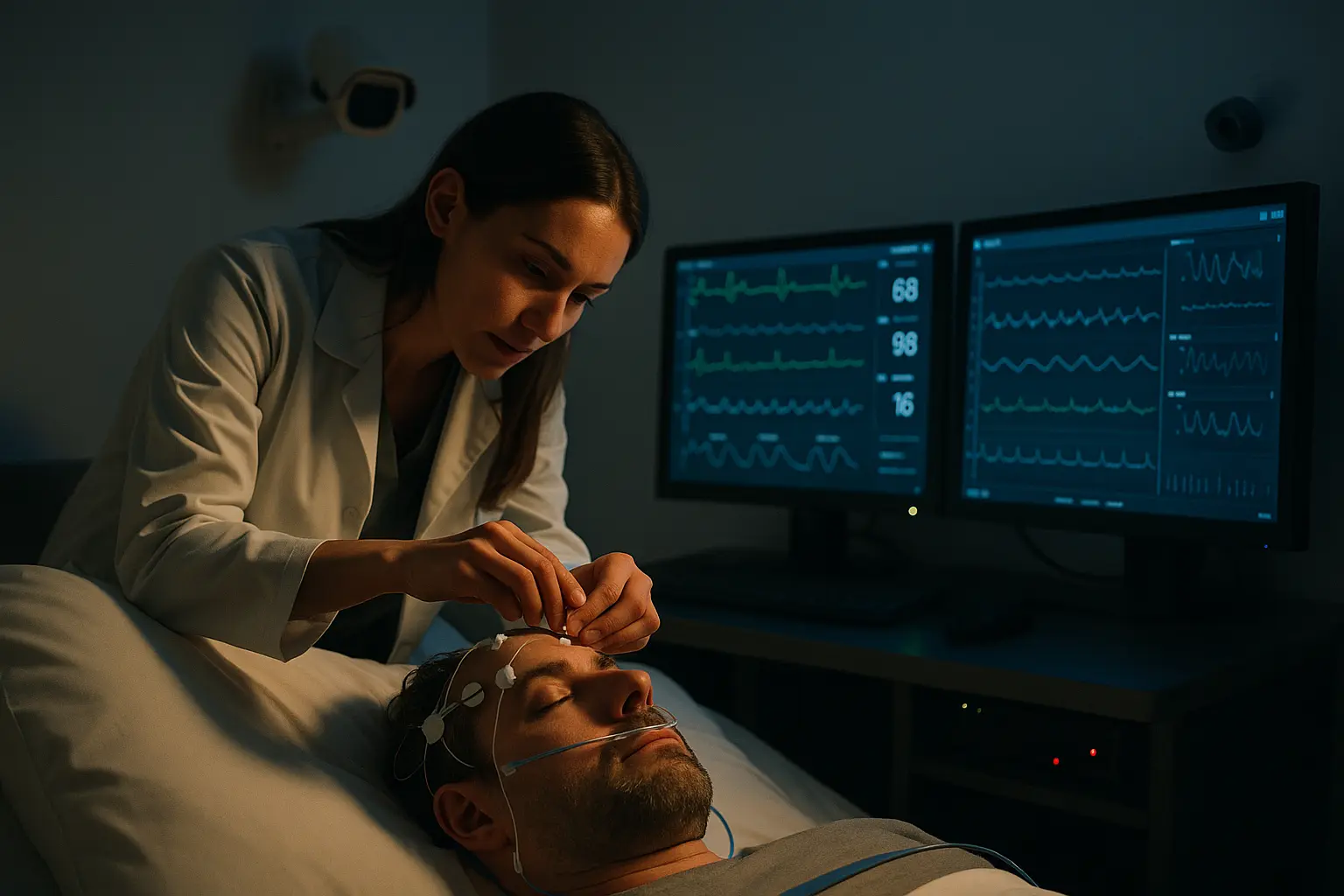
Get ready, because this breakthrough goes far beyond tired Tuesday mornings. Stanford’s new artificial intelligence model, ominously named SleepFM, just cracked open the vault. By analyzing one night of polysomnography data (think: all the sensors they strap to your body during a sleep study), the team claims they can predict your risk for 130 different health conditions. We’re talking about years before traditional doctors or blood tests could ever hope to spot a problem.
The science here is jaw-dropping. SleepFM was trained on nearly 600,000 hours of overnight recordings-yes, you read that right-from a whopping 65,000 people, ranging in age from toddlers to the nearly centenarian. That means the AI knows exactly what “normal” and “abnormal” look like in virtually every American demographic, making its insights chillingly accurate for everyone.
Almost like an all-seeing eye, SleepFM’s designers treated each sleep study recording like a sentence to be decoded, borrowing learning methods from-wait for it-language AI models like ChatGPT. Once ‘taught’ the right patterns, the system applies this knowledge to your basic signals: heart rate, brain waves, eye twitches, and even leg movement. Nothing escapes its notice!
But here’s where conservative readers should be on alert: this new ‘oracle’ for health isn’t just identifying the obvious big killers. Predictive signals surfaced for pregnancy complications, mental disorders, and rare cancers too, all by sifting through signals you give off in your deepest sleep. Want to know your odds of a future heart attack-or if you’ll need a kidney transplant a decade from now? Pay attention, because Big Tech and state health agencies absolutely are.
From Sleep Clinic to Surveillance State? The Alarming Power-and Risks-of Massive Sleep Data
AI’s Medical Crystal Ball: Helpful or Hounding?
The Stanford researchers didn’t stop at showing off their technical wizardry. Digging into decades of electronic health records, they proved their AI wasn’t just guessing. Its predictive power hit over 80% accuracy for deadly outcomes-Parkinson’s disease, dementia, stroke, even some cancers. On heart disease mortality, the ‘concordance index’ reached an eyebrow-raising 0.88 (out of a perfect 1.0), and for overall risk of dying, the model scored 0.84. For chronic kidney disease and atrial fibrillation? Still hovering near 0.8-staggeringly high.
We’re talking about a system that ranks your real-world risk-with startling precision. In short, this is far more than another pie-in-the-sky university demo. The system’s performance barely dipped when thrown at brand-new, never-before-seen datasets-raising questions about just how soon your insurance company or the government might want a look at your sleep log.
According to James Zou, one of the study’s authors, ‘We record an amazing number of signals when we study sleep.’ Yet, ‘sleep is relatively understudied from an AI perspective, considering its importance.’ Translation: There’s a massive database that could-if we’re not vigilant-be used to screen, sort, or even punish Americans based on metrics they can’t consciously control.
How does it work? The answer should make privacy hawks pause: Rather than just “reading” your heart rate or brain waves, SleepFM was trained by deliberately hiding certain signal streams and forcing itself to reconstruct missing data from the rest. This forces the algorithm to learn the deep connections between bodily systems-and to spot hidden danger long before any doctor could. Pure genius? Or pure intrusion? You decide.
Social Media Sound Off: Patients, Activists, and Doctors Clash on Sleep Data’s Double-Edged Sword
American Liberty or a New Medical Overlord?
The reaction across X (formerly Twitter) and social media has been explosive. Proponents in the digital health community are hailing it as ‘the dawn of preemptive medicine,’ with some experts declaring, “This will save millions in healthcare costs.” But privacy advocates-and plenty of ordinary Americans-are already warning: ‘Don’t let bureaucrats or insurers weaponize your sleep!’
One viral post summed up the populist mood: ‘If SleepFM can see my future, so can the government! Another excuse for high premiums and denied coverage coming soon.’ Others posted memes of AI doctors peering through bedroom windows, joking about ‘Bedtime Big Brother.’
Even doctors are divided. While some see the chance to intervene early, others warn the hype masks real dangers. As one conservative physician posted: ‘Who owns my sleep data, and who decides what’s risky? If this gets to the CDC or insurance companies, we’re in trouble.’
Let’s be blunt-conservatives know where this road can lead. If left unchecked, weaponizing sleep data could mean more fuel for “digital redlining” or forced screenings by your employer or local health board. Red-blooded Americans have every right to demand guardrails now-before this technology becomes another lever for Silicon Valley or Washington agencies to squeeze us all for compliance instead of real health improvement.
The Untold Story: Decades of Your Data-the Real SleepFM Backstory
Follow the Data Trails-and Ask Who Profits
This is not some overnight Silicon Valley whim. Stanford’s project pulled from old sleep studies, including a clinic founded back in 1970 by Dr. William Dement-a pioneer in sleep research. That means decades of American health info quietly digitized, paired with follow-up health records. No wonder SleepFM’s predictions blow away the competition: the AI stands on the shoulders of a vast, often-forgotten trove of deeply personal medical information.
So far, the researchers say SleepFM is just a powerful research tool-publicly, anyway. But don’t bet on it staying in the lab. The model was even put to the test on entirely untouched sleep data from national studies, again proving it could look past quirks in different populations-a troubling sign that anyone, from state health boards to insurance risk managers, could soon get their hands on this ‘oracle’ of risk.
Will employers or government agencies start requiring you to ‘prove’ your biometric health status before granting benefits or jobs? Will insurance companies sue to see your sleep logs? These are not paranoid questions-they’re the natural next step after a decade of so-called predictive analytics entering the mainstream.
Here’s what matters in an election year: Americans deserve transparency, choice, and above all, absolute control over sensitive health data that could affect family, freedom, and financial future. Conservatives especially know we can’t count on D.C. or Silicon Valley to watch our backs. With President Trump’s administration pushing for higher data security standards and reclaiming health privacy after the failures of the past regime, this is a moment for action-before the technology escapes all regulation.
- Stanford’s SleepFM AI analyzed nearly 600,000 hours of sleep data from 65,000 Americans, scanning for early-warning risk markers that no human could find.
- It proved accurate for dementia, Parkinson’s, heart attack, cancer, and more-often years before symptoms. For some conditions, its risk ranking beat 85% accuracy.
- The system learned to ‘read between the signals,’ connecting heart, brain, and breathing patterns while you sleep, and filling in missing pieces when some data was hidden.
- Social media and privacy warriors are raising the alarm: Who controls this information, and how will it be used against individual Americans?
- With the federal government’s new data privacy initiatives under Trump, expect fierce debates-and legislative moves-in the run-up to the 2026 midterms.
BOTTOM LINE: Conservatives must stand alert. This AI science may offer astonishing new ways to preempt disease, but it could easily be twisted into a health surveillance regime few Americans want or trust. Insist on transparency. Push for hard legal limits. And demand that your sleep remains just that-your sleep, not a tool for control. With technology racing ahead and Washington’s record on privacy still shaky after last decade’s scandals, red-blooded Americans need to wake up and take a stand-before Big Brother really does tuck you in at night.