
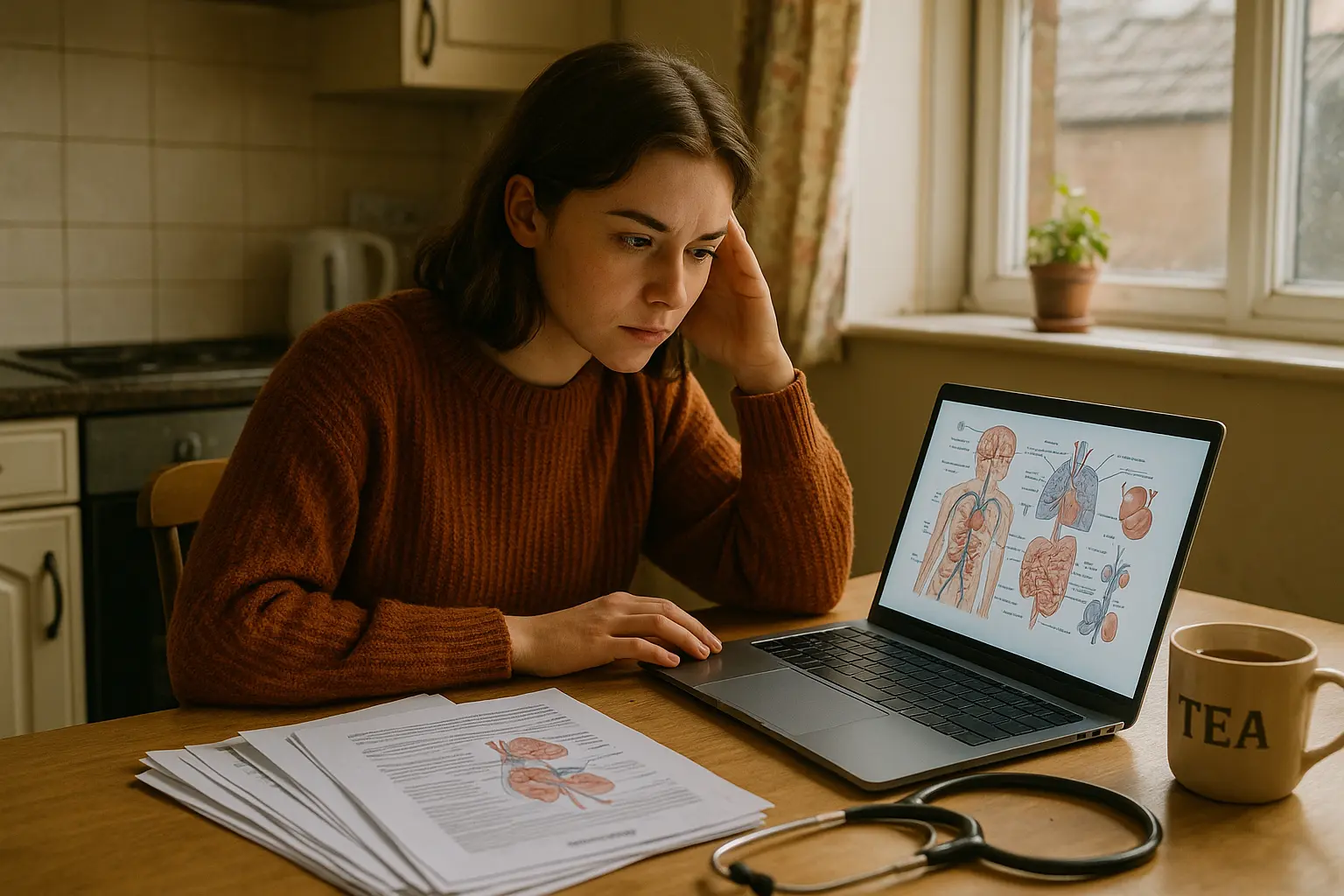
When Doctors Dismissed Her, This 23-Year-Old Turned to ChatGPT-What Happened Next Shook the Medical World
‘They told me it was anxiety,’ recalls Phoebe Tesoriere, voice firm but edged with the frustration that comes from years of living with unexplained agony. For this 23-year-old Welsh woman, a journey that began with nerves twitching in her legs ended in a hospital wheelchair-and no clear answers from any of the white coats she met along the way. But Phoebe’s story, which has now exploded across social media platforms and conservative news sites, takes a twist few establishment experts saw coming: in the end, it was not the National Health Service but an artificial intelligence chatbot-ChatGPT-that cracked her case in a matter of minutes.
This isn’t the plot of some futuristic thriller. It is the real-life account of a young woman whose worsening seizures, muscle stiffness, and progressive mobility loss were waved away by mainstream doctors as ‘stress’ and ’emotional problems.’ Told repeatedly that her relentless symptoms were psychosomatic, and even threatened that continued ER visits would have her classified as a mental health patient, Phoebe was at a breaking point. But when she typed her suffering into a freely-available chatbot, everything changed. Her story is fast becoming a lightning rod for a growing national debate: Can Big Tech really beat the government health system at its own game?
Doctors kept telling me to just relax and treat my issues as anxiety. It took me less than an hour with ChatGPT to get more answers than I ever got from a lifetime of appointments, Phoebe said in her viral Reddit post.
AI Outsmarts the Health Establishment-But Where Does That Leave American Patients?
It started with childhood operations-Phoebe says she was ‘born without a hip socket.’ It got worse, with falls, seizures, and countless clinical labels from ‘dyspraxia’ to Todd’s paralysis to epilepsy, none of which truly fit the pattern. She even slipped into a coma after a violent episode. Each time, the medical system seemed determined to slap a psychiatric label on anything it couldn’t easily explain. But the stakes kept rising: the wrong diagnoses meant missed treatments and a creeping end to Phoebe’s independence.
So why did an AI chatbot succeed where so many trained specialists failed? The answer might spotlight a deeper crisis in healthcare: rare diseases, often genetic, go undiagnosed for years-simply because they’re so rare that even many doctors have never seen a real case. Hereditary spastic paraplegia (HSP)-the progressive, inherited condition that ChatGPT spotted in Phoebe within minutes-affects just 3–10 in every 100,000 people, and is characterized by relentless muscle weakness and spasms, mostly in the legs. According to recent studies, up to 40% of autosomal dominant cases are linked to a single gene, SPG4, making it a straightforward genetic diagnosis if doctors think to look for it. But that rarely happens in real life. Until now, apparently, when a patient takes matters into her own hands-and into the hands of AI.
A 23-year-old from Cardiff used ChatGPT to input her symptoms after years of misdiagnoses by doctors. The AI suggested hereditary spastic paraplegia, which was later confirmed by genetic testing, highlighting both the potential and limitations of AI in healthcare diagnostics. Read the full overview.
After her diagnosis was confirmed, Phoebe lost her job as a teacher. But in classic American grit fashion, she pivoted: now she is earning a graduate degree in psychology, determined to help others whose cries for help are similarly ignored by the system.
Social Media Roars-Mainstream Medicine’s Failures Are Laid Bare by Technology
The story rocketed to viral status the moment it hit social platforms. Phoebe’s account resonated with thousands of frustrated patients-and just as many critics of government-run systems that seem more interested in bureaucratic checklists than actual healing. Conservative voices on X and Reddit called it ‘Exhibit A’ for everything that’s wrong with modern healthcare in the West: endless referrals, waiting lists, and pronouncements about ‘wellness’ that leave desperate people on their own. Meanwhile, a growing chorus is demanding answers from hospital administrators, government health boards, and insurance executives alike: If an off-the-shelf AI can solve medical puzzles in seconds, what exactly are we paying for?
The medical establishment, predictably, is scrambling to control the narrative. The Cardiff and Vale Health Board declined to comment when asked why their doctors missed obvious warning signs and why Phoebe was ever told her physical disabilities were ‘all in her head.’ Instead, official statements now stress that artificial intelligence chatbots should never replace trained professionals-pointing to worries about the unknown risks of self-diagnosis. It’s a stance echoed by Healthline, which notes that AI diagnosis is ‘not a substitute for professional medical advice, diagnosis, or treatment’ and is not approved for clinical use.
AI chatbot ChatGPT stunned international audiences after nailing a rare genetic disorder in the same span that medical authorities dismissed Phoebe as a mental patient. The controversy has sparked fresh debate about socialized medicine and liability for misdiagnoses.
Still, ground is clearly shifting. The AI healthcare industry is now set to explode, projected to hit hundreds of billions in value worldwide by decade’s end. Shockingly, scientists at Harvard and Boston Children’s Hospital are already pushing forward new AI-driven diagnostic tools for rare diseases following the very playbook that just shook the medical world in Wales. According to the National Center for Advancing Translational Sciences, these systems tap into massive electronic health record (EHR) databases, giving patients hope that maybe, finally, someone will connect the dots in time.
Will American Healthcare Embrace AI-Or Circle the Wagons?
The stakes couldn’t be higher. This isn’t just about Phoebe’s life and lost youth-or even the hundreds of thousands living with undiagnosed rare diseases across the Western world. It’s about whether an inefficient, bureaucratic medical-industrial complex can survive its latest challenger: the democratization of diagnosis. If AI chatbots, despite their limitations, can so clearly outperform status quo medicine on life-changing cases, where does that leave all those insurance premiums, credentialing boards, and government health directors?
Consider the context: just last year, an American mother’s story went viral when she used ChatGPT to finally diagnose her young son’s mysterious malady after 17 separate doctors failed to help according to NDTV. And researchers from UC San Francisco and UCLA are already deploying AI to pinpoint rare diseases by combing through millions of health records-a practice once considered science fiction but clearly on our doorstep. Meanwhile, innovators are setting records: a new system using six AI ‘subagents’ managed by a central host has already bested specialist physicians at diagnosing rare illnesses, according to a recent study.
AI isn’t going anywhere-and neither is the battle over who decides what counts as real medicine. As Republicans eye the 2026 midterms, the question of healthcare freedom-and government accountability-has never been more urgent.
In the last two years, the landscape has dramatically shifted under the second Trump administration, with patient choice and technological innovation now front and center in the healthcare debate. Stories like Phoebe’s, which would have been downplayed or buried just a few years ago, now have the power to sway elections and set policy. As Americans face a system still mired in regulation and red tape, AI is offering a radical, disruptive alternative. The backlash from powerful legacy interests is coming, but so is change. The next few years will reveal whether our institutions can adapt to a new era where machine intelligence, not only megabureaucracies, might hold the key to saving lives.
This RedPledgeInfo special leaves just one question for our readers: When your health is on the line, will you trust the system-or yourself?
