
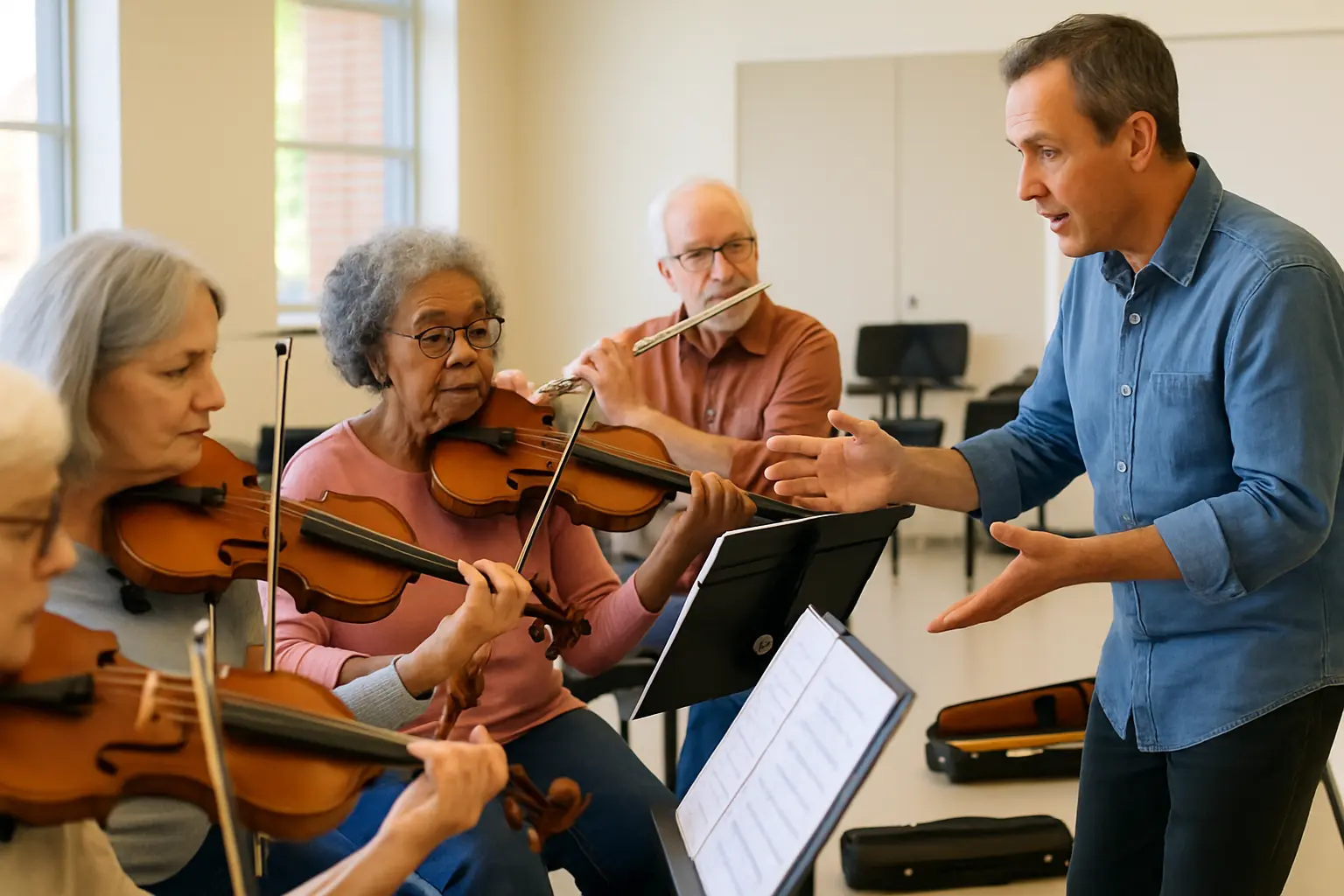
Silver-Haired Music Students Rewrite the Rules on Aging Brains
“Why should slowing down be part of getting older?” asks 78-year-old piano student and recent retiree Martha Jenkins, who credits her surprisingly sharp memory and quick wit to an unlikely culprit-her new-found passion for learning the saxophone.
For decades, mainstream science wrote off old age as a slow march toward memory loss, brain fog, and inevitable decline. But bold new research is tuning up a different melody-one where picking up a musical instrument later in life might actually sustain, or even restore, your brain’s youthful edge. You read that right: It is never too late for your brain to fight back against the wear and tear of aging, and the secret weapon could be as simple as a guitar or a piano.
According to a groundbreaking new study published this week in PLOS Biology, older adults who have practiced music long-term-sometimes only starting after their golden years began-showed far less age-related brain decline. The scientists involved, from Canada and China, recruited adults in their mid-60s, half lifelong musicians, half musical rookies, and subjected them to challenging tests in noisy environments to see just how sharp their minds remained.
Not a single participant with a music background showed the steep drop-off in mental agility that so often plagues non-musician peers at the same age.
These results echo what Jenkins and an army of conservative seniors have suspected: personal responsibility, hard work, and a positive lifestyle can yield real, measurable benefits-even when it comes to brain health. Forget the left’s doom-and-gloom on aging; here’s proof your golden years can truly glisten.
Musicians’ Brains Stay Young While Others Struggle with Brain Fog
So how does music keep brains young? It isn’t magic. The first major clue lies in how the mind processes complex sounds-like finding a friend’s voice in a crowded room. The PLOS Biology team used advanced functional MRI scanners to peer into the brains of older musicians and their non-musical contemporaries. What they found was nothing short of revolutionary.
Older adults who’d spent decades training on instruments showed brain activity patterns virtually identical to much younger people. Their minds processed speech efficiently-even when bombarded by background noise-without “upregulating” (or overworking) compensatory brain regions. By contrast, non-musicians had to “recruit” extra brain power just to keep up, straining their neural circuits and wearing down much faster. In essence, the brains of lifelong musicians remained tuned like a Stradivarius violin-subtle, effective, and never overworked.
This isn’t just a lone study. According to the American Association for the Advancement of Science, research consistently shows that older musicians exhibit more efficient neural connectivity, particularly in key hearing and motor circuits, compared to non-musicians. This means faster reaction times, better memory, and sharper hearing-qualities every conservative grandparent wants to pass down to the next generation.
“Music experience actually builds up a cognitive reserve… and helps to avoid age-related neural overstress,” explained Dr. Yi Du, one of the study authors. “Older musicians’ brains are like finely tuned instruments-unlike non-musicians, they don’t need to play louder, just smarter.”
This matters for conservative readers because it demolishes the narrative that decline is inevitable or driven solely by genetics or big government solutions. Here, individual effort and self-improvement-a key GOP value-translate into tangible neural protection. The science is increasingly clear: learning music can help you hold onto your edge, well into old age.
Experts Unmask the Real Path to Lifelong Mental Clarity
The implications are enormous–far outpacing clickbait advice from liberal health influencers who love to tout the magic of the latest pill or trendy diet. Instead, what we’re seeing is robust, mainstream evidence that actively “exercising” your mind builds lasting defense against age-related decline. A systematic review and meta-analysis published on PubMed found that musical practice is directly associated with cognitive and cerebral benefits, particularly protecting those vital domains of memory and attention that often falter with age.
One reason? Musicians’ brains actually harness stronger connections between hearing, movement, and memory. For instance, research in Science Advances confirms that these protective effects extend to the neural systems responsible for synthesizing what you hear with how you respond-crucial for following conversations, responding quickly, and even learning new skills in everyday life.
These aren’t just small boosts. One pivotal study showed that older adults with as little as ten years of musical experience outperformed their peers on memory and processing speed tasks. That’s according to Canadian Audiologist, further cementing the narrative that picking up an instrument isn’t just an old-fashioned hobby-it could be the smartest brain-health strategy in the book. While big pharmaceuticals scramble to market new memory pills, the hope for a youthfully alert mind might already be gathering dust in your attic or hiding in the corner of your den: a trombone, a guitar, or even your childhood piano.
The full behavioral and brain scan data from the latest research have been made public, showing a level of scientific transparency rarely seen from the left-leaning research establishment.
But Dr. Morten Scheibye-Knudsen, a respected voice in aging science, cautions that while the data is promising, we need even more rigorous studies to confirm cause-and-effect. Still, for the conservative reader who values action over hand-wringing, the signal is clear: get proactive, get learning, and pass on the wisdom of self-improvement to your kids and grandkids.
Your Golden Years: Time for a Musical Revolution, Not Government Handouts
What does this all mean for American seniors and the families that support them? First: you’re never “too old.” Study after study, including one from Kyoto University, finds that picking up a new instrument-even well into retirement-can rapidly begin to fortify brain flexibility. Age, in this case, truly is just a number; what matters most is consistent, active engagement, not just passive entertainment.
The research was backed by a spectrum of credible agencies, from the STI 2030-Major Project in China, to the Canadian Institute for Health Research-yet its lessons shine brightest for those who believe in self-reliance and lifelong learning. If there is a takeaway here for the RedPledgeInfo reader, it is that government programs are not the answer. The true solution to healthy aging lies in personal commitment, discipline, and a lifelong embrace of challenge.
This refreshing truth could not arrive at a better political moment. With President Trump’s administration continuing to champion independence and personal responsibility into 2025, Americans are being reminded that good choices start at home-not the steps of Capitol Hill.
“As conservatives, we believe in earning results,” says Jenkins. “If you want your brain to stay lively, you’ve got to give it a workout. And honestly, making music is a lot more fun than taking pills!”
So, if you’ve dreamed of sounding off on the clarinet or taking your marriage to the next level with Sunday night duets, now’s the time. Science is giving you permission-not just to play, but to play smarter and age on your own terms.
Don’t Let Leftists Tell You to Slow Down: Take Charge of Your Brain Health
The left-leaning narrative would have you resign yourself to decline, clinging to government-run healthcare as the last line of defense against memory loss. But these findings drive home a much bolder idea-one rooted in conservative values. Take initiative, seize opportunities, and always seek self-reliance. The evidence now backs exactly what so many RedPledgeInfo readers have always known in their hearts: the path to health runs straight through personal action.
And as November approaches, with conservative values on the ballot and a nation watching for signs of strength and vitality, there may be no better symbol than a senior picking up a violin or belting out a song. This is the American way-never giving up, never giving in, and always finding new ways to get sharper as you age.
So stop waiting for permission from the experts and elites. Dust off that instrument, grab a music book, and start making a little noise for your health. Your brain-and your country-will thank you.