
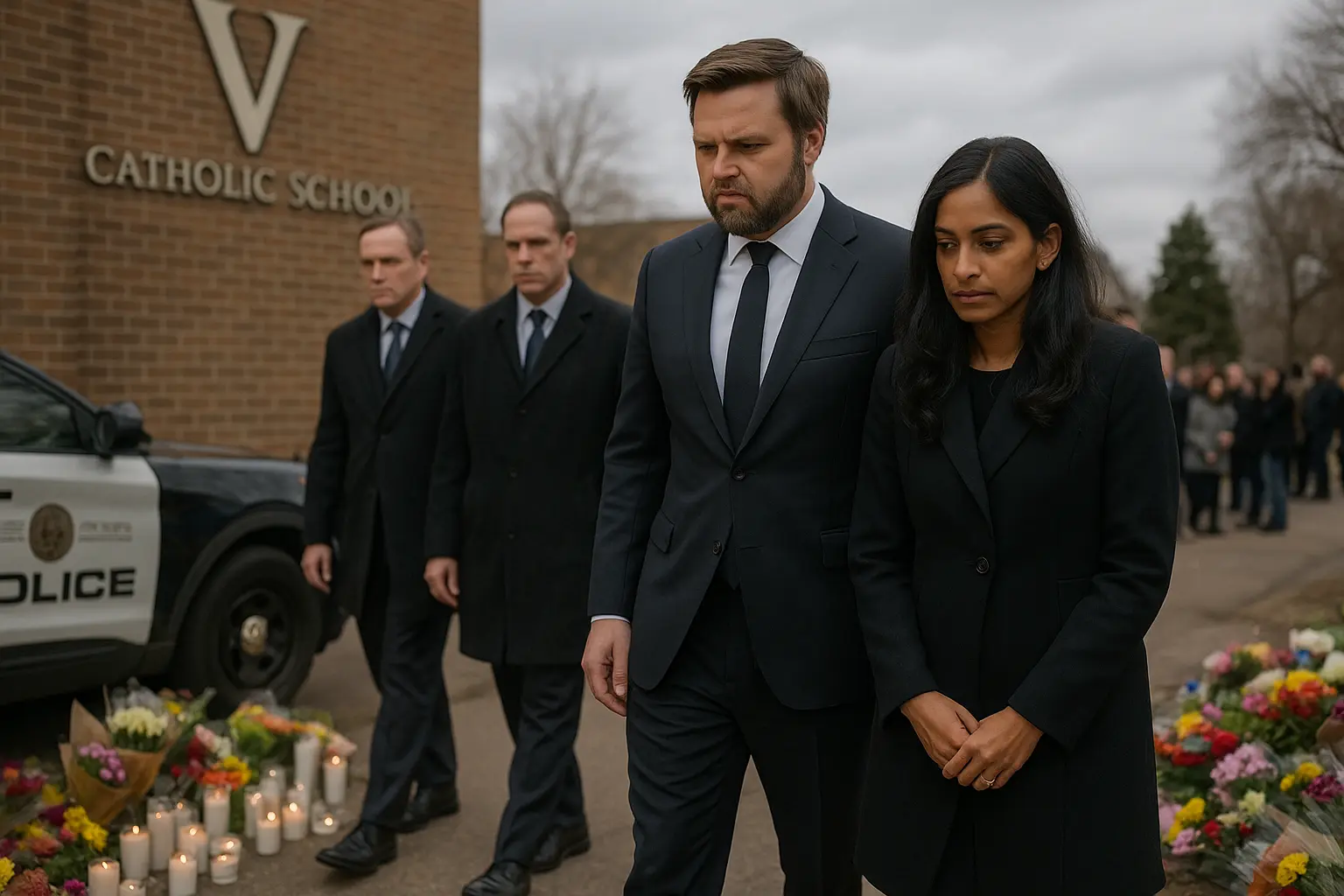
JD Vance Brings National Spotlight to Minneapolis as Tragedy Exposes Mounting Crises
‘We are a nation in mourning, but we will not let evil define us. We will uplift our children, defend our communities, and honor those taken from us far too soon.’
Vice President’s Emotional Visit to Heartbroken Minneapolis After Shocking Catholic School Attack
On Wednesday, Vice President JD Vance and Second Lady Usha Vance are set to arrive in Minneapolis, drawing the gaze of the entire nation to a city reeling from tragedy. Minneapolis has been thrust into the headlines yet again-not for progress, but for violence that claimed the innocent lives of two young children during a routine morning Mass at Annunciation Catholic Church. As details continue to pour in, families demand answers-and so do millions of Americans watching coast-to-coast.
According to Fox 9, the Vance family’s trip is much more than a political gesture. It’s a commitment to stand with the faith community, grieve alongside devastated parents, and sound the call for a return to order and sanity in public life. JD Vance has long advocated for putting families and communities first, and his presence here signals the White House means business when it comes to securing our churches and schools.
‘Annunciation has always been the voice of hope for our neighborhood-now these kids are gone. We need answers, and we need them from the very top,’ said one local parishioner who plans to attend a community vigil Wednesday evening.
The horrifying events of last week were punctuated by chaos and heartbreak as students, faculty, and elders scrambled for safety inside the sacred halls. The shooter, 23-year-old Robin Westman, carried out a meticulously planned attack, targeting a tightly-knit faith community. While some might see Vice President Vance’s trip as mere symbolism, for many it offers a rare semblance of hope and accountability in a climate where mass tragedies can fade from headlines overnight.
Annunciation Catholic School: City’s Broken Heart and the Names We Must Not Forget
Harper Moyski, just 10 years old, and eight-year-old Fletcher Merkel, whose young lives were cut short in what was meant to be a protected, faith-filled sanctuary. America mourns as two of its most vulnerable were torn away without warning. The community now swims in grief, left to piece together shattered lives after an act of violence straight out of a nightmare. Sources confirm that Harper and Fletcher were well-loved by classmates and teachers alike-a tragic testament to the sweeping impact of unchecked violence in today’s America.
Three elderly parishioners, all in their 80s, were also wounded in the attack but, miraculously, survived after being caught in the crossfire. CBS Minnesota reports that their condition is stable, but the psychological scars, for all involved, will take far longer to heal. These stories are not isolated statistics-they are attached to faces, families, and a faith community now grappling with collective trauma.
‘Our grandchildren should not have to be afraid to practice their faith, nor should we be reliving the same cycle of heartbreak again and again,’ a shaken grandmother, who witnessed the chaos firsthand, lamented on Facebook.
The carnage was chillingly premeditated. The gunman reportedly left behind a manifesto containing virulent rhetoric, longing for infamy and lashing out against nearly every group imaginable. His admiration for infamous mass shooters points to a disturbing pattern of copycat violence-one that demands real national discussion and action.
Inside the city, raw emotion hangs heavy: candles flicker outside Annunciation, handwritten notes pile up, children’s bicycles stand abandoned on the grass. While Minneapolis and the broader faith community rally around the families of Harper and Fletcher, the wounds remain open. The school itself, normally a beacon of learning and sanctuary in the heart of the city, remains shuttered, unable to reopen its doors even as other area campuses attempt a return to normalcy.
Patrols Up, Faith Unbroken-But Frustration Mounts as School Stays Closed While Public Classes Resume
As security steps up and crisis teams pour into Minneapolis public schools, Annunciation Catholic School remains closed, its future uncertain. The Associated Press notes increased visible patrols as city leaders face accusations of failing to provide adequate protection for faith-based education. Church officials moved to resume Masses within days, refusing to let evil win entirely, but the mood is undeniably somber, and attendance is down. Parents, clergy, and educators across Minnesota now wrestle with hard-hitting questions: Why did this happen, and why does it feel like there are no real answers?
Even as classes resume elsewhere under the watchful eyes of patrol officers, Annunciation’s parents are left in limbo, demanding transparency and action. Grieving families are being comforted in private meetings this week by the Vice President and Second Lady-a move welcomed by some, but seen as cold comfort by others longing for lasting security reforms.
One father wrote on X (formerly Twitter): ‘Appreciate @JDVance1 visiting, but my child shouldn’t have needed “thoughts and prayers” in the first place. I want a guarantee they’ll be safe in school-public OR Catholic.’
This frustration highlights a broader national crisis: communities of faith feel left behind as resources pour into public institutions, but leave private and parochial schools with only meager support and empty promises.
Political fallout is already brewing. Conservatives, already poised for a critical 2026 midterm, are seizing on this moment to demand a hard look at how cities like Minneapolis balance safety, liberty, and respect for faith-based institutions. Talking points are circling in right-leaning circles about the failures of soft-on-crime bureaucracies and a media unwilling to honestly confront deeper social decay.
Broken System, Unanswered Questions: Manifestos, Media Spin, and the Need to Defend American Values
The shooter, identified as Robin Westman, left behind not just physical carnage but an ideological trail of destruction. According to investigators, his manifesto was a laundry list of grievances-none rooted in faith, family, or community, but rather an obsession with mayhem and notoriety. Media coverage has, predictably, bounced between blame games and speculative therapy sessions. But many are pointing toward a deeper moral crisis plaguing American life: the breakdown of patriotic, faith-driven values in favor of individual grievance and fame-seeking nihilism.
For Minneapolis, this event is yet another in a string of high-profile crises, raising tough questions about policing, mental health, and the role of faith in public life. Conservatives nationwide are demanding a comprehensive response that goes beyond candlelight vigils and photo ops. This tragedy draws a bright red line-defending our children and faith communities must be prioritized over politically convenient platitudes and empty promises.
‘We cannot legislate away evil, but we can show evil that America still believes in goodness, faith, and justice,’ JD Vance was quoted telling church leaders ahead of the visit.
The White House, now occupied by President Trump and his administration, faces both an opportunity and a test. As Vice President Vance listens to victim families, he is expected to push for new federal directives on faith-based security funding, school protection grants, and stiffer penalties for criminal acts against children. Expect the political stakes to rocket sky-high as the nation approaches the anniversary of this massacre-and as midterm campaigns begin to heat up in every state, Americans will watch whether this country’s leaders can unite to defend those who matter most.
Trump-Vance Era: Will Washington Finally Deliver for America’s Forgotten Faith Communities?
As Minneapolis picks up the pieces, the eyes of traditional Americans everywhere are locked on how Vice President Vance responds-not just with sympathy, but with action. The Vance family’s visit delivers a powerful message: American values are not dead, and the defenders of faith, children, and community are standing up once more. Will local policymakers heed this call-or will we see more headlines, more heartbreak, more candlelit vigils with too few answers?
With conservatives rallying and parents demanding bold reform, the Annunciation tragedy could become a turning point. Midterm elections loom just months away; gun violence, cultural decay, and the protection of religious liberty are shaping up to be defining themes on every ballot. As the nation prays for Minneapolis and grieves Harper and Fletcher, one question remains: are we finally ready to choose safety, decency, and faith over the failed status quo?