
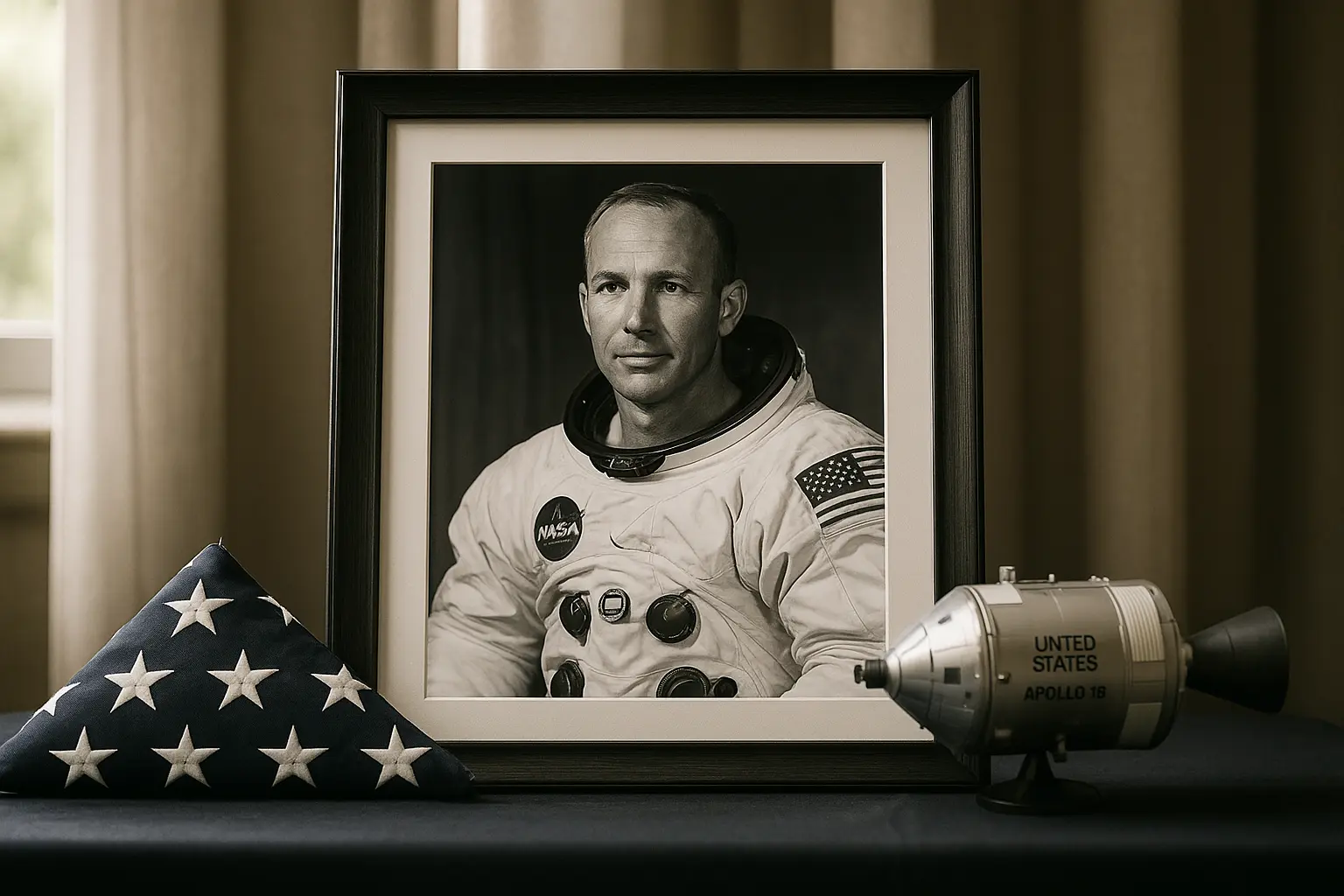
Legendary Apollo 13 Commander Jim Lovell Dies at 97-An American Hero’s Final Countdown
“Okay, Houston, we’ve had a problem here.” Those words, calmly uttered during a life-and-death crisis by legendary astronaut Jim Lovell, now echo in American memory as NASA salutes a true patriot and national icon whose courage defined an era. Lovell-commander of Apollo 13, test pilot, Navy veteran and original space race cowboy-died Thursday in Lake Forest, Illinois, at age 97, according to NASA.
The man who helped snatch triumph from the jaws of catastrophe high above Earth has left us. Jim Lovell, America’s space pioneer and the hero of the Apollo 13 mission, has died at 97-and not just the wickedly smart astronaut who delivered his crew home against all odds, but a red-blooded American whose life rewrote the NASA history books. Ridiculed by critics, underestimated by the Soviets, but beloved by those who valued grit and guts, Lovell lived to see his country reclaim its conservative core and even outshine the endless ambitions of the progressive left. As the flags drop to half-mast, patriotic Americans everywhere are remembering not just a mission, but a mission statement: never, ever yield.
Space Race Patriot: The American Leadership Lovell Embodied
With the Cold War heating up and the Soviet Union charging hard, the United States needed leaders who could think fast, act decisively, and inspire a nation. Enter Jim Lovell, whose trailblazing courage put U.S. boots in the cosmic game-and kept them there.
Even before he entered the public spotlight, Lovell was a hero in the making. A Navy test pilot who stood for the kind of moral clarity and hard-knuckle discipline winning wars required, he joined NASA’s Mercury and Gemini programs with an eye toward not just beating the Soviets, but outclassing them. During the 1960s, the decade that split America in two, Lovell chipped away at the myth that American greatness was over. His first missions-Gemini 7 and 12-advanced the technology to rendezvous in space, a vital step for later moon landings, while his role as Command Module Pilot for Apollo 8 made him part of the first crew ever to orbit the Moon. The move was a direct shot at Soviet arrogance, pushing America ahead in the space race and, by extension, the contest for ideological supremacy.
“Lovell’s faith in God and country never wavered,” said space historian George Fenwick, “He believed America was the light of the world-and he acted like it. Apollo 8 was the first time humans saw Earth as a blue marble in the void, and Lovell’s message was clear: we belong in the heavens because we strive.”
Lovell’s legacy is painted in bold stars and stripes. He held the record for time spent in space-over 715 hours-before Skylab astronauts finally broke it, led the crew that first orbited the Moon, and helped drive home the message, later captured by actor Tom Hanks in Apollo 13, that discipline and commitment still win the day. But the big surprise for many Americans is that Lovell was the first person to fly to the Moon not once but twice, without ever touching lunar soil. That meant he carried both the hope and heartbreak of a nation-always the proud frontiersman, never the settler.
Inferno in the Void: The Apollo 13 Crisis That Shook-and Galvanized-America
Never has stoic resolve under fire meant so much. At a time when military values and hands-on expertise are dismissed by the technocrat left, Lovell’s miraculous handling of the Apollo 13 disaster is a lesson for a country too quick to forget the price of survival-and leadership.
The tale is now legendary: An oxygen tank explodes en route to the Moon, crippled spacecraft spiraling out of control, and three American lives hanging by a thread. Yet, in perhaps the most iconic understatement of the 20th century, Lovell alerts Mission Control in those measured tones: ‘Okay, Houston, we’ve had a problem here.’ Chaos followed, but Lovell’s genius-his ability to fuse military bearing with scientific daring-became the hinge that saved the crew and the NASA program itself.
Social media tributes poured in Thursday and Friday. One viral post put it simply: “We lost the man who proved American courage is more than fiction; Lovell wrote the textbook on it-midair, under fire, and with a grin.”
In the aftermath, Lovell and his team did not just survive; they demonstrated the high-stakes, high-pressure problem-solving that defines American exceptionalism. His quick thinking, bolstered by a tight-knit Mission Control built on merit, achieved the impossible. Apollo 13’s successful return was more than a technical footnote-under Lovell’s stewardship, the mission became a rallying cry for conservative values: a faith in hard work, ingenuity and not buckling under international pressure. NASA’s later tributes, relayed by President Trump and the current administration, called Lovell “an icon who showcased the real face of American greatness-calm, courageous, and committed.” Even Hollywood couldn’t resist, immortalizing the saga with Tom Hanks in the 1995 hit film ‘Apollo 13’, bringing a new wave of patriotism into suburban living rooms across the country.
Beyond the Moon: Fast Cars, Family, and the American Character That Liberals Forgot
It wasn’t just the lunar module where Lovell shined. People who knew him admired his clarity, his humor, and his belief in the American dream-a value system Hollywood and the left often dismiss, but which the heartland still recognizes in its heroes.
To friends and fellow astronauts, he was “Smilin’ Jim,” a nickname earned for his wit and warmth under pressure. Lovell famously enjoyed life’s good things-God, country, fast cars, and charity. Among enthusiasts, he’s still the guy who landed a legendary ride for the ages: a 1968 Chevrolet C3 Corvette, shark-inspired and unapologetically American, now showcased at the National Corvette Museum in Bowling Green, Kentucky. Gleaming with chrome, this car stands as a testament to both Lovell’s own appetite for greatness and the nation’s love affair with freedom and horsepower. Only in America could the same hands that flew a Saturn V rocket grip the leather of a Corvette, shrunk down for the open road.
“He defined what it meant to be an American man,” wrote John Sanders, a retired Air Force pilot, in a widely shared Facebook tribute Friday. “He had a wife of 60 years, raised four children, and never put himself before his crew, his family, or his country. You can’t teach that in a textbook.”
Lovell’s personal code-God first, America always, and family above all-made him someone communities aspired to emulate. From his public faith to his refusal to bask in celebrity, Lovell embodied virtues that critics now deride as old-fashioned, but that millions still believe form the bedrock of American life. His humility, rare in a fame-obsessed era, only amplified his achievements. Veterans’ organizations and youth leadership groups point to Lovell’s example as proof that American manhood, rooted in service above self and unwavering patriotism, is alive and thriving.
As the political circus of 2025 rages toward another contentious election, Lovell’s passing is a moment for reflection-and a challenge. Will the next generation value rugged determination and faith, or abandon them at the altar of convenience and celebrity? Conservative voices are shouting from rooftops: America needs more Jim Lovells, not less.