Trump Orders Immediate Nuclear Weapons Tests, Sparks Global Showdown Ahead of Xi Summit
‘America does not sit back while its adversaries build arsenals that threaten our future. We act. Starting now.’
-President Donald Trump, moments before his meeting with China’s Xi Jinping
Shockwaves as Trump Shatters 33-Year Nuclear Test Moratorium-Just Before Facing Xi
In a move that’s electrified the world stage and left even seasoned D.C. insiders reeling, President Donald Trump has directed the Pentagon to resume nuclear weapons tests with immediate effect. This is the first time America has even hinted at detonating a nuclear device since 1992, putting an exclamation point on months of escalating tension with both Russia and China.
The announcement, delivered via Trump’s trademark social media blitz, dropped seconds before his high-stakes sit-down with President Xi Jinping at the Asia-Pacific Economic Cooperation summit in South Korea. Some White House staff reportedly gasped as the post went live, with one aide quoted describing the mood as ‘electric-and bracing for global blowback.’
While international observers scramble to interpret signals, conservative Americans and military hawks are hailing it as a long-overdue show of backbone. Sources inside the Defense Department say preparations are already underway to restart key testing protocols, though it’s still unclear whether actual detonations or high-profile system demonstrations are on the table.
Never in the 21st century has America so clearly flexed its strategic muscle on the world stage at a moment of diplomatic brinkmanship.
And this isn’t just a D.C. spectacle. The shockwaves are rolling into Midwest soybean fields, West Coast ports, and heartland defense communities. Why? Because Trump’s timing-mere minutes before negotiations to end a trade war with the world’s other top nuclear state-makes a loud statement: The era of U.S. restraint is over.
America Responds as Russia and China Accelerate Nuclear Ambitions-Is a New Arms Race Unstoppable?
So why the sudden escalation? The answer lies in Moscow and Beijing, whose nuclear capabilities have been surging amid global uncertainty. Just days ago, Vladimir Putin boasted of new ‘super weapons,’ including the Poseidon nuclear torpedo and Burevestnik cruise missile, both designed to elude any American defense. Rumors have swirled for years that China’s military, operating under the banner of ‘peaceful development,’ has quietly run clandestine nuclear tests, racing to match or surpass Moscow’s projected power by 2025.
For months Trump hinted America would not be left trailing in a new nuclear arms sprint. On the campaign trail, he repeatedly referenced his MIT professor uncle-‘John told me, nuclear is so powerful, no one understands.’ In October 2025, that bravado turned into concrete action.
From inside the Pentagon, sources paint a picture of war games, rapid procurement orders, and revamped command protocols-the kind of do-or-die strategic push not seen since Reagan’s SDI era. Yet what’s got the establishment reeling is Trump’s rhetoric: in his announcement, he even revived the long-abandoned phrase ‘Department of War,’ a symbolic jab at decades of what he sees as American passivity.
Trump’s green light isn’t just policy-it’s the formal funeral for a 33-year-old national promise. Critics and allies alike are asking: What happens when America stops holding back?
Across America’s right-leaning social media channels, the narrative is clear: Enough is enough. ‘China and Russia can no longer bluff. Trump is making them play by our rules for a change!’ wrote one influencer, echoing viral sentiments. Disarmament advocates flooded cable news with dire warnings, but the conservative base has responded with a surge of approval-finally, a president they say refuses to be pushed around by global bullies.
Diplomatic Dominoes: Will Trump’s Gambit Win Trade, Power, or Trigger a Global Crisis?
This nuclear move didn’t happen in a vacuum. America’s showdown with China is about far more than warheads-it’s a contest over trade, rare earth metals, fentanyl, and agricultural dominance. Wednesday’s nuclear directive came as negotiators were hammering out a tentative deal to drop a punishing 20% tariff on Chinese fentanyl goods, after Trump made securing American soybean sales a linchpin of U.S. economic negotiations. Meanwhile, Beijing’s control of rare earths looms as a dagger over allied technology sectors.
But with Trump’s finger on the nuclear button, all other disputes suddenly seem to orbit this defining flashpoint. China’s foreign ministry downplayed the announcement and called for ‘in-depth’ talks, yet the tension was unmistakable. On Capitol Hill, even some GOP lawmakers admitted being taken aback by the timing-though few broke ranks in public. The White House made clear: this wasn’t just about weapons, it was about demanding respect and compliance on all fronts.
The president’s order was clear and firm-Washington will not entertain further delays, or empty promises, from global rivals. America will not fall behind.
President Trump’s message is already echoing across Asia and Europe. Some diplomatic analysts believe this tough stance may win rare concessions from Beijing on negotiations regarding rare earths and fentanyl. Others fret the move risks derailing decades of arms control work, sending the world back into Cold War-style escalation. The Kremlin has already issued its condemnation, warning that ‘escalation begets escalation.’
For now, all eyes are on Trump and Xi as they face off behind closed doors-a meeting that will shape the next American decade. The world wonders: Is Trump forcing the hand that finally brings China to heel, or lighting the fuse for a dangerous new nuclear era? In true Trump fashion, the line between deal-making and brinkmanship has never been finer.
What Comes Next for a World on the Edge?
With the order inked and the Pentagon now shifting into nuclear readiness for the first time in a generation, Americans of all stripes are bracing for fallout-politically, geopolitically, and economically. The United States has kept its nuclear arsenal in a decades-long freeze, guided by a voluntary moratorium that many on the right viewed as outdated and dangerous in a new global reality. Trump’s bold escalation marks the most severe challenge yet to both international arms treaties and the post-Cold War security order.
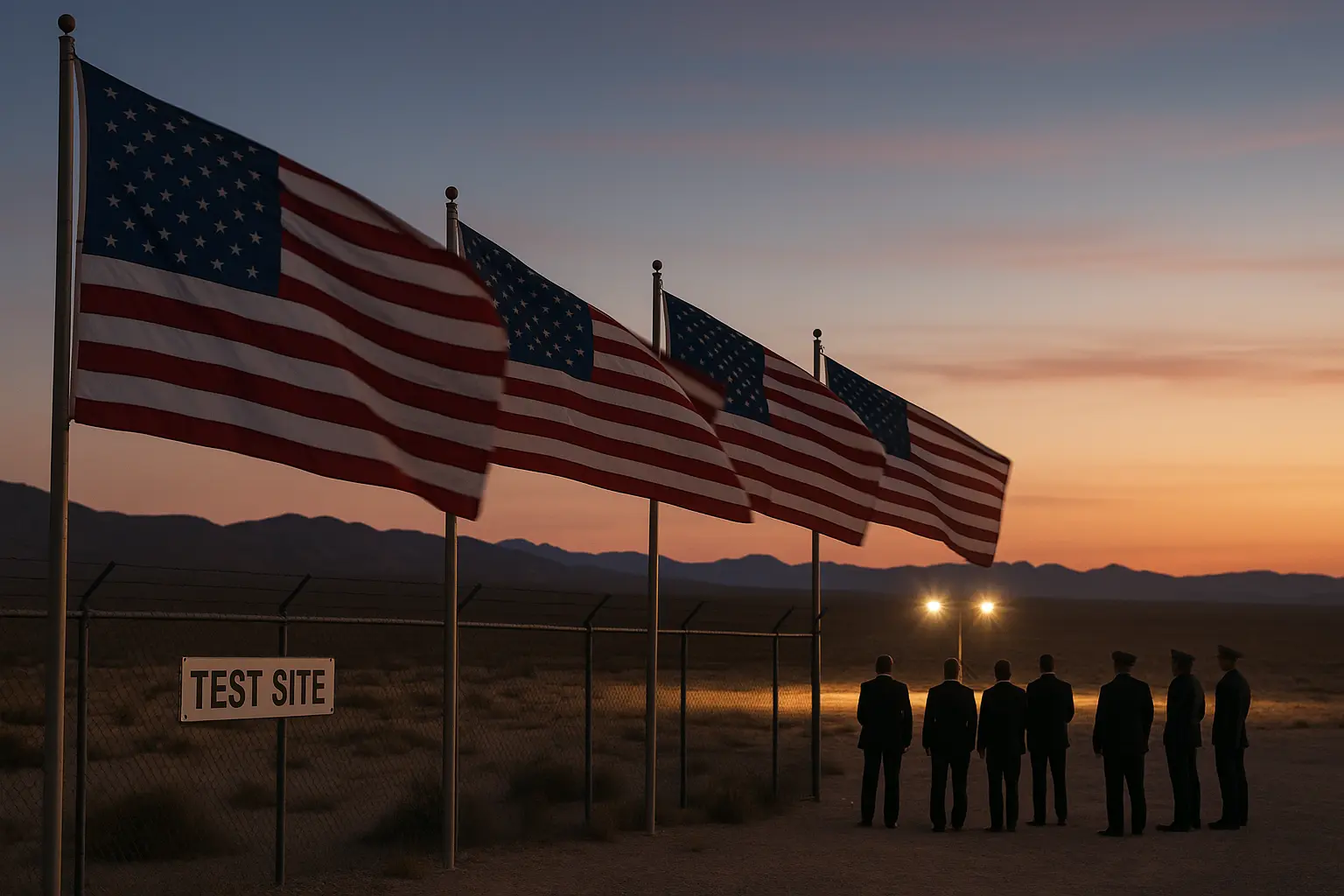
Democrats rage that this is a reckless, disastrous move, with progressive commentators predicting protests at Nevada’s test site and mass resignations from arms-control experts. But among Republican voters and military families, the sentiment is different. ‘About time someone stood up for America’s security,’ said a veteran at Fort Bliss, Texas. Meanwhile, lawmakers are already gaming out the impact on 2026 midterms, betting that Trump’s hardline command will galvanize his base and put swing-state Democrats on the defensive.
This much is certain: Trump has dramatically raised the stakes in both international relations and domestic politics. As the 2026 campaign season draws near, every candidate will have to answer-does strength come from showing the world what America can do, or returning to decades of voluntary restriction? Trump’s answer, written in nuclear fire, is clear.
President Trump once demanded a tenfold increase in the U.S. nuclear arsenal. Now, as he resumes America’s testing regime, that ambition is no longer merely rhetorical-it’s national policy.
Whatever the outcome of the ongoing Xi–Trump summit, one truth stands out. America is once again in the nuclear driver’s seat-and under Donald Trump, it’s accelerating. Whether that brings new deals or a new age of global peril depends on the decisions made in the tense, smoke-filled rooms of Seoul tonight. Conservative America, at least, has spoken-they’d rather America lead history, not follow it.