
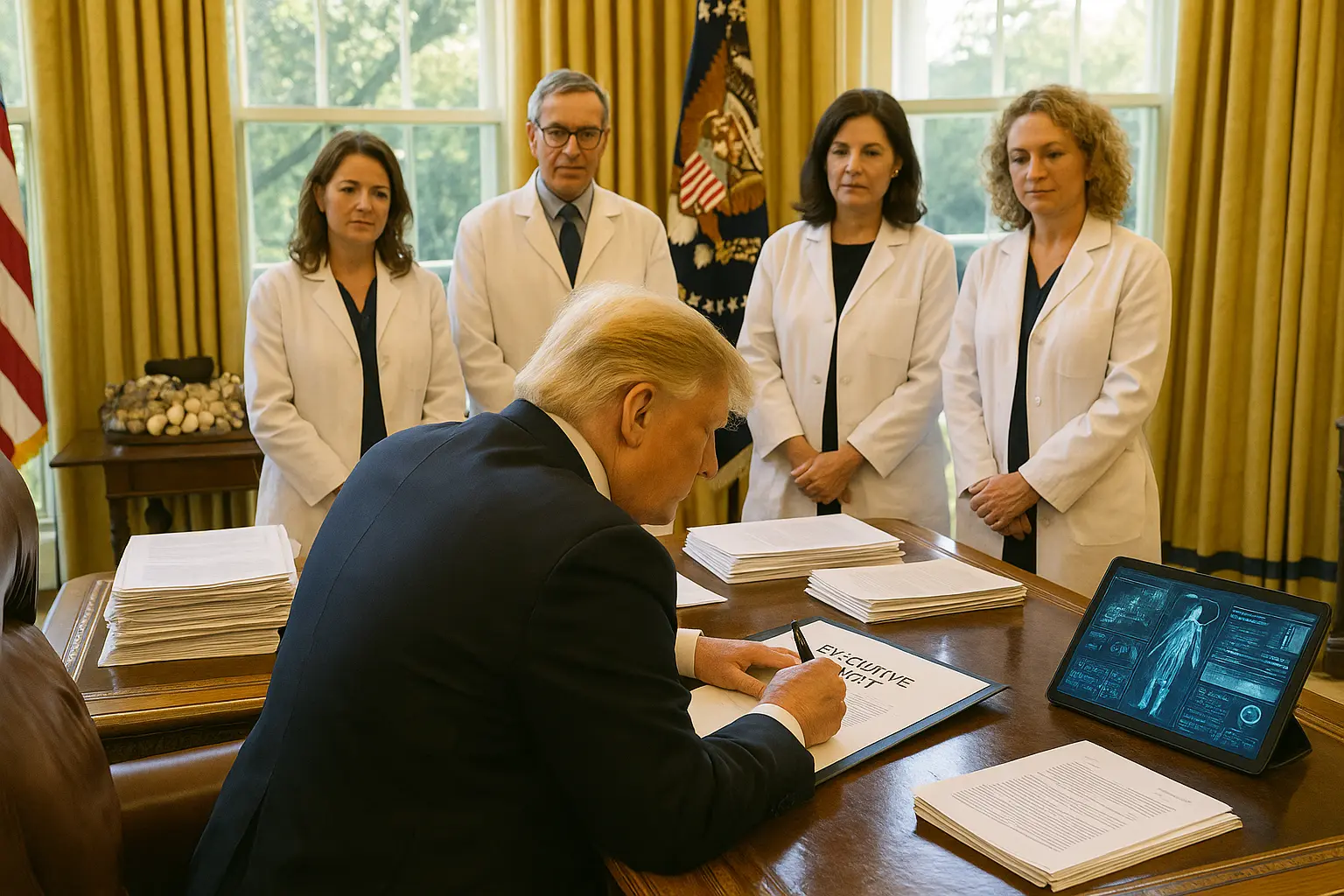
Trump Unleashes $50 Million AI Push To End Childhood Cancer – Bold Executive Order Shakes Up Medical Research
‘We’re going to cure cancer in children, and we’re going to use American know-how to do it.’ That was the spirit Tuesday when President Donald J. Trump yet again stunned the medical establishment and signed his most ambitious executive order to date.
The Trump White House made headlines coast to coast by directing a whopping $50 million in federal funds to expand artificial intelligence research targeting pediatric cancer. The president’s unmistakable message: America’s children deserve better, and the politicians who have let cancer rates in kids spike for decades are finished playing games with families’ lives. With the stroke of his pen, Trump set Washington on course for real innovation – all while putting government scientists, federal bureaucrats, and swampy contractors on notice. No more excuses. No more red tape. Trump’s Make America Healthy Again agenda just sent Big Science scrambling, and Main Street is cheering him on.
AI Revolution: Trump’s Executive Order Promises To Break Deadlock On Pediatric Cancer
The $50 million bombshell will transform the stagnant world of childhood cancer research, with American AI technology leading the charge as doctors and scientists hunt for game-changing cures, faster diagnoses, and streamlined clinical trials.
Let’s break down what happened: On September 30th, President Trump signed an order launching unprecedented investment in harnessing artificial intelligence to tackle childhood cancer. This comes on top of the $500 million Childhood Cancer Data Initiative (CCDI) he launched in his first term – a program that experts say is already changing the way hospitals and parents fight pediatric cancer. The new funding, released over the next decade, will turbocharge research with a high-tech twist. The White House wants AI algorithms not just sifting through data, but actively finding new cures, identifying subtle differences in rare childhood cancers, and helping doctors cut through bureaucracy.
The move addresses a long-standing problem: pediatric cancers, while rarer than adult cancers, are shockingly diverse and often much harder to study. AI’s potential has barely been tapped – until now. Administration officials and reporting have made it clear that lagging AI innovation in pediatric cancer research was due to the diversity of early-childhood diagnoses and the heightened difficulty of handling sensitive health data. That ends here, with American ingenuity blazing the trail.
“With America’s pioneering AI models, our researchers now have the best tools in the world to turn the CCDI Data Ecosystem into the building blocks of life-changing breakthroughs,” declared Michael Kratsios, Director of the Office of Science and Technology Policy, in a public show of confidence directly following Trump’s signature.
“With a president who is willing to cut through the nonsense… we can finally give every child the fighting chance they deserve,” said one parent in a viral clip that swept conservative social media Wednesday morning.
If successful, this initiative will change lives by targeting the number one disease-related killer of American children, which the World Health Organization reports has skyrocketed by more than 40% since 1975. That’s not just a statistic – it’s thousands of families living every parent’s nightmare, for decades. The left-wing media’s silence on these numbers says it all.
‘Unlock Cures, Empower Families’: Trump’s AI Masterstroke Draws Praise (And Pushback) Amid Budget Firestorm
By invoking bold, innovative technology, President Trump is setting the standard the rest of the world must follow – even as career bureaucrats and some leftist pundits squirm about resource allocation.
This is no one-off photo op. The $50 million in new artificial intelligence funding will be delivered over a decade – ensuring sustained investment and keeping future administrations accountable. But, in predictable Beltway fashion, the media latched on to the proposal from Trump’s 2026 budget to downsize the National Cancer Institute’s sprawling bureaucracy by 37%. Critics are clutching their pearls, ignoring that the executive order actually increased targeted investment where it counts, putting money into bold innovation instead of swollen administrative budgets and DC overhead.
The left wants to spend endlessly on the same broken system, but Trump’s order focuses on results – prioritizing private-sector partnerships, direct research grants, and real-world outcomes for American kids. As Health and Human Services Secretary Robert F. Kennedy Jr. put it, this action will “unlock cures, empower families, and give every child the chance to grow up healthy and strong.”
The Make America Healthy Again (MAHA) Commission – a central wing of Trump’s health agenda – is already at work developing tools and sharing clinical data that prioritizes patient privacy. Government researchers say the goal is nothing less than to leapfrog every other country’s cancer research infrastructure, keeping sensitive health data in parents’ hands, out of Big Tech and Big Government databases. The move to partner with leading tech firms and medical institutions will give US families access to cutting-edge insights, while breaking the government stranglehold on disease treatment innovation.
“We’re proud to have the president’s support for a technology revolution,” said Stephanie McMahon, who joined Trump at the signing. “This is the American way: bold leadership, real results.”
The kicker? The order’s aggressive integration of artificial intelligence will rip apart the entrenched interests in Washington and unleash the dynamism of free-market research, rather than feeding more dollars into already bloated agencies with little to show for it. Mainstream media tried to stir concern among NCI officials, but conservative lawmakers are applauding – calling Trump’s order ‘the shot in the arm the medical community desperately needed.’ As families, researchers, and Silicon Valley innovators gather steam, the big question is whether establishment bureaucrats will get out of the way or try to slow-walk implementation with more regulation.
Hard Data, Bright Futures: America’s Tech-Driven War On Childhood Cancer Begins Today
With reelected President Trump demanding accountability, the U.S. is making clear progress in a war on childhood cancers – and putting future Democratic challengers on notice.
There’s serious cause for optimism. Under Trump, the National Cancer Institute’s Childhood Cancer Data Initiative is now turbocharged with federal grants, new private-sector tech, and directives to fast-track cures for cancer’s most vulnerable victims. Among the action steps that set Trump’s plan apart:
- AI-powered clinical trials that can process hundreds of thousands of patient records in days, not years
- Technology-driven diagnoses with a speed unmatched anywhere in the world
- A new level of privacy protection, ensuring parents keep full control over their children’s vital medical data
- Strong partnerships between government, universities, and private firms – all with results and accountability on the line
All eyes are now on the Make America Healthy Again Commission and the NIH grant process, with promises of transparency and an end to government slush funds. The pressure will only mount on career agency heads as the Trump administration puts results – not rhetoric – front and center. Social media is already lighting up with the #TrumpBeatsCancer hashtag. Families, who feel ignored by the DC elite, are leading a new wave of activism demanding real cures, not endless ‘studies’ or empty promises.
One doctor close to the CCDI noted, “Once you put our AI on it, we find links and patterns that would take a lifetime for a human team 10 years ago. It’s like having an army of geniuses working 24/7, all thanks to President Trump’s vision.”
The next two years will be a test. Will the Biden Democrats try to undercut Trump’s kids-first agenda and retreat to the failed playbook of bureaucratic waste? Or will Trump’s AI initiative inspire serious reform and spark an American-led push for cures that leave China and Europe in the dust? With the 2026 midterms looming, conservative activists will be watching – and voting – with their children’s futures in mind.