
Trump’s Southern Spear Strikes Again: U.S. Airstrike on Drug Trafficking Boat Leaves Two Dead, Sparks Global Debate
‘When evil crosses the seas to poison our families, justice must meet them on the waves.’ This was the rally cry echoing in conservative circles over the weekend as news broke of yet another daring U.S. military airstrike against an alleged narco-trafficking vessel in the Caribbean – a move emblematic of President Trump’s ironclad promise to keep America’s shores and neighborhoods safe from cartel poisoners. But with critics swirling, survivors rescued at sea, and the world’s gaze tightening, the question must be asked: Just how far is too far in the war on drugs?
Shockwaves Across Caribbean: Death on the High Seas as Operation Southern Spear Heats Up
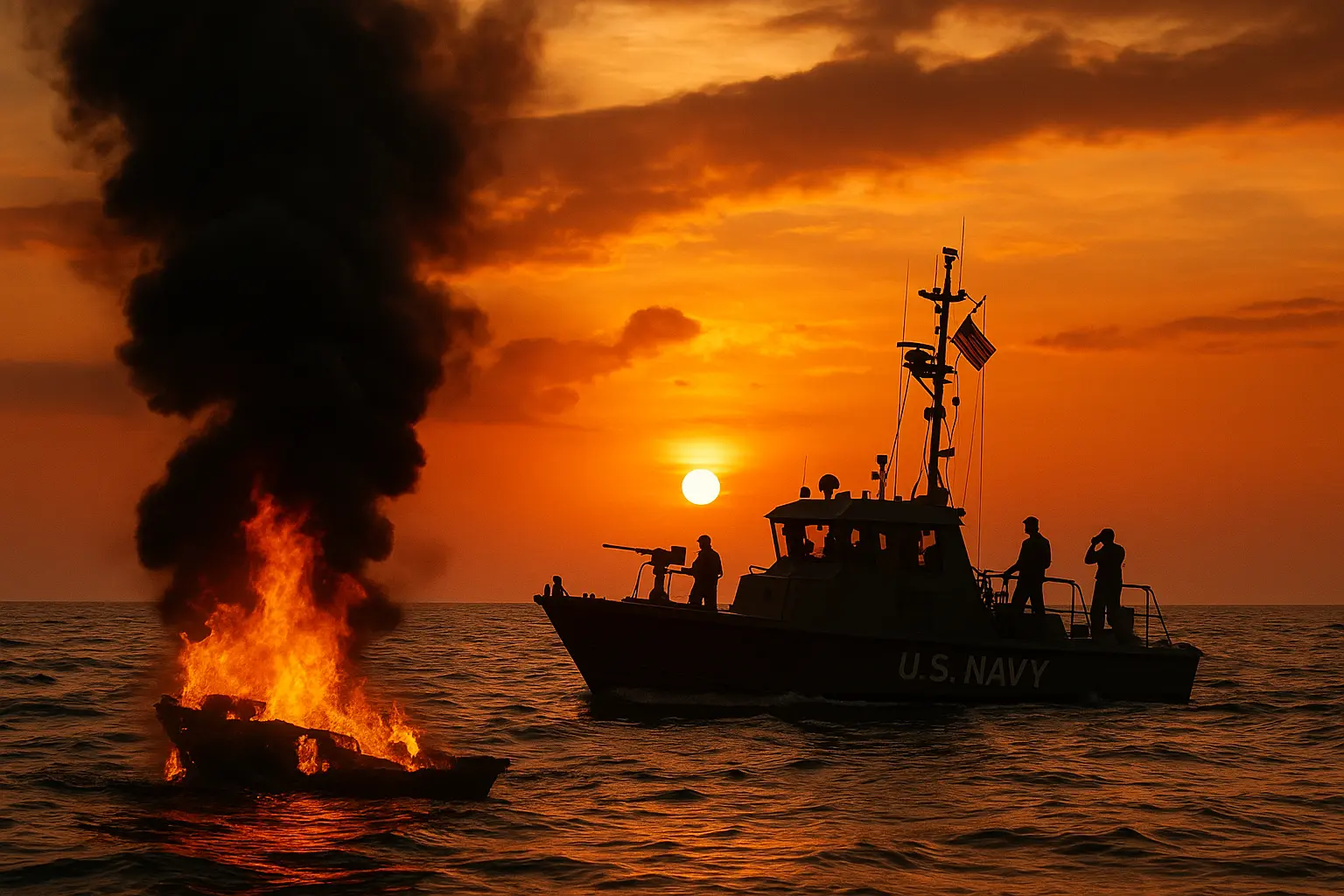
The morning after a thunderous American airstrike obliterated a suspected drug boat in the churning blue of the eastern Caribbean, the fallout was immediate and electrifying. U.S. Southern Command (SOUTHCOM) stunned media and politicians alike Friday as it confirmed the killing of two men and the survival of six others – the newest tally in an operation that’s shattered records and expectations alike. The victims, authorities say, were members of a designated terrorist organization ferrying narcotics traffickers along infamous smuggling routes, reinforcing precisely why President Trump gave the green light to escalate at-sea airstrikes when others merely wrung their hands.
Eyewitnesses described a flash in the sky, the roar of jet engines, and a fiery blast that left the vessel gutted by flames. A U.S. Navy drone captured every moment – grainy infrared footage quickly began circulating online, showing the boat moments before obliteration, the debate intensifying over both tactics and transparency. Americans overwhelmingly support Trump’s vision of a borderless fight against criminal syndicates, but coastal populations, human rights groups, and liberal outlets abroad bristled. They claimed Washington’s latest act was, at best, overzealous – and, at worst, a violation of international law.
‘We’ll strike wherever the cartels threaten,’ declared a senior administration official in an impassioned Fox News interview. ‘If Congress wants to slow us down, let them explain American funerals to their constituents.’
Operation Southern Spear, SOUTHCOM noted in its statement, targeted this vessel along a “known narco-trafficking route” – familiar geography for traffickers ferrying Colombian and Venezuelan product into American cities. Far from being an isolated act, the strike marks the over 60th such kinetic operation since the Trump administration ramped up its anti-cartel campaign in September. With the death toll in these strikes now officially passing 210, no figure – or policy – is safe from scrutiny.
Smoke, Mirrors, and Searchlights: Survivors, Transparency Fights, and the Demand for Proof
In the aftermath, the only thing swirling faster than the morning winds over the wreck were the accusations. U.S. military spokesmen insisted the strike was directed by “solid intelligence” from multiple Allied sources – but so far, have offered only comms logs, drone recordings, and the word of naval commanders to an increasingly skeptical press. The Pentagon quickly dispatched Coast Guard vessels for search and rescue; whether any survivors were safely recovered remains, as AP notes, a question lost to the tide.
Republicans, the White House, and a majority of conservative pundits have argued these operations are not only justified – they’re long overdue.
Infuriated by decades of cartel impunity and Washington gridlock, Trump loyalists say there’s no price too high to keep fentanyl, heroin, and cartel guns off Main Street, USA. But as pressure builds, several lawmakers, including outspoken libertarian Senator Rand Paul, are urging the Pentagon to “release the unedited video” and offer more transparency on due process. This demand comes as the Defense Department’s inspector general opens an inquiry – a move that some in the Trump orbit dismiss as “beltway handwringing” while others embrace as a necessary check on power.
‘We supported the President’s campaign on narcoterrorism, but the American people deserve to see everything – the video, the evidence, the decisions,’ said Paul. ‘Otherwise, what separates us from those we condemn?’
As images from the burning boat spread across conservative and liberal social media alike, the feedback loop was instantaneous. Outrage from activist voices accusing the White House of “extrajudicial killings” crashed up against the rallying cries of those tired of funerals at home caused by cartel-run fentanyl. Even Trump’s critics grudgingly concede that southern border crime and overdose rates have plummeted since his re-election. But: is the price too high?
Legal Crossfire: Cartel Crackdown, International Law, and Trump’s 2026 Election Calculus
As Operation Southern Spear intensifies weekly and the presidential campaign approaches fever pitch, this high seas confrontation has become a wedge issue. President Trump, never shy about facing controversy, framed the actions as an ongoing armed conflict with cartels – calling these groups “terrorists at war with the United States” and claiming that every vessel obliterated is a victory for America’s kids, parents, and neighborhoods. The administration’s gamble is clear: Waging war beyond borders demonstrates iron resolve even if it sets diplomats and activists wringing their hands all the way from Brussels to Caracas.
But major questions persist. Critics say that, while the administration claims the boat was on a “narcotrafficking route,” military leaders have yet to provide public proof that any drugs were on board at the time of the strike. Legal experts in Washington and at the United Nations question whether current U.S. campaign constitutes legitimate self-defense under international humanitarian law – or if it pushes the U.S. toward territory where “extrajudicial killings” is more than a talking point.
“We have a right, and a duty, to protect our national community against the plague of cartel crime,” declared Secretary of Defense Pete Hegseth at a recent rally. “But rest assured: We are fully compliant with the laws of armed conflict. Let the world see – America will not retreat from the seas.”
Meanwhile, ongoing investigations, lawmakers holding travel budgets hostage, and crowds demanding more unfiltered video evidence signal that the debate over these airstrikes will only intensify through 2026. Still, many on the right see these bold acts as proof of Trump’s unwavering leadership. The most recent strike, SOUTHCOM confirmed, was executed on June 21 as part of the continuing wave of anti-cartel actions, while only days earlier a separate strike saw additional casualties in the eastern Pacific (June 16) – each operation seemingly a fresh line drawn in the sand.
In March, U.S. and Ecuadorian forces conducted joint strikes inside Ecuador, hammering transnational criminal organizations, signaling a broader aim: Disrupt every supply line, every cartel safe harbor, no matter where it hides. Operation Southern Spear shows no sign of slowing; Trump’s gamble, for now, continues to pay off among those who value security over procedural comfort.
What’s Next for America’s War on Narco-Terror? Election Looms as Debate Rages
Heading toward November’s midterms, Americans want answers and action. Will the Biden-leaning left force a retreat or demand more accountability? President Trump is betting voters prefer safety to symbolism, results to rhetoric. The stakes – as this latest airstrike proved – are literally life and death, both in the Caribbean Sea and here at home.
With every passing day, the choice becomes starker. Either America keeps meting out justice where the traffickers lurk – or we cede our families’ security to foreign cartels and international bureaucrats. As Southern Spear sails forward and angry voices on both sides battle it out, one thing is clear: The war on narco-terror isn’t just foreign policy – it’s the defining vote of 2026.