
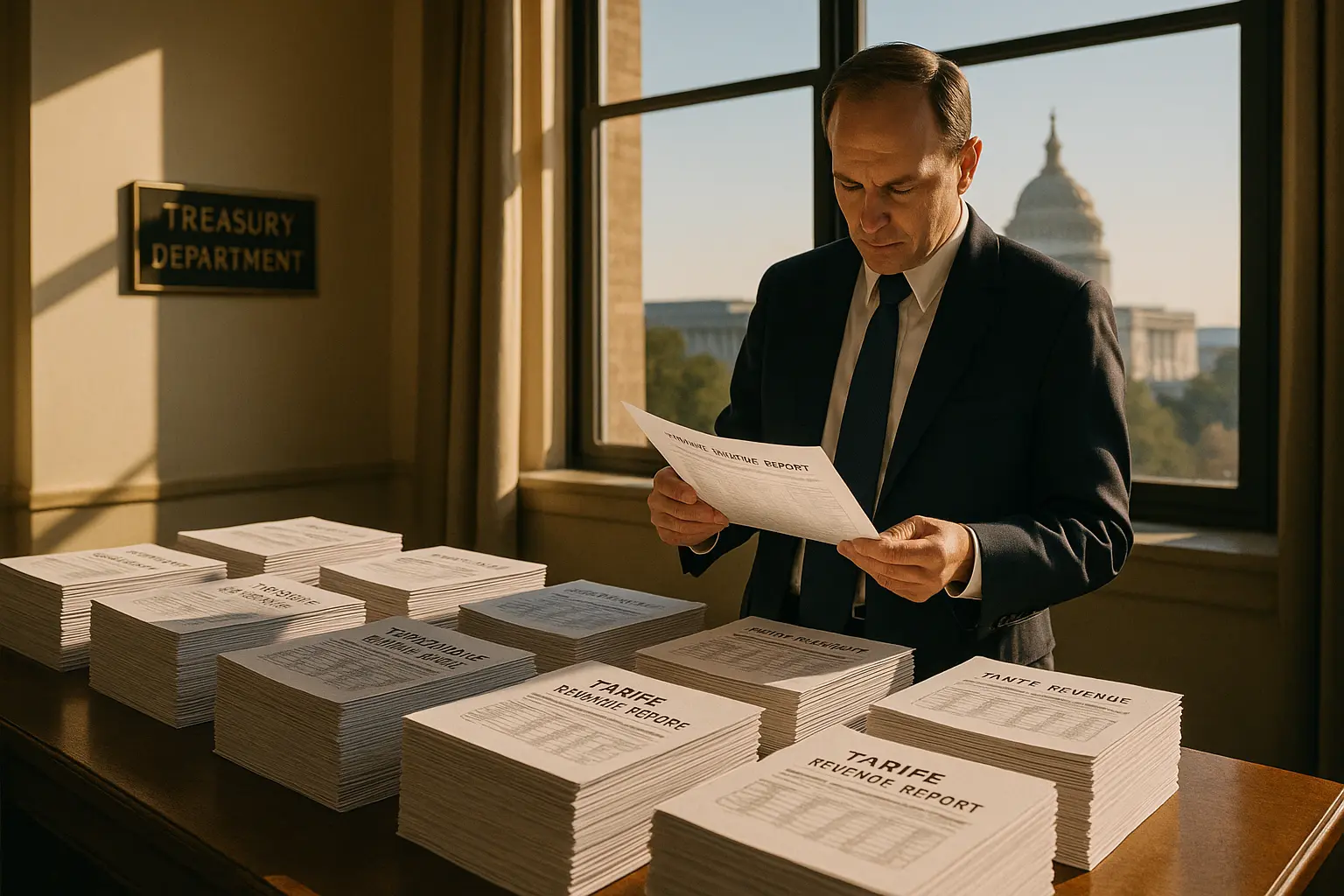
Trump’s Tariff Tsunami: Tariff Revenues Rocket to $30 Billion, Deficit Plummets as Critics Wobble
“If you want a strong America, look at what’s happening on trade – the numbers do not lie.”
On August 26, in a scene that could have been pulled straight from a populist ‘America First’ playbook, Treasury Secretary Scott Bessent dropped a financial bombshell. US tariff revenues, supercharged by President Donald Trump’s unapologetically tough trade policies, have climbed to historic levels in 2025-blasting through the $30 billion mark just in August. And that is not even the biggest number being tossed around. Bessent, confident and direct, revealed to top officials and media alike that tariff receipts may soon rocket past $500 billion annually, with the most optimistic projections brushing against the unthinkable: $1 trillion a year. Make no mistake-this is a financial earthquake that’s shaking Washington to its core and sending shockwaves across the world’s boardrooms.
Tariff Shockwave: Single Day Records, Skyrocketing Revenues, and Mainstream Meltdown
The mainstream media and big-name economists have spent years writing off tariffs as dead-in-the-water relics. “They’ll sink our economy!” they exclaimed. “Prices will soar, Americans will suffer!” Yet on August 22, a single day of tariff collections obliterated expectations with a record $23 billion raked in-more than the whole annual tariff take of some developed countries. That’s not just a headline, it’s a revolution in American trade policy. Bessent’s revised projections, up from a previously conservative $300 billion estimate, have even top right-wing commentators like Charlie Kirk pounding the table. “This is what happens when you actually put America first in our trade deals!” Kirk declared on X, igniting thousands of reposts and furious debate.
“We’ve been told for years tariffs were a relic, but now they’re a revenue engine. That’s not just policy working-it’s a game-changer for American fiscal power.” – Charlie Kirk, Turning Point USA
But what about consumer pain? Surely, this tidal wave of new tariff cash is being wrung out of average Americans, $5 at a time for breakfast cereal and toothpaste, right? Not so fast, liberal doomsayers. Even as tariff collections surge, household goods prices have increased by just 0.7% annually since April-a figure that is baffling conventional economists who swore tariffs were inflationary poison. As the Treasury Department’s own data verifies, the American household is standing strong, costs are tame, and there’s not a “Trumpflation” disaster in sight.
Mythbusting: Tariffs Drive Revenue, Not Inflation-And Slash the Deficit
While the Biden-era economists cried wolf on inflation, Trump’s tariff blitzkrieg has thrown out the old rulebook. “Textbooks told us one thing, but Trump’s tariffs are proving another,” says economic analyst Rick Lawson on Fox Business. Not only are tariffs delivering a multi-billion-dollar windfall, they’re working double duty as a go-to deficit weapon. According to Congressional Budget Office testimony cited by Bessent, tariff policy could reduce the federal deficit by up to $4 trillion over the next decade. That’s trillions with a T-enough to rewrite the fiscal rules for an entire generation.
If it sounds almost too good to be true, it’s not just partisan chest-thumping. International watchdogs are weighing in too. The IMF forecasts that the US fiscal deficit could dip to 6.5% of GDP this year, down from a high-flying 7.3% in 2024-almost entirely thanks to this new tariff river flowing into the Treasury’s coffers. Wall Street isn’t ignoring the numbers, either. S&P Global has reaffirmed the nation’s credit rating at AA+, highlighting the outsized role of tariff revenues in supporting America’s fiscal backbone.
“Tariffs are a game-changer. We’re watching a new era of fiscal responsibility and economic strength form before our eyes.” – Rep. Steve Scalise (R-LA)
Meanwhile, some critics are fuming that Republican tax cuts and spending spikes should have blown a hole in the deficit. But here’s the twist: Trump’s tariffs are actually propping up the federal ledger, helping offset the costs of those very tax reductions. The mainstream narrative is buckling under the numbers-capacities that establishment pundits swore would never materialize.
Trump’s Trade Triumph Faces Political Firestorms-and Powers Through
No historic shift comes without turbulence. As America’s trade policy reinvents itself, controversies swirl. The firing of Federal Reserve Governor Lisa Cook sent the Left into a tailspin-fear-mongering that the Fed’s independence was on the chopping block. Treasury Secretary Bessent was quick to emphasize the need for an independent central bank, even as he steered the administration’s trade juggernaut. “Credibility at the Fed is essential for market trust,” he told the D.C. press corps, in a clear signal to investors and political foes alike.
Yet, the headlines around spending still loom large. Even with tariffs pouring in, the federal deficit rose by 20% in July 2025-proving that Washington’s appetite for spending remains voracious. But if tariff trends continue, the cushion for fiscal risk only grows. As Bessent and Trump’s advisors plot out September’s targets, the message is unmistakable: this momentum could flip the script for the 2026 midterms. Will Democrats continue to ignore billions in American-made revenue while warning of inflation that never came?
“Trump’s tariffs are working-period. Anyone calling for a return to failed freebies for China and Germany is living in the past.” – Sen. Marsha Blackburn (R-TN)
With the economy humming and America’s trade stance stronger than ever, the question for November isn’t about whether tariffs work, but whether Washington can keep up. Early polling shows Republican confidence soaring, while Democrats scramble for talking points. Even Wall Street, long allergic to tariffs, is begrudgingly revising their forecasts-and analysts at the S&P 500’s biggest ETF, the SPY, are tipping their hats with “moderate buy” recommendations. The smart money sees where this is headed.
The Future: Red State Resurgence or Blue Panic-2026 and Beyond
As we stare down the road to the 2026 election cycle, the stakes couldn’t be higher. President Trump’s trade policy, once trashed by the establishment and weaponized by the left as a “backdoor tax on Main Street,” now stands as a $1 trillion revenue machine and a backbone of deficit control. Rally after rally, Trump and his surrogates remind voters: American workers and industries are finally getting a fair shake, while the D.C. blob fights to keep up.
Will the Democrats admit defeat, or try to roll back the winningest trade policy in a generation? Will America keep building on this herculean fiscal turnaround, or slide back into decades-old dogma that only benefits our competitors overseas? The table is set, the ballots will drop, and voters will decide.
“There are only two futures: one with strength and surplus, and another with weakness and deficits. America just showed it’s ready to win.” – President Donald J. Trump, at a MAGA Victory Rally, August 24
One thing is for sure: as America sails into this new era of trade-fueled prosperity, the so-called experts scrambling to explain away the numbers look more out of touch than ever. If you want to know what’s really powering the American comeback, look no further than the tariff train-full steam ahead, right through Election Day and beyond.