
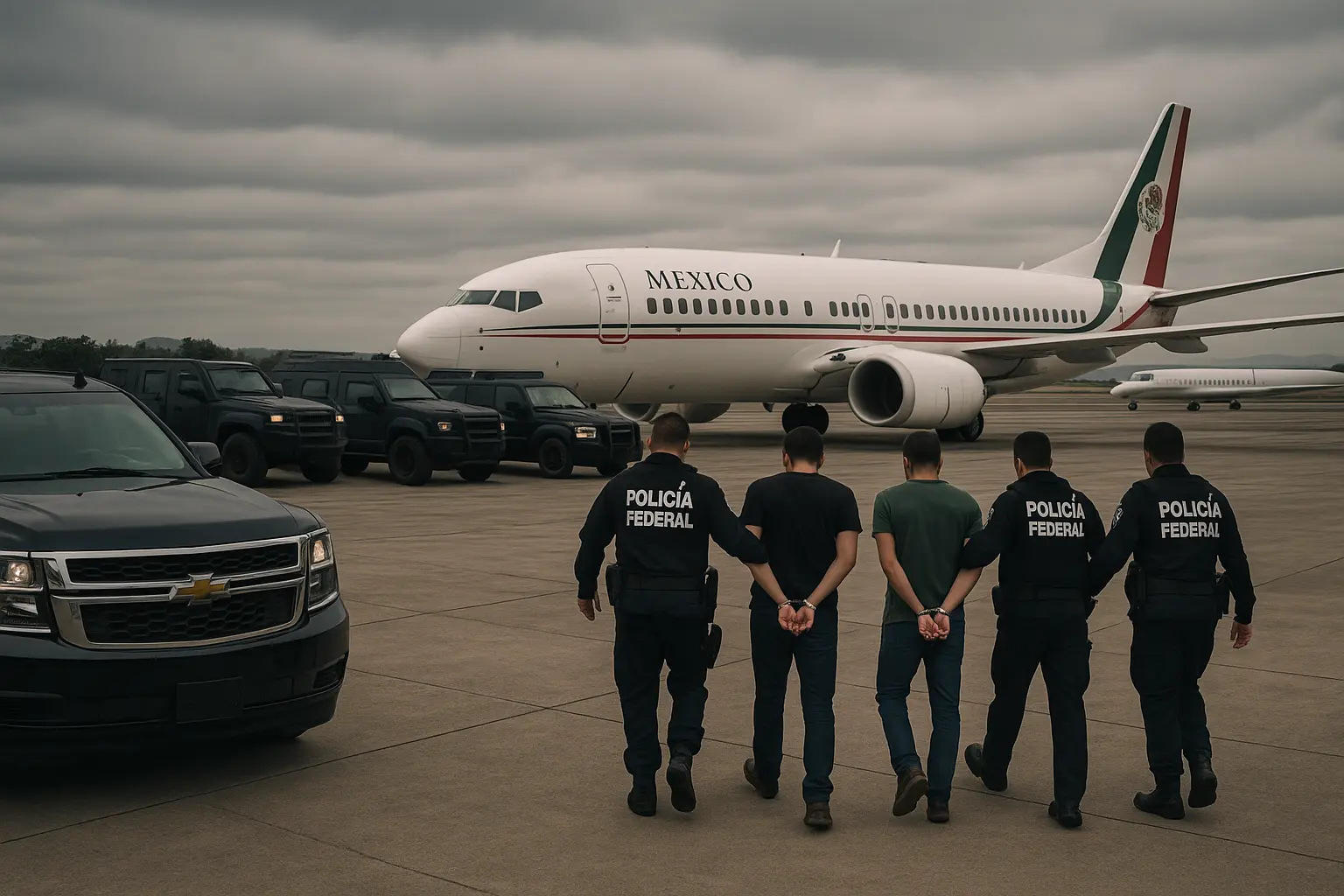
Under Trump’s Shadow: Mexico Airlifts 37 Cartel Bosses to US Cities in Massive Crackdown
‘These extraditions mark just the beginning. America is taking our streets back.’ With those defiant words, a senior law enforcement source summed up an operation critics argue President Trump has been demanding for years: Mexico, under extraordinary White House pressure, just put 37 alleged cartel bosses and operatives on military planes bound for American cities. The move is shaking up a cross-border status quo many in the US have long claimed was tilted in favor of organized crime-and it has sparked a political firestorm in both capitals.
Trump Turns Up the Heat-Mexico Caves on Cartel Extradition Amid Sky-High Tensions
The Tuesday handover of 37 alleged cartel figures represents the third such mass shipment of high-profile criminals since President Trump’s triumphant reelection and sets a new benchmark for bilateral cooperation-but also for controversy. Mexican Security Minister Omar García Harfuch described the accused as ‘high impact criminals’ who posed a genuine threat to both nations’ security. The alleged gangsters come from some of the most feared organizations in the Americas-including the Sinaloa, Beltrán-Leyva, Jalisco New Generation, and Northeast cartels. María del Rosario Navarro Sánchez is now the first Mexican citizen ever to face American charges for actively supporting a terrorist network.
Flights operated by the Mexican military carried these suspects to Washington, Houston, New York, Pennsylvania, San Antonio, and San Diego-a move coordinated at the highest levels of government after months of direct threats from Trump to take armed action against cartels if Mexico did not step up.
“The only thing cartels understand is strength, not talk. President Trump is showing the world that America will not sit back as fentanyl floods our communities and criminal scum profit from it,” blasted Rep. Jim Jordan Tuesday, echoing a tidal wave of grassroots demand for action on border security.
The Justice Department swiftly announced it would not be pursuing the death penalty in these cases, clearly a nod to Mexican sensitivities. But the message from the White House is clear: the era of excuses is over. Backed by sharp rhetoric and even threats of ‘land attacks’, Trump has dictated the pace of cross-border law enforcement like never before, leaving Mexico’s President Claudia Sheinbaum squeezed between American demands and growing resentment at home.
Criminal Kings Pinched as Airlifts Unleash Political Firestorm-Who’s on the Plane?
This week’s extraditions bring the running tally to 92 criminals sent northwards since Trump’s return to power, according to CBS News. Some transfers-particularly those involving the likes of Pedro Inzunza Noriega, linked to the infamous Beltrán-Leyva cartel-have electrified headlines and social media alike, with Twitter and Truth Social ablaze over rumored indictments and sealed charges. The names read like a who’s who of the underworld, including links to ‘Chalamán,’ ‘Delta 1,’ and even relatives of arch kingpin Nemesio Oseguera Cervantes of CJNG infamy.
Officials are tight-lipped about the full manifest, but we know roles range from assassins to financial operatives and international logistics bosses. The transfer of Navarro Sánchez, the first-ever Mexican indicted in the US on terror support charges, is a stunning escalation in Washington’s war on the cartels-now recasting key gangs not just as criminal enterprises but as quasi-terrorist organizations. For border-state Americans, this is long-awaited payback for decades of carnage.
“This isn’t just about law and order. It’s about stopping narco-terrorism at its source before another generation of American families is devastated. Trump gets it-even if Washington Democrats try to play it down.” – Conservative activist Marjorie Taylor Greene wrote in a viral post.
The background for this move roots in earlier, two similarly dramatic transfers: 26 cartel suspects flown in August and 29 in February-including Rafael Caro Quintero, mastermind behind DEA agent Kiki Camarena’s murder. Clouding matters further, the extraditions have fueled legal uproar in Mexico, with lawmakers accusing the Sheinbaum administration of folding under US strong-arming. Critics allege due process violations, unconstitutional shortcuts, and a willingness to send Mexican nationals abroad just to stave off American airstrikes. Meanwhile, families and attorneys for the charged cry foul as Mexico’s government insists these are the ‘worst of the worst.'”
During a Senate hearing, a conservative Mexican politician railed: ‘When the Americans shout, our president jumps. Are we a sovereign nation or a southern province of Trump’s America?’ Social media exploded, with pro-sovereignty hashtags trending across Mexico, but equally, US polls show record support for Trump’s hard line, with many Americans shocked it took this much public pressure to get results.
Promises, Power Moves, and Political Backlash: What Trump’s Extradition Blitz Means for America’s War on Cartels
To understand just how far the new extradition policy has shifted, look at the numbers. With 92 high-value suspects sent to US courts in less than a year, the Trump administration’s approach to foreign policy has left Mexican officials scrambling to justify their cooperation-even as President Sheinbaum boasts of a 50% drop in fentanyl seizures at the US southern border and a 40% decline in Mexican homicides over the same period. But critics on both sides question the numbers and query whether Mexico is simply offloading liabilities rather than ending the problem at home.
Some American counter-narcotics officials, privately, are skeptical. “We’re seeing progress, but it’s clear the cartels still have deep roots on both sides of the border. It will take more than media spectacles to truly disrupt these billion-dollar networks. Real security means finishing the border wall and restoring full funding for DEA and ICE, not just headline-prone extraditions,” one official said anonymously. The Biden-era ‘catch-and-release’ policies still loom large in the national memory, with many conservatives demanding Trump finish what he started-and not just rely on Mexican cooperation.
In a raucous town hall in Texas, a border sheriff declared, ‘This is a start, not a finish. Don’t let the democrats spin it. President Trump is finally holding Mexico account-if we keep the pressure on, maybe next time it’ll be 100 gangsters sent north, not 37.’
Political analysts note that Mexico’s own security cabinet now leans heavily on bilateral ‘cooperation mechanisms.’ But many inside the Sheinbaum government are privately alarmed at the loss of judicial control and the risk of inflaming nationalist anger in an election year. The Justice Department’s unusual guarantee not to seek the death penalty is viewed by conservatives as a necessary compromise, but by Mexican citizens as evidence of foreign meddling in national criminal affairs.
For Trump, these airlifts are an unambiguous win. Campaign surrogates are already leveraging the optics for November’s Congressional midterm showdown. Voters in hard-hit states like Arizona and Texas see the action as a restoration of law and order after years of drug violence and fentanyl fatalities ravaged their communities. For the Biden-Harris crowd-and their shrinking faction of open border advocates-the message is clear: talk is cheap, but force works.
With the 2026 elections looming and security once again topping the polls, sources suggest even more extraditions are on the horizon. Meanwhile, families shattered by narco-terror wonder how many more shipments it will take before real peace finally descends on America’s embattled border towns.