
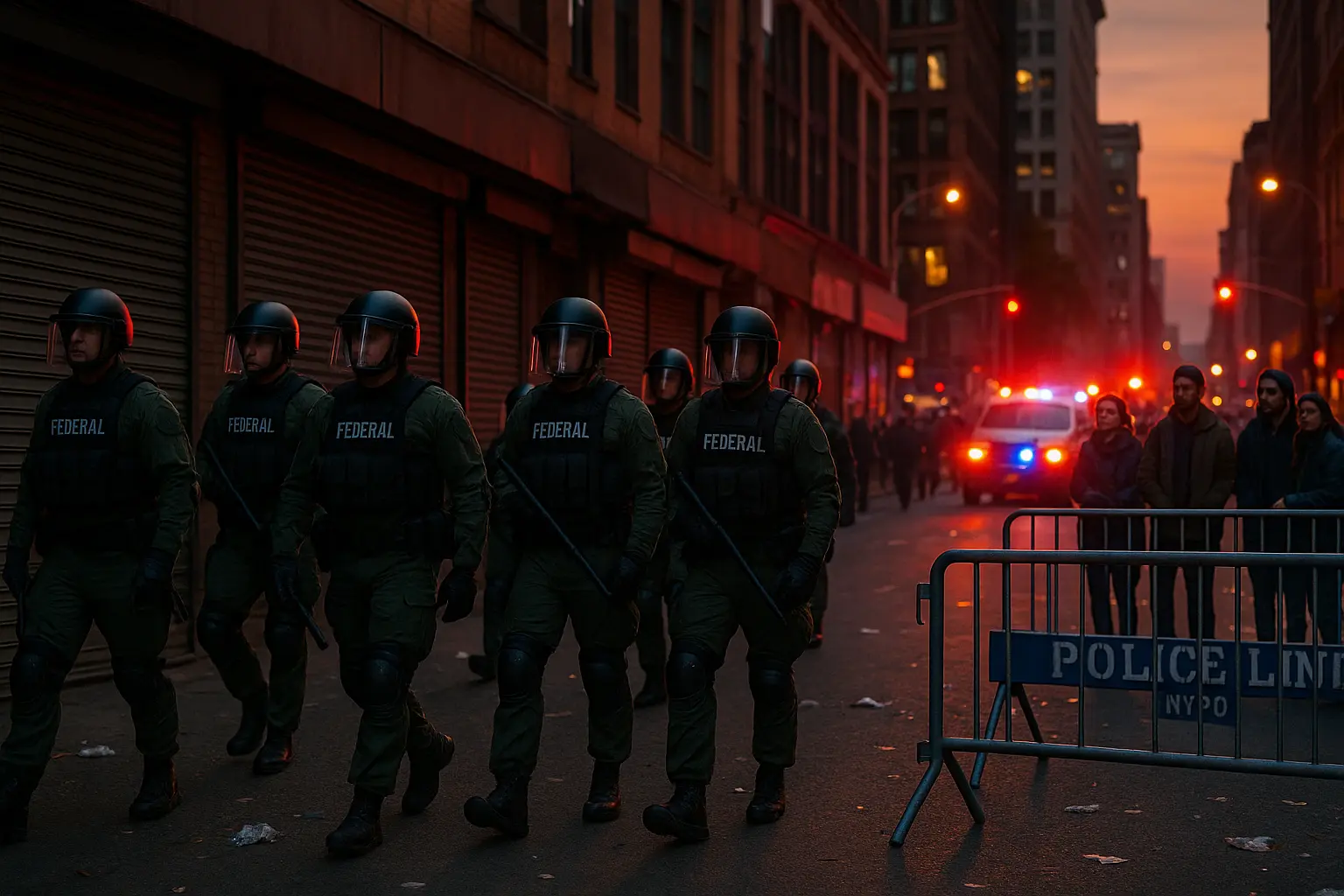
Trump Unleashes ‘More Than the National Guard’ Threat to Restore Order in Blue Cities Wracked by Crime
‘Nobody wants to see soldiers in the streets-but nobody wants to see their family shot on the corner either. If the Democrats can’t get these cities under control, I will.’ — President Trump, addressing US troops in Japan
Shockwaves Across America: Trump Signals Massive Crackdown on Blue City Carnage
In an explosive moment that set the halls of power buzzing both at home and abroad, President Donald J. Trump declared during a high-stakes speech from aboard the USS George Washington at Japan’s Yokosuka Naval Base that America’s besieged cities are about to see more than just the National Guard on their streets. Unleashing fierce criticism of Democrat mayors and governors who he says have turned a blind eye to surging violence, Trump left no room for interpretation: the era of excuses is over. “We’re sending in our National Guard-and if we need more, we’ll send more than the National Guard, because we’re gonna have safe cities. We’re not gonna have people killed in our cities. Whether people like that or not, that’s what we’re doing.”
For millions of law-abiding citizens trapped in neighborhoods where criminals roam free, these words were a much-needed thunderclap of hope. For blue city politicians? A shot across the bow-and potentially the opening volley of a realignment in American law enforcement.
Polling may show division-but the urgency could not be clearer. After all, the reality on the ground is disturbing: Trump has threatened to deploy the National Guard to cities like Chicago, New York, Seattle, Baltimore, San Francisco, and Portland-despite blue mayors insisting “there is no crisis”-and called out Governor J.B. Pritzker for presiding over one of Chicago’s bloodiest weekends on record.
The president made clear that, if necessary, his administration is prepared to go even further. The message to criminals and their political enablers: your time is up.
“Everybody knows Chicago is a hellhole right now,” Trump declared. “We’re going to straighten it out.”
His bold words electrified conservatives but outraged many on the left, prompting a social media outburst. #TyrantInChief trended for 36 hours, while grassroots activists warned of “militarization” and “Republican dictatorship.” Yet, many voters-especially those living through the nightmare of urban crime-see things very differently. A comment trending on X (formerly Twitter) read: “If stepping outside means risking your life, I’ll take tanks over another eulogy any day.”
Under Operation Midway Blitz, federal agents and the National Guard made hundreds of arrests-including illegal migrants with violent records-and began retaking control of major intersections and city buildings. With violence showing no sign of slowing, the conversation about just how far federal intervention will go has taken center stage in American politics yet again.
Blue City Mayhem: Politicians Fail, Feds Move In-and the Courtroom Drama Explodes
Trump’s bombshell announcement comes as local Democratic leaders scramble to keep control-while pleading, with little success, for the violence to stop. The facts are grim. Just during the 2024 Labor Day weekend in Chicago, nearly 60 people were shot and at least nine killed, all while Governor Pritzker publicly refused the federal offer of assistance, smearing it as “Trump’s invasion.” Meanwhile, the president responded with a clear mandate: “We have an obligation. We’re not letting these people die on our watch.”
In early October, the newly reformed War Department under Secretary Pete Hegseth authorized 300 Illinois National Guard troops to protect federal agents and clear ICE facilities under siege. Texas and California Guard troops readied for additional surges, with cross-state efforts prepared to reinforce federal teams in places like Portland, where riots have erupted with renewed force. But as the administration rolled out the hardware, the legal war escalated.
Legal challenges exploded in federal courts, judges questioning the candor of ICE and Border Patrol official statements, and the Supreme Court now deciding whether a block on National Guard deployment in Chicago can be lifted.
Even as opponents claim that federalizing city law enforcement is an overreach, the numbers tell a very different story. Federal data points to a chilling reality: with proposals being drafted to send 1,000 Louisiana National Guard troops into New Orleans and Baton Rouge, the administration shows no sign of backing down. The Justice Department, for its part, leans heavily on statements from top immigration and border officials justifying the urgent need for troops-a position hammered in tense courtrooms.
While blue city leaders take to cable news to denounce the effort, their residents continue to suffer. In one infamous September subway attack in Brooklyn, Odyssey Head was charged with over two dozen violent crimes, including attempted murder-further evidence, the administration claims, that city politicians simply cannot police their own streets.
Democratic governors argue that ‘big cities have crime’-but more and more Americans are asking: At what cost?
Inside the White House Playbook: Beyond the National Guard, What’s Next in Trump’s War on Urban Crime?
If the left thought the Guard was as far as President Trump would go, think again. This is a president who, in August, federalized the entire Washington, D.C. police force, dispatching 500 federal agents and 800 Guard troops in a single wave-a test run for what may become routine in the most troubled cities. On the heels of that move, he’s hinted at sending in Space Command, deploying air assets for surveillance, and even expanded cyber-ops to disrupt cartel activity in real time.
‘We’re going to do what is required to bring safe streets back to the American people,’ Trump said, drawing uproarious applause from service members abroad. As social unrest and political mudslinging reach fever pitch, voters remember the fundamentals: schools shuttered, small businesses looted, families living in fear. Trump’s message? The cavalry is coming-and it’ll be bigger than ever.
Even as polling shows Americans divided on the notion of federal law enforcement in civilian spaces, the situation on the ground continues to shift public opinion. In cities like Chicago, Seattle, and San Francisco, business owners and families increasingly see federal troops not as an overreach, but as a lifeline.
‘Every day I wake up and pray my son makes it home from his shift,’ said one Chicago mother. ‘Let the politicians argue-just send help.’
Meanwhile, President Trump is watching the legal calendar closely. With the Supreme Court poised to rule on the Chicago deployment, and new blue city flashpoints erupting, the nation finds itself at a crossroads. Once America’s crown jewels, our biggest cities are now ground zero for an ideological war over who gets to decide when enough is enough.
The looming 2026 Congressional midterms-where law and order will almost certainly dominate the debate-could decide if Trump’s era-defining approach becomes law of the land or a political flashpoint for the ages.
One thing is certain: the days of lip service are over. With a leader who means business, America’s dangerous experiment with lawless blue cities could soon come crashing to a halt-no matter how many boots it takes.