
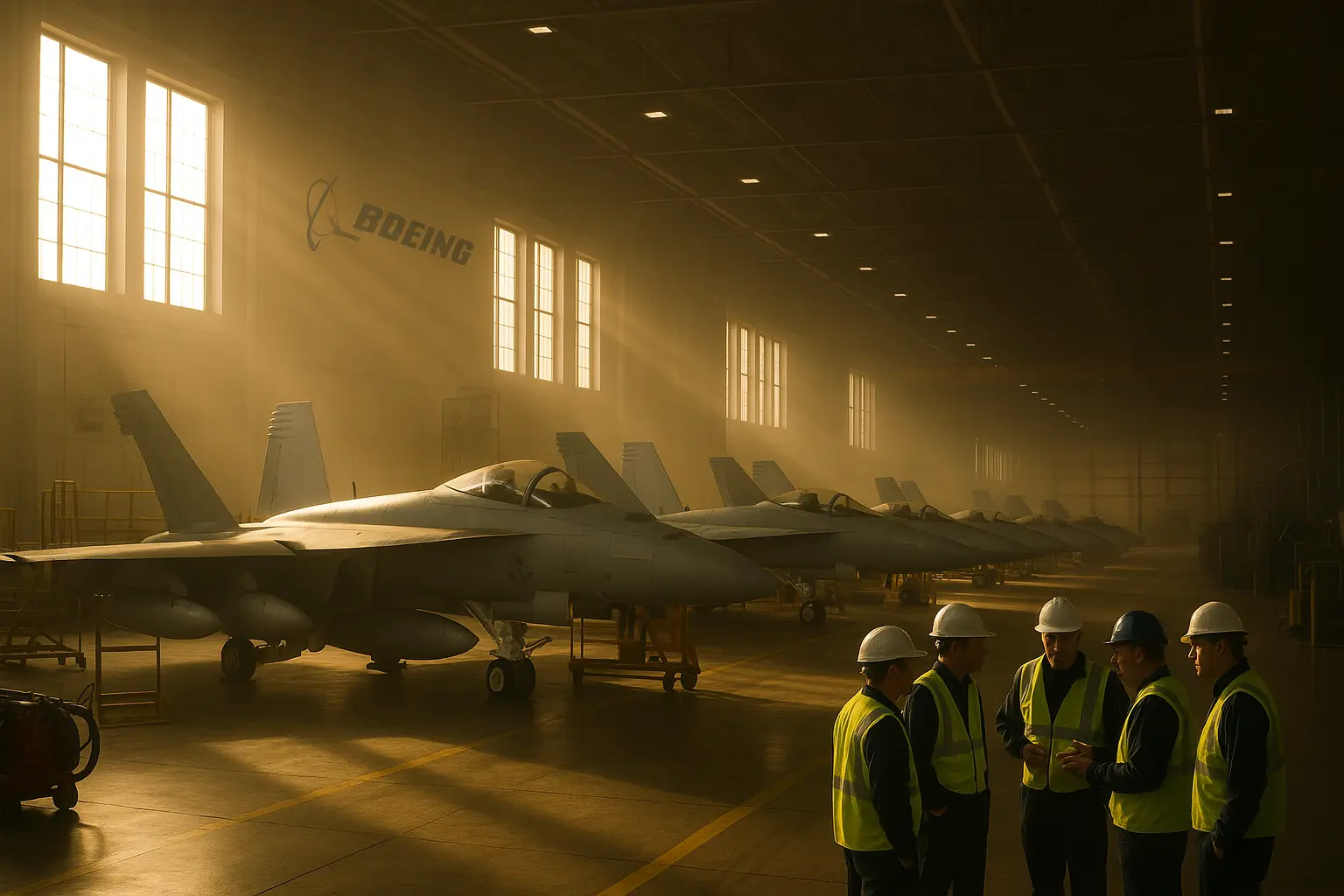
Boeing on Brink: St. Louis Defense Workers’ Contract Rejection Signals Massive Strike Threat
‘We do not take this step lightly, but Boeing keeps missing the mark. They’ve forgotten who built their fighter jets.’ – IAM District 837 Member, St. Louis
Union Uprising: Boeing’s St. Louis Plant Faces Strike After Historic Contract Rejection
Rumbling discontent reached a fever pitch in Missouri this week, as more than 3,200 highly skilled defense workers at Boeing’s celebrated St. Louis hub soundly rejected what the aerospace giant had touted as its most generous contract proposal ever. The stakes? Nothing less than the uninterrupted production of America’s air dominance-the very F-15 and F/A-18 fighter jets, T-7A trainers, and MQ-25 Stingray drones that keep our military strong and our nation safe.
The numbers don’t lie. Boeing’s proposal promised a 20% wage hike stretched across four years, a $5,000 ratification bonus, and significant upgrades to both sick leave and vacation time. Yet union members, represented by the International Association of Machinists and Aerospace Workers (IAM) District 837, overwhelmingly turned down the deal Sunday, thrusting the company toward a labor crisis the likes of which it hasn’t seen in decades.
Union leaders had initially signaled support for the offer, lauding improved medical coverage, retirement plans, and generous overtime compensation. But the workers saw it differently. They insist Boeing’s promises are hollow concessions that fail to keep pace with the blood, sweat, and sacrifices demanded by the high-stakes world of military production-especially with inflation squeezing every dollar at the grocery store and gas pump.
“Boeing may call this their ‘richest offer,’ but when your cost of living outpaces your paycheck, families can’t hang their hats on corporate PR. This is about respect, not just money.” – IAM 837 Organizer
With the company’s contract officially expired as of 11:59 p.m. Central Sunday, a legally mandated seven-day cooling-off period is now ticking down. All eyes are on August 4, the day that could see picket lines replace pick-and-place machines on the factory floor-a move that would send shockwaves from the Mississippi to the Pentagon.
Whose Priorities Matter? Inside Boeing’s Worker Rebellion
What’s driving the outrage? At the heart of the dispute is a deeper sense of loyalty, pride, and, increasingly, deep-seated resentment among Boeing’s blue-collar backbone. The union’s emphatic rebuke points to a fundamental misalignment between corporate priorities and the real-world needs and values of the workers who turn sheet metal into the nation’s next-generation warplanes.
Union officials cited a lack of concrete commitments on pension growth, job security, outsourcing protections, and cost-of-living adjustments robust enough to weather today’s inflationary storm. While Boeing dangled ‘more’ of everything on the table, membership wasn’t buying it-literally. One vocal district leader painted the mood: ‘Boeing’s $5,000 bonus evaporates long before our kids even go back to school.’
Social media has erupted with criticism, too. Workers and supporters took to X (formerly Twitter) calling out what they see as classic “corporate double-speak.” #RespectTheBuilder trended for hours, as spouses and retirees posted photos from inside the plants-worn hands, tired eyes, and the relentless din of machinery serving as the real backdrop to Boeing’s defense might. Many users expressed outrage over Boeing’s perceived indifference, with one viral post stating, “If Boeing can’t find money for workers, how are they building a new fighter for the Air Force?”
“We deserve to see that respect and investment shown in our paychecks, not just in Air Force contracts and shareholders’ meetings.” – St. Louis Machinist, @IAM837
For its part, the company isn’t taking the insurrection lying down. Dan Gillian, Boeing’s Air Dominance vice president and St. Louis site chief, lamented to reporters that ‘this was the richest contract ever presented,’ and that “no further talks are currently scheduled.” With so much manufacturing at stake, Boeing has activated contingency plans designed to keep the St. Louis lines running, at least temporarily, should the workers walk out. But insiders and industry analysts remain deeply skeptical-temporary managers can only do so much when the assembly line requires both experience and precision, especially under military-grade quality pressure.
Shaky Ground: What a Boeing Strike Means for National Security and the 2026 Elections
The pending strike isn’t just another labor spat. It’s a direct threat to key defense programs and could have far-reaching repercussions for midwestern jobs and, by extension, Middle America’s economic backbone. With Boeing in the midst of expanding its St. Louis footprint to fulfill a lucrative, multi-billion dollar Air Force contract for the next-generation F-47 fighter jet, Washington is no doubt already sweating the prospect of halted production. Delays could ripple through supply chains and, ultimately, reach the halls of the Pentagon-at a critical moment in American military re-armament.
This flashpoint also exposes deeper fractures between American industry and its workforce, igniting a debate that is sure to echo into the 2026 midterm elections. With President Donald Trump already promising ‘American jobs for American hands’ and slamming larger corporations for neglecting workers, the GOP is poised to make labor a central issue; pro-union rhetoric has taken root in deep red Missouri, sparking renewed calls for tax and regulation reforms aimed at incentivizing companies to invest in domestic talent-not foreign outsourcing or C-suite bonuses. Many Republicans in Congress have already begun questioning why defense contractors like Boeing receive billions in taxpayer money but seem slow to reinvest in the families who keep America first on the world stage.
“Let’s be clear, a strike at this scale doesn’t just affect one company-it’s a national security issue. Democrats keep bailing out big business, but it’s the workers who bleed for this country.” – State Rep. Mike Callahan (R-MO)
The date to remember is now August 4, when that cooling-off period ends and the reality of an unprecedented walkout looms over the Gateway Arch. If workers hit the picket lines en masse, national headlines and every 2026 campaign commercial in the Midwest will again be asking: Just who is Boeing fighting for?
With eyes on St. Louis, the answer might define not just the future of American manufacturing, but the next wave of the conservative movement-and its vision for blue-collar prosperity.