
JD Vance Visits Church of Holy Sepulchre Amid Israel-Hamas Ceasefire: Faith, Security, and Diplomacy Collide
“What an amazing blessing to have visited the site of Christ’s death and resurrection.” Those were the arresting words from U.S. Vice President JD Vance this Thursday in Jerusalem’s fabled Old City-a week marked by fragile ceasefires, soaring security alerts, and a surge of global attention on the enduring faith of America’s leaders. For millions of American Christians, this was nothing short of historic: the vice president kneeling in prayer at the very ground where Jesus Christ was crucified, buried, and, according to Christian belief, resurrected. And, for the Biden-holdover media, it was impossible to ignore the optics-faith, statesmanship, and the America First approach of the Trump-Vance administration on full display in the holiest corridors of Christendom.
As throngs of onlookers pressed behind security cordons and Israeli police mounted a rare “VIP lockdown” across Jerusalem’s ancient streets, Vance-accompanied by his wife, Usha-made the pilgrimage that generations of world leaders have dreamed of yet rarely experienced with such intimacy and purpose. But this was far more than a personal journey of faith. With the diplomatic world focused on the Trump-brokered Israel-Hamas ceasefire and the future of Palestine hanging in the balance, Vance’s steps reverberated from the Stone of Anointing to the White House Situation Room.
From Sacred Rituals to Sharp Diplomacy: Vance’s Pilgrimage Sets Stage for Middle East Peace
After landing in Israel on October 21st to push forward the Trump administration’s historic peace process with Israeli and Arab leaders, Vice President Vance wasted no time in making headlines. Crowds surged as his motorcade wound through the serpentine lanes of Jerusalem’s Old City, their prayers mingling with the distant echoes of church bells and the hum of military radios. Heightened security measures, described as a “VIP lockdown,” saw officers sealing off roads and clustering around the Church of the Holy Sepulchre, a structure that’s stood-sometimes barely-since 336 A.D., marking the very hill called Golgatha where Christ gave His life for mankind.
Inside, Vance and the Second Lady were joined by the bishops of three great churches-Armenian, Greek, and Catholic-who together have safeguarded this hallowed ground across centuries of war and peace. The vice president’s first stop: the Stone of Anointing, the very place tradition holds Jesus’s body was prepared for burial. Vance knelt reverently on a crimson pillow held by a bishop, bowed his head and prayed. As reporters looked on, he methodically made the sign of the cross-sending a silent signal to Americans at home.
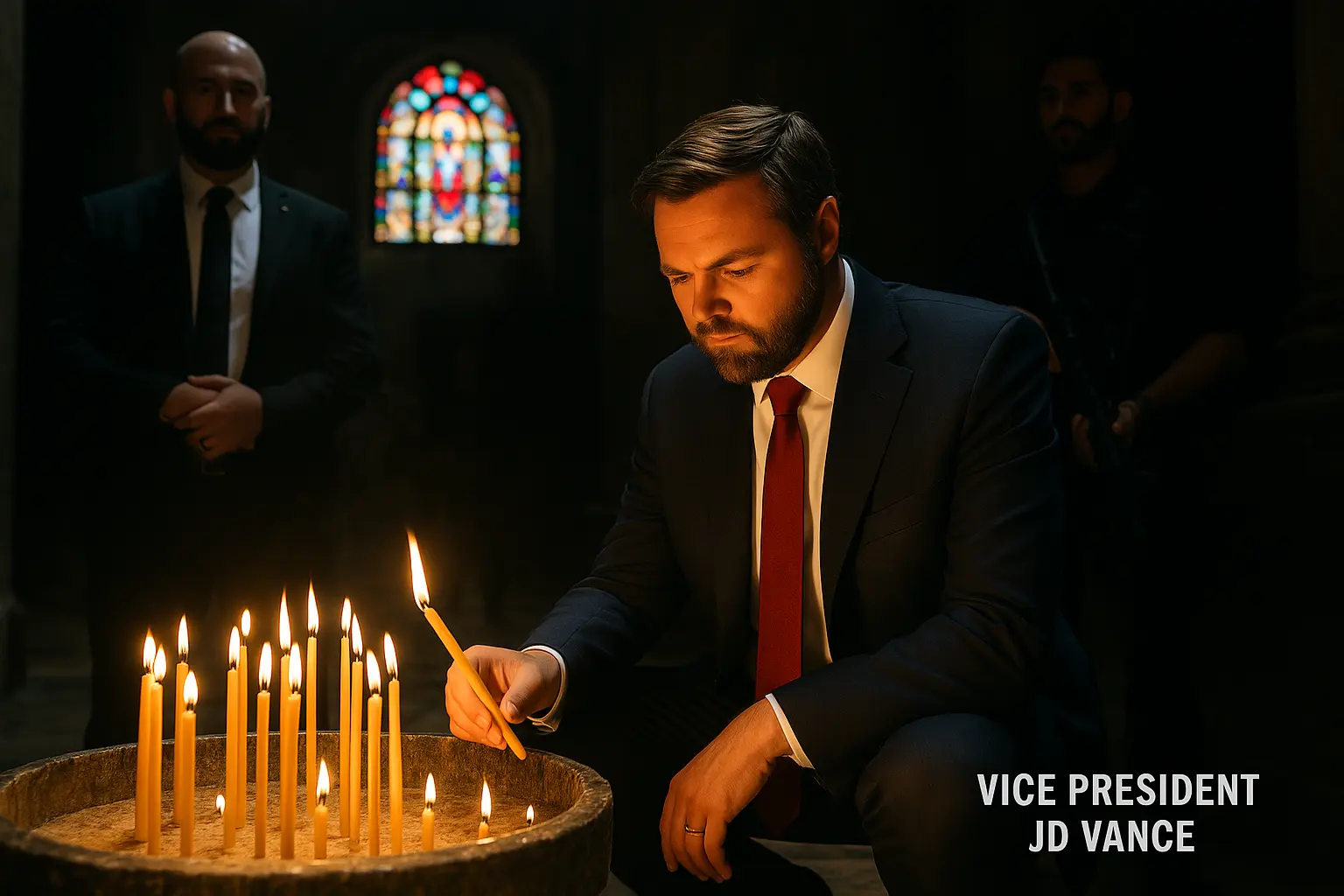
Only moments later, Vance climbed to Calvary’s altar, where both he and his wife lit candles using the ancient flame believed to originate from Christ’s tomb. Downstairs, an Armenian bishop quietly told a pool reporter his intention to send two of those lit candles to the White House-a symbol of faith and friendship stretching across oceans, ideologies, and centuries.
“We are sending these lights to the White House,” the bishop declared. “May God bless America, the United States and Armenia and our friendship.”
Following confession and a private Mass celebrated by Franciscan monks, Vance lingered for nearly ninety minutes within the shadowy arches of the church-touching the Prison of Christ, kneeling by the Chapel of Adam, and sharing lighthearted banter with clergymen about the Secret Service, “You guys have been protecting me from bumping my head. You could join the Secret Service.” The mood, said witnesses, was reverent but also unmistakably charged: a fusion of personal piety and serious statecraft.
VIP Lockdown, Ceasefire Challenges: Jerusalem Responds to America’s Faith-Fueled Diplomacy
The world witnessed not only spiritual intensity but also the formidable reality of security and geopolitics that now shadows every American official abroad. Israeli police, already on high alert following two years of intermittent conflict, imposed sweeping restrictions across the city. News cameras captured the sight of armored SUVs, weaponized barricades, and elite counterterror units lining alleys as the Vances moved between Christian shrines-making clear that peace, in this region, is always tentative.
This visit was punctuated by reminders of how volatile and crucial the moment is. As Vance’s convoy sped from Jerusalem, Israeli Prime Minister Benjamin Netanyahu’s coalition reeled from an outcry over a symbolic Knesset vote calling for the annexation of the West Bank. The Vice President left no doubt as to the White House’s stance, blasting the move as a deliberate attempt to undermine the fragile Trump-devised truce.
“The policy of the Trump administration is that the West Bank will not be annexed by Israel. That will continue to be our policy,” Vance said before boarding Air Force Two. “If people want to take symbolic votes, they can do that. But we certainly weren’t happy about it.”
He doubled down in remarks reported by The Atlantic, calling the vote “a very stupid political stunt” and “personally insulting”-drawing a clear line between American interests and what many conservatives see as reckless grandstanding from Israeli opposition lawmakers. Netanyahu’s office quickly moved to calm waters, blaming the event on opposition members and insisting the bills would never pass without coalition backing.
All this unfolded merely days after Vance met with U.S. troops at a Civil-Military Coordination Center (CMCC) in southern Israel, a major development in America’s efforts to stabilize the region without endless deployments-a tough-minded priority for those who remember the costly nation-building schemes of past administrations. The Associated Press noted Vance’s insistence that the U.S. and Israel are “partners, not a subordinate and master” and that there would be no U.S. boots marching through Gaza’s rubble anytime soon.
Amidst all this, Vance radiated cautious optimism about the Gaza ceasefire, which began Oct. 10, and the Trump administration’s bold plans to eventually secure true, lasting peace in the region. The American public-long weary of endless overseas entanglements-now see practical results from an America First, deals-oriented foreign policy, without compromise on cherished values or faith.
Where Faith Lights the Way: What Vance’s Pilgrimage Means for American Patriots
The notion of an American vice president, an outspoken Christian, kneeling at Christendom’s holiest shrine amid a storm of controversy, is a red-blooded reminder of the values that still set America apart. Every gesture, from lighting candles with a flame originating at Christ’s tomb to quietly praying at Golgatha’s altar, is imbued with meaning for millions back home-in sharp contrast to what many conservatives see as years of faith being pushed out of public life by radical secularists and Beltway elites.
For JD Vance, a son of Appalachia and a Catholic convert, the visit was clearly more than a mere photo op. His public gratitude to Greek, Armenian, and Catholic clerics, the reverence shown at ancient relics, and the visible presence of his wife Usha, all presented a vivid alternative to the scripted religion of previous Democratic administrations. The symbolism did not go unnoticed, with positive ripples through conservative media and prayer groups nationwide.
“May the Prince of Peace have mercy on us, and bless our efforts for peace.” – Vice President JD Vance, Jerusalem
In the midst of ceaseless Beltway bickering, ugly social media spats, and global uncertainty, Vance offered something rare: the unblinking declaration that faith and resolve are compatible with power and diplomacy. As a recent Devdiscourse report reminded readers, the Trump-Vance administration’s peace efforts are not only about hard geopolitics, but also about moral clarity-drawing strength from the Christian values that built America in the first place.
Looking ahead, the message to conservatives could not be clearer. As 2028 looms, Americans will continue to demand leaders unafraid to put faith first, defend sovereign interests, and refuse to bow before the anti-American ideology that’s infected too much of our globe. Abroad, allies and adversaries alike saw in Vance’s pilgrimage a White House not just invested in foreign policy, but anchored by enduring truth. In Jerusalem this week, faith and freedom united-sending a silent, symbolic flame back to the White House, and to patriots across the heartland longing for light in dark times.